
Optimizer for thickeners.
Thickener control keeps the underflow at the density the next step can take, the overflow clear enough to reuse, and the bed and rake inside their limits, while the feed changes through the shift. The Optimizer moves the underflow pump and the flocculant dose together, sees changes in feed flow and solids as they arrive, and uses the least flocculant that keeps the overflow on spec.
- Clearer overflow in surgesoverflow above spec for 2–5% of the time in the solids surges tested, against 13–15% with flocculant ratioed to feed
- Flocculant where it is needed18–31% less when the feed is steady or the flow rises, more only when the overflow needs it
- Gentle on the underflow pump10–55 times fewer pump reversals than a well-tuned density loop
- You stay in controladvice mode first, the loops switched on by your team
Results from ProcessOpt digital twin trials on a tailings thickener of about 2,900 t/h dry solids, compared with typical control on the same feed. Tap any screen to open it full size.
Why a thickener is hard to hold steady
A thickener answers slowly and on several fronts at once. More solids in the feed raise the bed over an hour or more, a finer or different ore settles more slowly and clouds the overflow, and a flow surge pushes fines over the weir within minutes. The underflow pump and the flocculant act on all of these, each in its own way. A density loop on the pump works on one target; the flocculant, set as a fixed ratio to the feed, does not know when the overflow needs more or could do with less.
Sees the feed change as it arrives
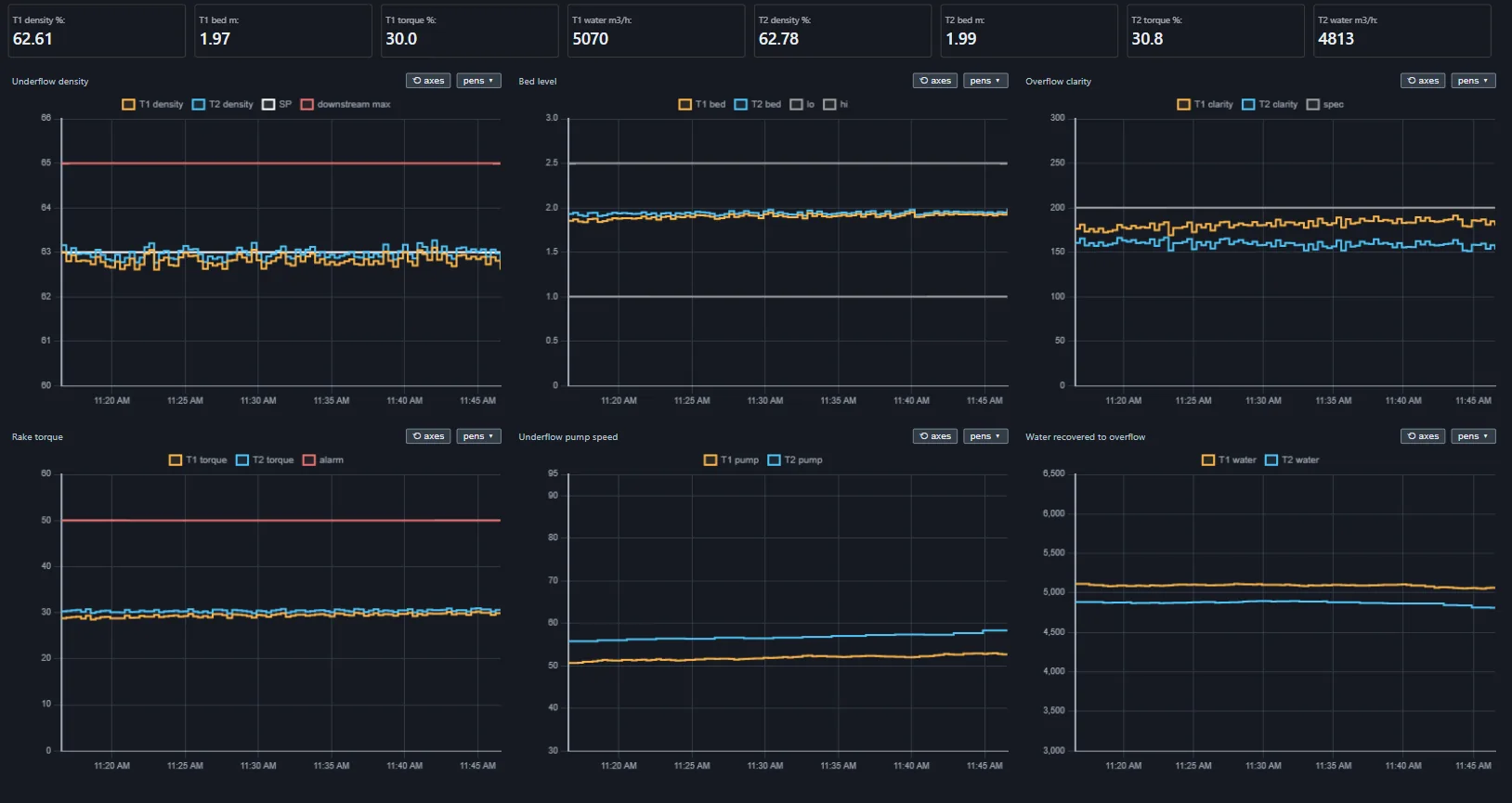
The Optimizer reads the feed flow and feed density that most thickeners already measure, and works out what each change will do to the bed, the underflow and the overflow over the next hours. It moves the pump and the flocculant as the change arrives, rather than after the bed or the overflow has drifted.
Flocculant where the overflow needs it
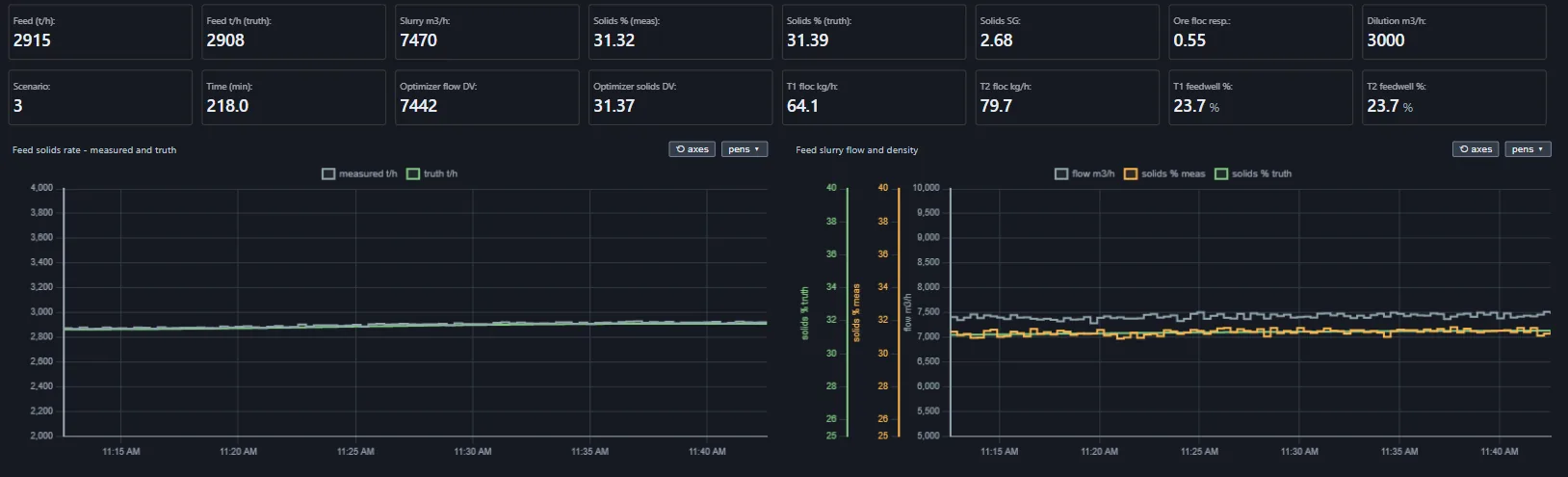
Flocculant is held at the lowest dose that keeps the overflow inside its limit. When the feed is steady, that is often well below the usual ratio. When more solids arrive, the dose rises with them, before the overflow clouds over.
Both thickeners on one screen
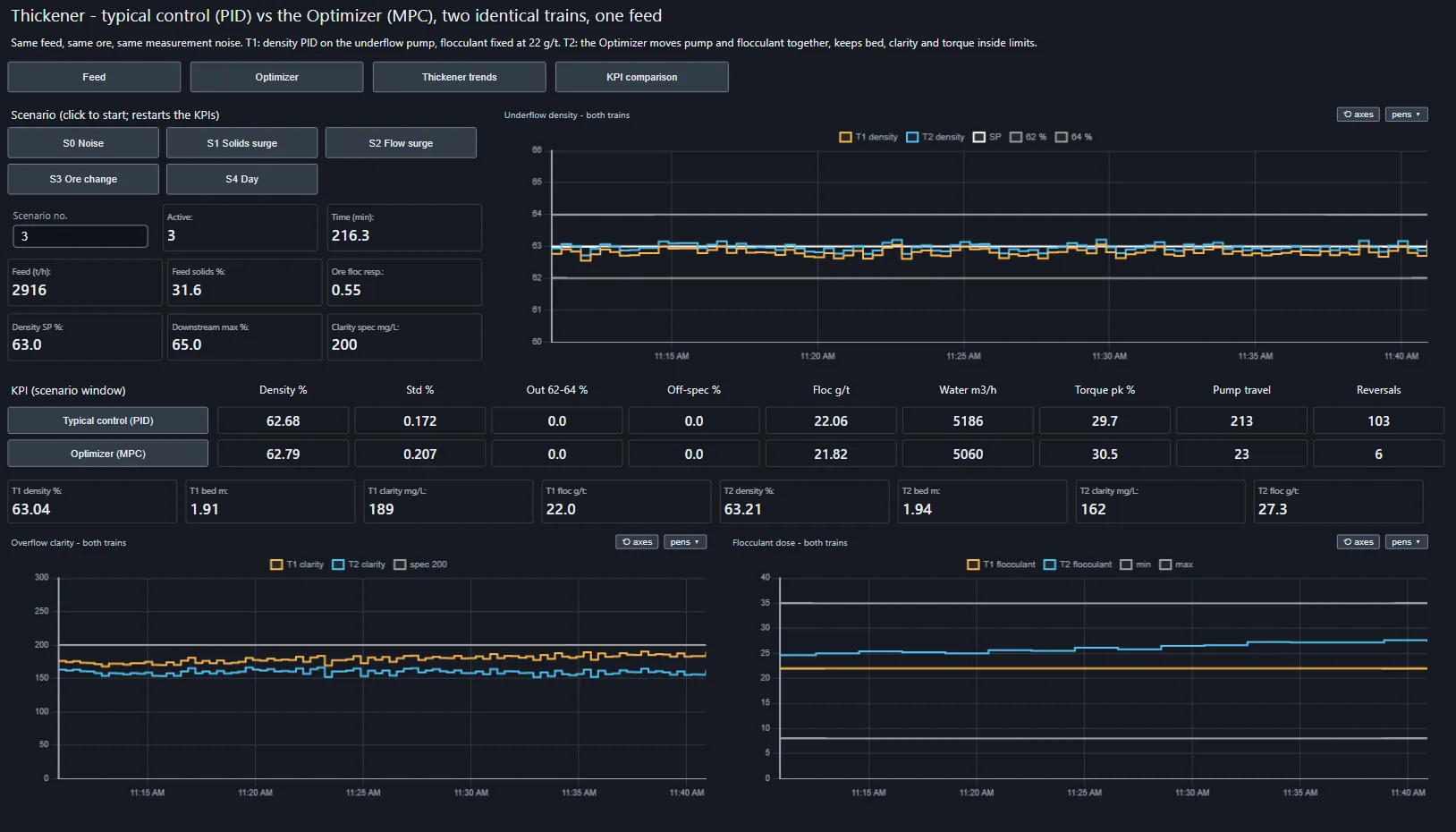
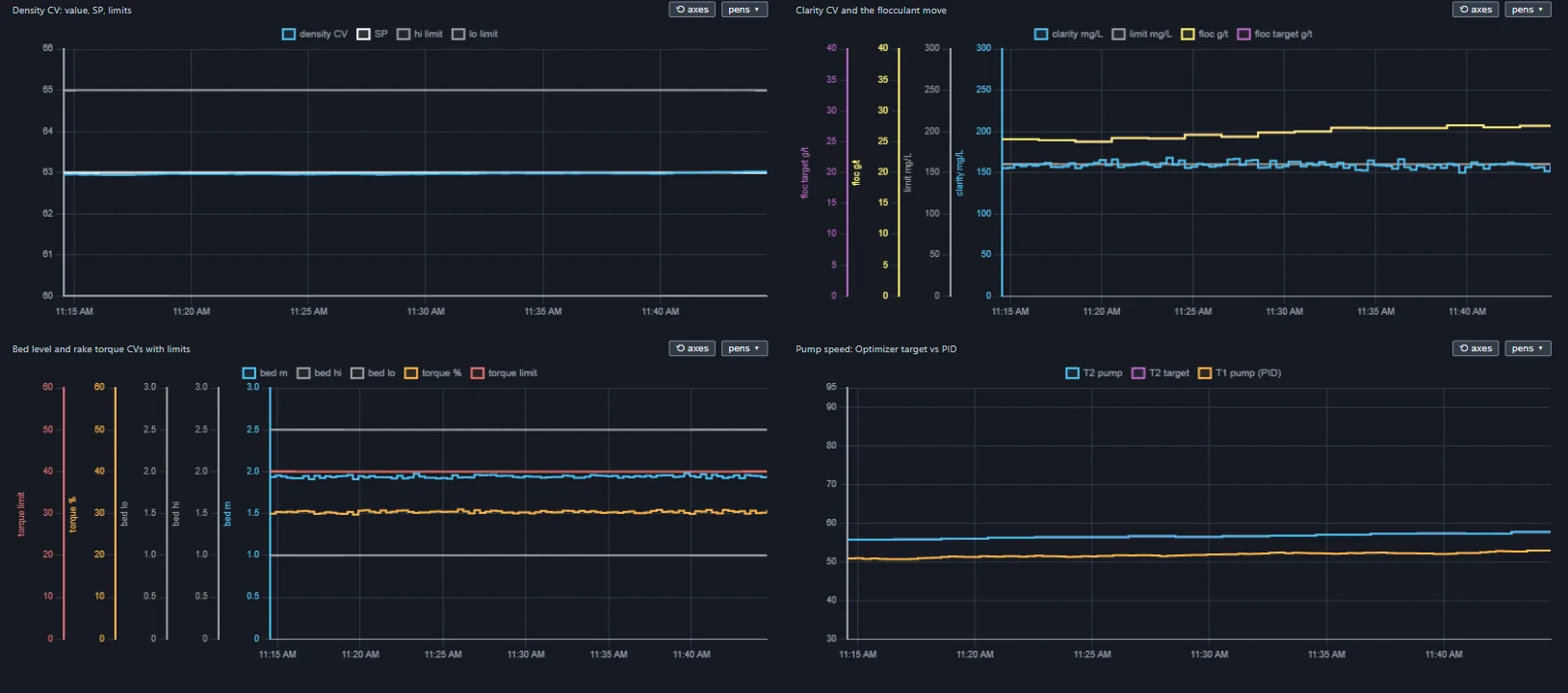
The overview shows the feed, the underflow density of each thickener, overflow clarity, flocculant dose and the running results: density, time outside the window, overflow off spec, flocculant per tonne, water recovered, rake torque and pump movement. Your team can compare the Optimizer with your current control on the same feed before deciding anything.
Steady on the underflow pump
The Optimizer plans its moves every two minutes within the pump’s range and the limits on bed, clarity and rake torque, so the underflow pump makes a few deliberate moves instead of answering every flicker of the density reading. Pumps, valves and pipelines wear less, and the next step receives a steadier flow.
Results
Each case ran on the same feed and noise for both thickeners. Overflow above 200 mg/L, flocculant per tonne of solids, and reversals of the underflow pump:
| Case | Overflow off spec: typical / Optimizer | Flocculant g/t: typical / Optimizer | Pump reversals: typical / Optimizer |
|---|---|---|---|
| Steady feed with ordinary noise | 0% / 0% | 22.0 / 15.2 | 134 / 15 |
| Feed solids surge, 31 to 33.5% | 14.9% / 4.8% | 22.0 / 24.9 | 141 / 4 |
| Feed flow 25% higher | 0% / 0% | 22.0 / 18.0 | 101 / 6 |
| Ore that settles more slowly | 0% / 0% | 22.1 / 21.0 | 222 / 4 |
| A day of mixed changes | 13.5% / 2.4% | 22.0 / 22.9 | 230 / 15 |
If your overflow rarely goes off spec and flocculant is a small cost, a well-tuned density loop with a flocculant ratio may be enough, and we will tell you so. The Optimizer earns its place when the feed changes often, when the overflow water is reused in flotation or leaching, when flocculant is a large cost, or when the underflow pump and pipeline wear matter.
Where it pays off
- Clear water back to the plant — fewer periods of cloudy overflow carrying fines and flocculant into the process water
- Flocculant with care — the dose rises when the overflow needs it and comes down when the feed allows, rather than following a fixed ratio
- A steadier underflow — the tailings line, filter or paste plant downstream receives a calmer flow at the density it can take
- Equipment — far fewer pump reversals, less wear on pumps, valves and pipelines
- Calmer shifts — operators see the feed change and the reason for every pump and flocculant move on one screen
Installation
- Feed flow and density, underflow density, bed level, overflow clarity or turbidity and rake torque; the Optimizer sets your underflow pump and flocculant through your existing loops
- The thickener’s response is learned from your own data and short step tests, run with your team
- Runs on a computer on site, beside your DCS, connected over OPC UA or Modbus TCP; no cloud connection
- Advice mode first, closed loop when your team is ready
- A 7-day free trial on your own thickener, so you can judge the results before you commit
Questions about thickener control
How is a thickener usually controlled?
Most often with a loop that sets the underflow pump from the underflow density, and flocculant dosed at a fixed ratio to the feed. Bed level and rake torque are watched by the operators. It works on a steady feed, but each loop acts on its own and only after the change shows up.
Does the Optimizer give a denser underflow?
Not by itself. In our tests, a well-tuned density loop held density as closely as the Optimizer. Where downstream can take a higher density, the Optimizer can run closer to that limit while keeping bed and rake torque in their bands, but its main gains are overflow clarity, flocculant and a steadier pump.
Will it reduce flocculant use?
When the feed is steady or the flow rises, yes: 18–31% less in our tests, because the dose is held at the lowest level that keeps the overflow on spec. During solids surges it uses more, to keep the overflow clear. Over a mixed day the use came out about the same.
What does the Optimizer need from our plant?
Feed flow and density, underflow density, bed level, rake torque, and an overflow clarity or turbidity reading, plus access to the underflow pump and flocculant set-points. Where clarity is not measured online, a regular sample can stand in to begin with.
Does it work on paste and high-rate thickeners?
Yes. The same approach applies to high-rate, high-density and paste thickeners and to concentrate thickeners; the limits change, for example rake torque and yield stress matter more for paste. We set it up on your thickener’s own response.
See how the Optimizer would run your thickener.
Request a demo