
Optimizer for leaching and CIL.
CIL control usually means a cyanide loop on the first tank, with oxygen, leach density and carbon advance set once and left alone. The Optimizer works the whole carbon-in-leach train together: cyanide at the head and mid-train, the dissolved oxygen set-point and the leach feed density, so more gold leaves on carbon and less in the residue, with the tail cyanide held under its detox limit.
- More gold from the same ore+0.25 to +0.95 points of recovery in every case tested, against a well-tuned cyanide loop
- Less cyanide per tonne17–21% less NaCN, with the tail free cyanide under 92 mg/L against a 100 mg/L limit
- Steadier dosing pumps6–12 times fewer reversals of the head cyanide pump
- You stay in controladvice mode first, the loops switched on by your team
Results from ProcessOpt digital twin trials on a gold CIL circuit of 250 t/h at 2.0 g/t, compared with typical control on the same ore. Tap any screen to open it full size.
The whole CIL train, not just the cyanide
A cyanide loop works one handle. The Optimizer works cyanide, the dissolved oxygen set-point and the leach feed density together, tank by tank, so more gold leaves on carbon and less in the residue, for less cyanide per tonne.
Sees the ore change as it arrives
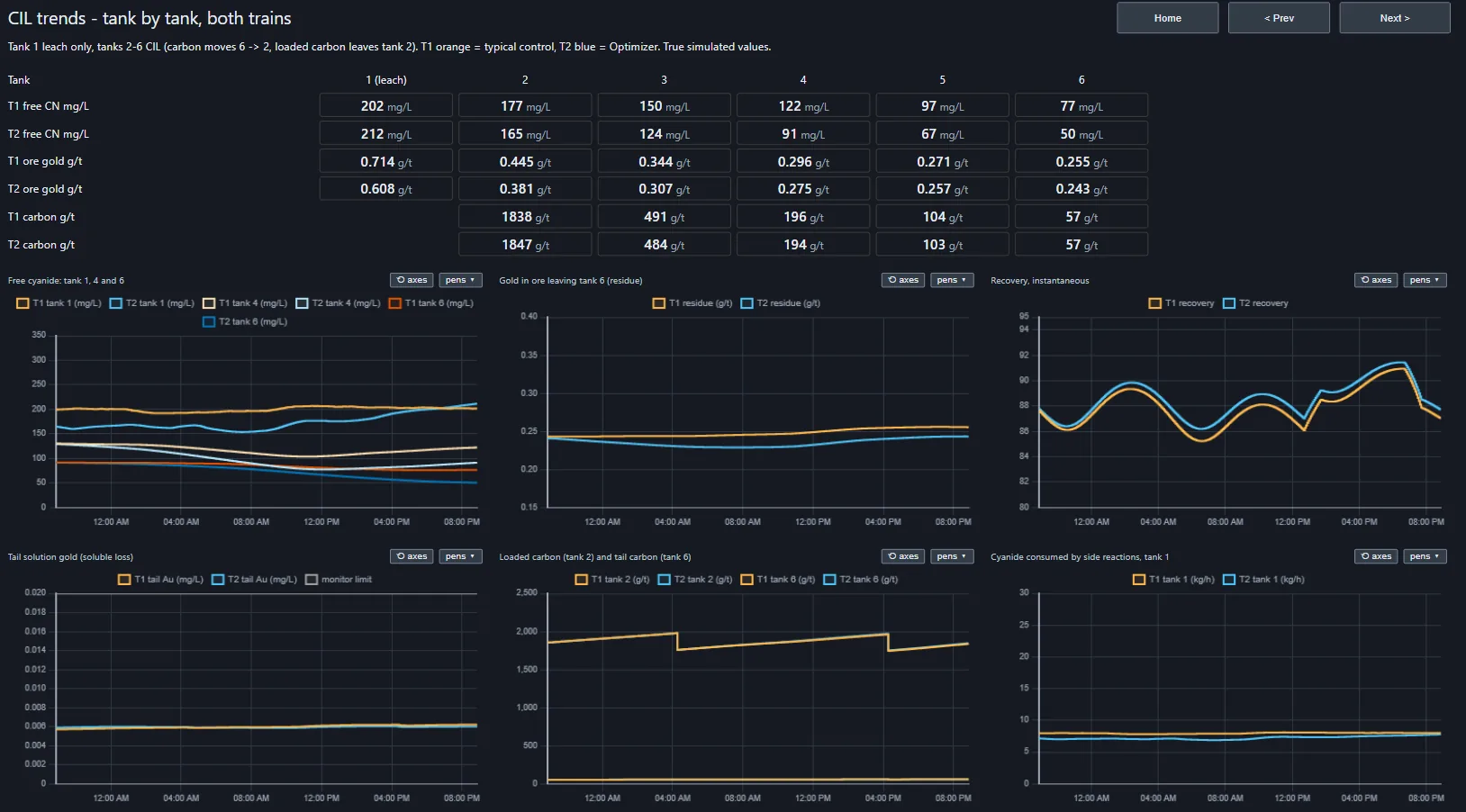
The Optimizer reads the tonnage and the head grade from the lab, and works out what each change will do to cyanide strength and residue over the next day of residence. It raises or trims the additions as the change arrives, and watches free cyanide at tank 4 as an early guard, so the tail does not drift toward its limit before anyone sees it.
Both trains on one screen
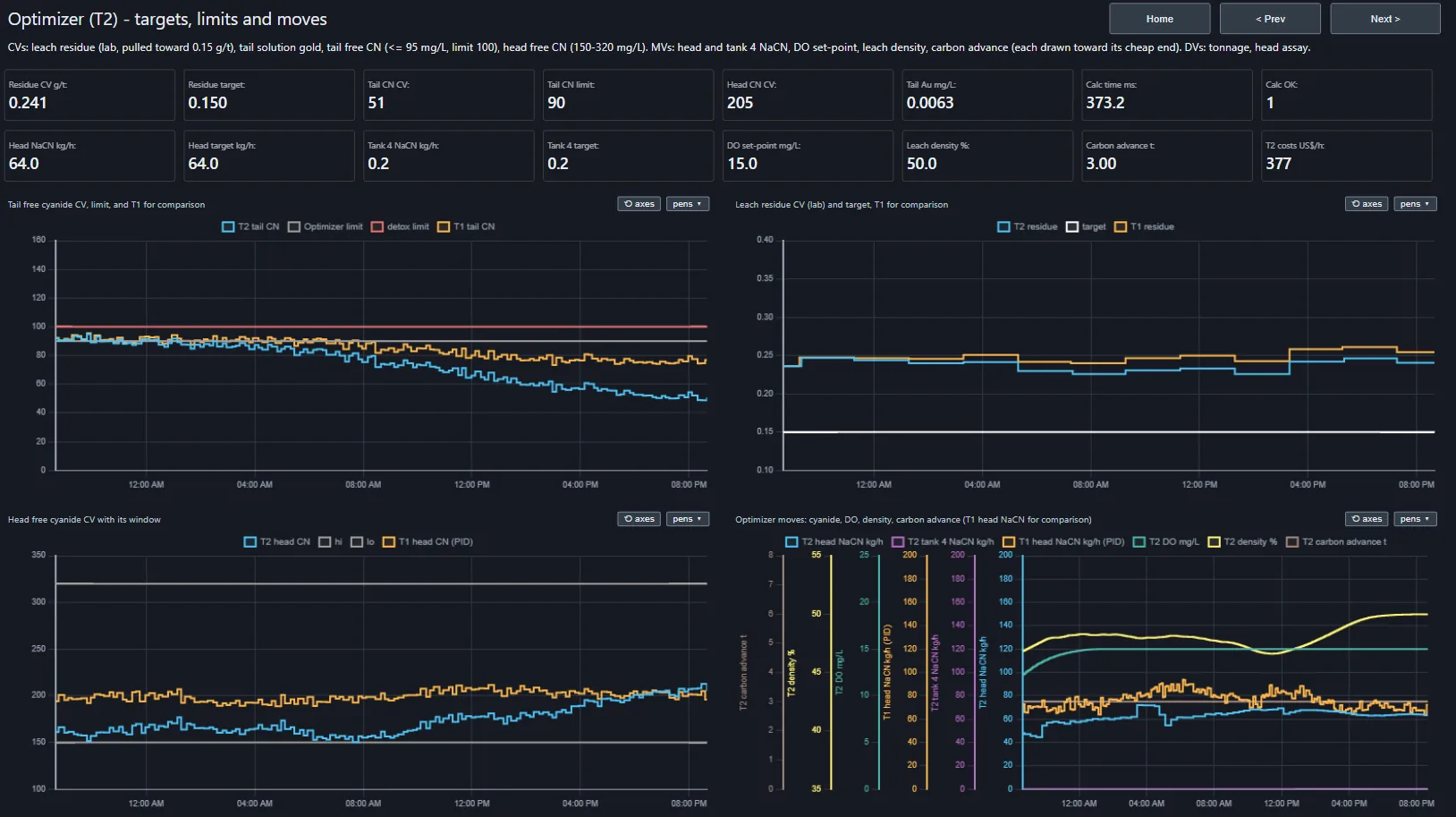
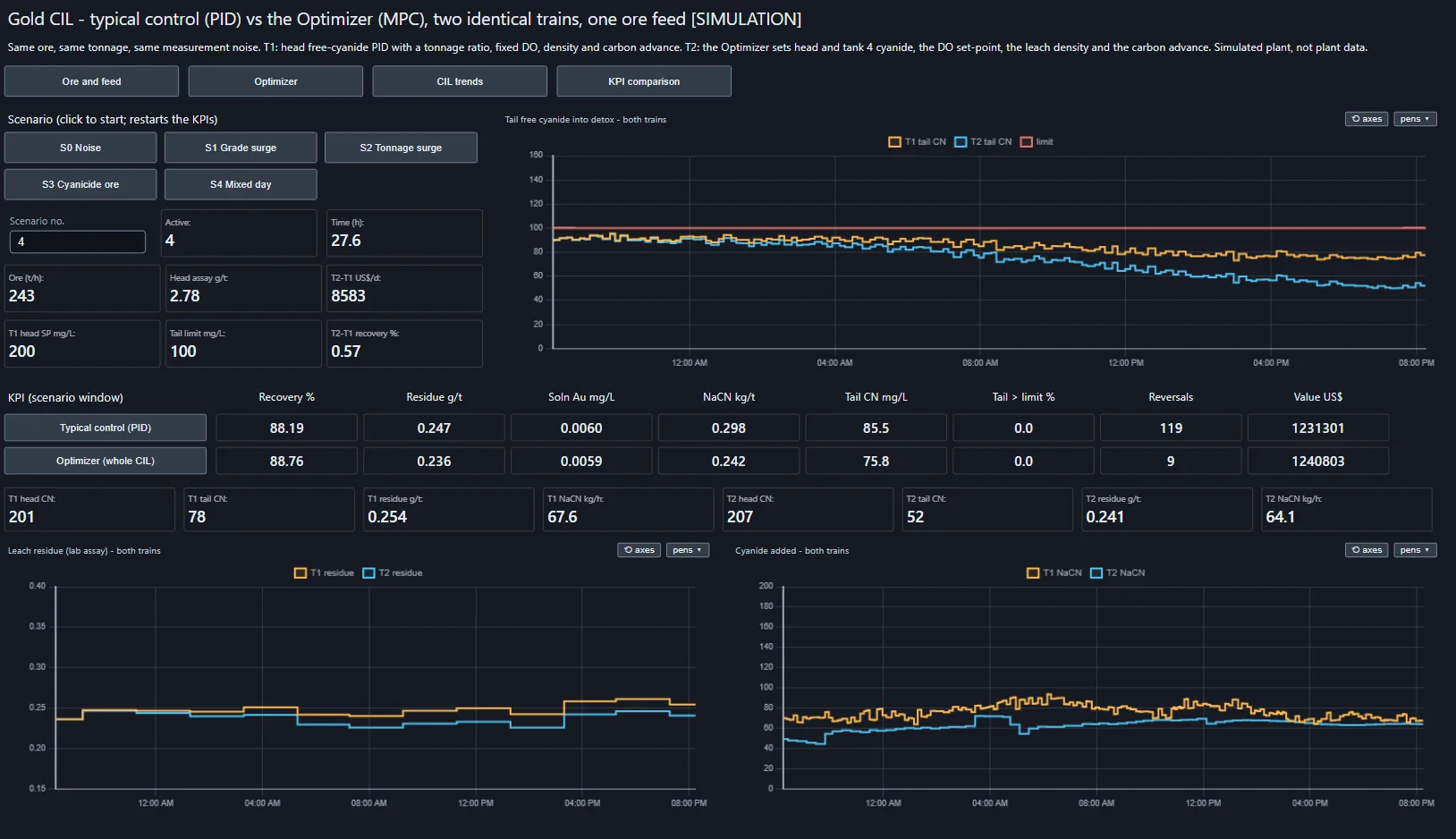
The overview shows the ore, the cyanide strength along each train, the residue, the cyanide and oxygen use and the running value of each train. Your team can compare the Optimizer with your current control on the same ore before deciding anything.
Inside the tail cyanide limit, every hour
The tail limit is the line a CIL circuit cannot cross. The Optimizer holds the tail free cyanide under it with a margin, and when a cyanide-consuming ore arrives it accepts a little residue rather than chase it with cyanide. In every case tested the tail stayed under 92 mg/L against the 100 mg/L limit.
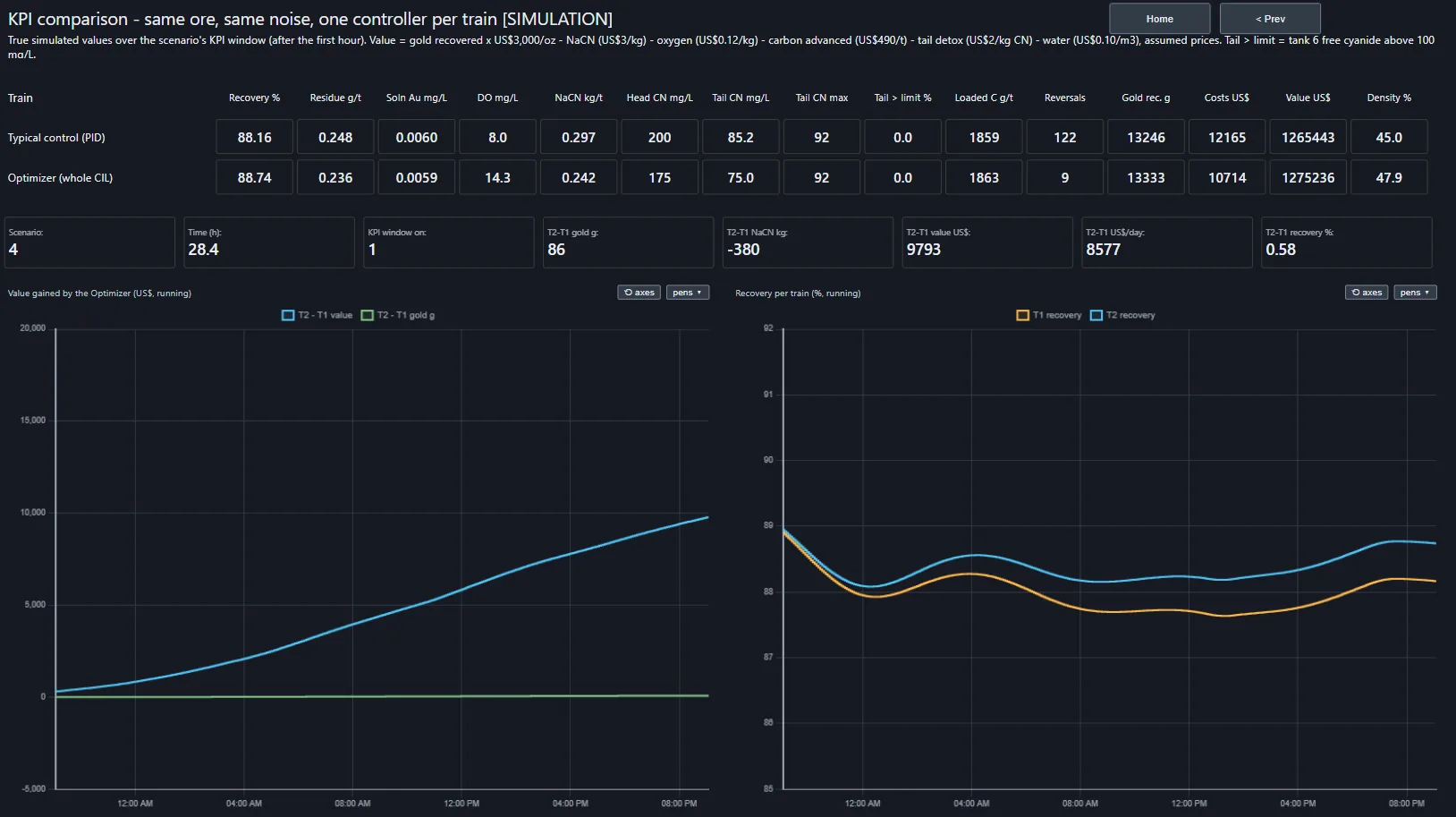
Results
Each case ran on the same ore for both trains. Gold recovery and cyanide per tonne of ore, typical control against the Optimizer:
| Case | Recovery: typical / Optimizer | NaCN kg/t: typical / Optimizer | Less cyanide per tonne |
|---|---|---|---|
| Ordinary ore variation | 87.56% / 88.44% | 0.281 / 0.229 | 19% |
| Head grade 40% higher for 12 hours | 88.54% / 89.45% | 0.281 / 0.225 | 20% |
| Tonnage 15% higher for 8 hours | 87.38% / 88.33% | 0.281 / 0.222 | 21% |
| Cyanide-consuming ore | 86.86% / 87.11% | 0.313 / 0.259 | 17% |
| A day of mixed changes | 87.67% / 88.63% | 0.290 / 0.239 | 18% |
Where it pays off
- More gold from every tonne — a lower residue means more metal from the ore already mined and milled, and less ore mined for each ounce
- Cyanide with care — less cyanide per tonne, and less to destroy in the detox circuit
- Inside the tail limit — tail cyanide held with a margin through tonnage, grade and ore changes
- Equipment — far fewer reversals of the cyanide dosing pumps
- Calmer shifts — operators see the ore change and the reason for every cyanide, oxygen and density move on one screen
Installation
- Tonnage, leach feed density, free cyanide at the head and at least one later tank, dissolved oxygen, and the lab head grade and residue; the Optimizer sets your cyanide, oxygen and density targets through your existing loops
- The circuit’s response is learned from your own data and short step tests, run with your team, including the oxygen response of your ore
- Runs on a computer on site, beside your DCS, connected over OPC UA or Modbus TCP; no cloud connection
- Advice mode first, closed loop when your team is ready
- A 7-day free trial on your own circuit, so you can judge the results before you commit
Questions about CIL control
How is a CIL circuit usually controlled?
Most often with a cyanide loop on the first tank, sometimes with the dose ratioed to tonnage, and a dissolved oxygen loop on a fixed set-point. Leach density and carbon advance are set by the shift and changed now and then. Each loop acts on its own, and the residue is only known hours later from the lab.
Will the Optimizer reduce cyanide use?
Yes. In our tests it used 17–21% less cyanide per tonne while recovering more gold, because it moves oxygen and leach density together with the cyanide.
Does it need pure oxygen?
To reach a set-point near 15 mg/L, yes: air sparging usually tops out around 8 mg/L. Many CIL plants already inject oxygen or hydrogen peroxide. Where only air is available, the gain comes mainly from leach density and is smaller.
What does the Optimizer need from our plant?
Tonnage, leach feed density, free cyanide at the head and a later tank, dissolved oxygen, and the lab head grade and residue, plus access to the cyanide, oxygen and density set-points. Online cyanide analysers help; regular titrations can stand in to begin with.
See how the Optimizer would run your CIL circuit.
Request a demo