
Optimizer for pH and neutralisation.
pH control for tailings water neutralisation keeps the treated overflow inside its discharge window while the water coming from the tailings storage facility changes by the hour. The Optimizer reads the feed flow and feed pH, estimates how much acid the water is carrying, and sets the lime dose ahead of the change, so iron and aluminium settle out in the clarifier and the overflow stays on spec.
- Overflow on specno off-spec time in the strength, flow and day-long cases tested, against 17–70% for a pH loop alone
- Knows the wateracid strength estimated online from flow and pH, within about 8 minutes of a change
- Gentle on the lime pump3–15 times fewer pump reversals than a PID loop with the same feedforward
- You stay in controladvice mode first, the lime loop switched on by your team
Results from ProcessOpt digital twin trials on acidic tailings water, 400 m³/h at pH 3, compared with a pH loop on the same water. Tap any screen to open it full size.
Why tailings water is hard to neutralise
The overflow from a tailings facility is not a fixed recipe. Rain dilutes it, water from an older cell brings stronger acid, and the decant pumps change the flow. The pH also responds very unevenly: near pH 3–4 a lot of lime barely moves it, while above pH 7 a little lime moves it a long way. A pH loop on the tank sees a change only after it has reached the tank, then has to recover on the steep part of the curve. The overflow ends up too low for iron to settle, or too high and carrying lime that was not needed.

The same screen shows a trade-off that lime alone cannot avoid: manganese needs a pH near 10 and more than twice the lime, and aluminium dissolves again at that pH. The Optimizer shows the trade-off so your team can decide on it, rather than hiding it.
Knows the water before the tank does
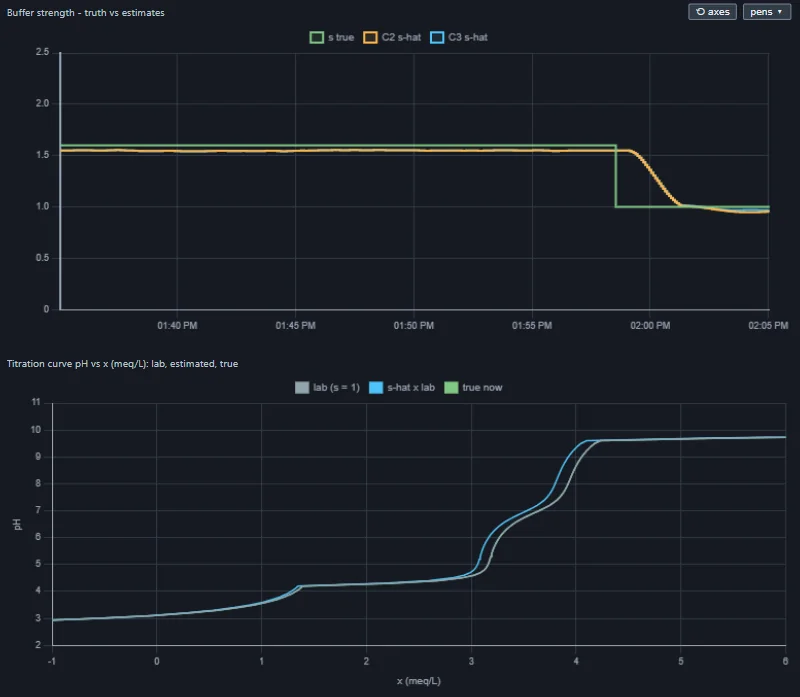
The Optimizer starts from one lab titration: a litre of your overflow titrated with your own milk of lime gives the shape of its curve. Online, the feed pH places the incoming water on that curve, and the tank’s response to the lime already dosed tells the Optimizer how strong the water is. When the water gets stronger or weaker, the estimate follows within minutes, without a new sample.
Doses ahead of the change
With the water’s strength known, the Optimizer works out the lime the incoming water will need and moves the dose as the water arrives, not after the tank pH has drifted. The pH loop then only trims what is left.
Every train on one screen
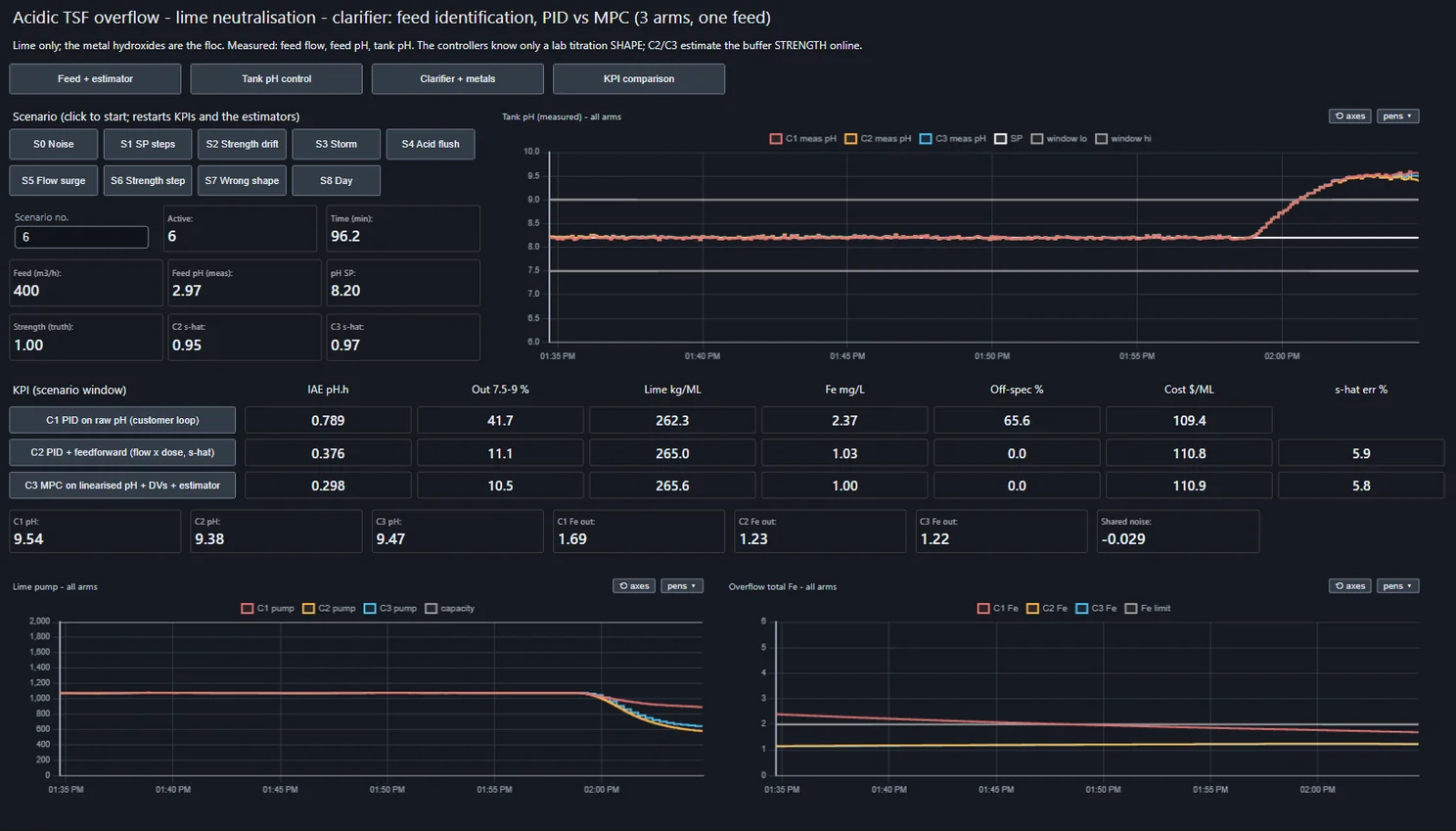
The overview shows the water arriving, the estimated strength, the tank pH of each train and the running results: time outside the window, overflow iron, lime per megalitre and off-spec time. Your team can compare the Optimizer with your current loop on the same water before deciding anything.
Steady on the lime pump
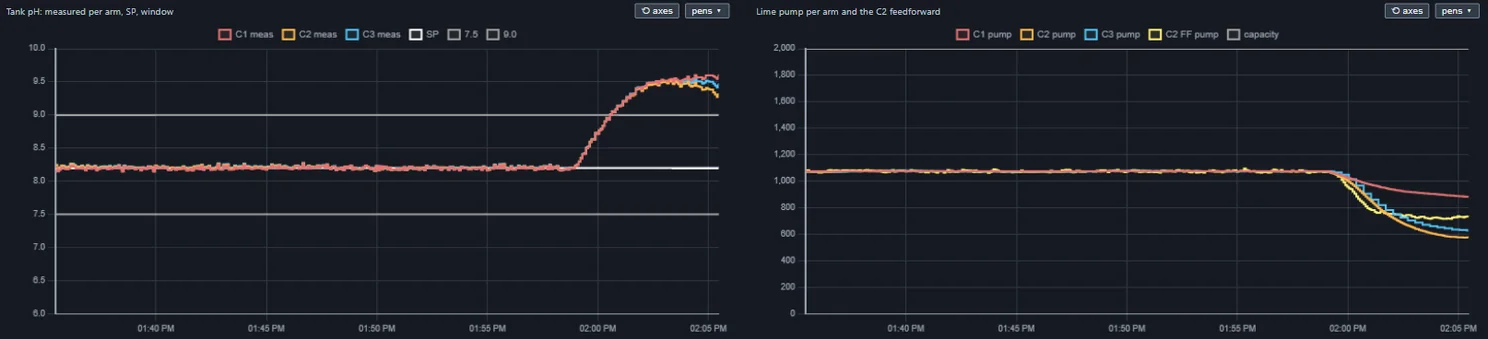
The Optimizer plans its moves every 20 seconds within the pump’s range and rate, so the lime pump makes a few deliberate moves instead of chasing every flicker of the feed pH. Pumps, valves and lime lines last longer, and the dose stays readable for the operator.
Results
Each case ran on the same water and noise for all trains. Time outside pH 7.5–9.0 in the tank, and time with the overflow off spec (iron, aluminium, suspended solids or pH out of limit):
| Case | Outside 7.5–9.0: pH loop / Optimizer | Overflow off spec: pH loop / Optimizer |
|---|---|---|
| Water 60% stronger, then back | 42% / 8% | 70% / 0% |
| Flow surge | 56% / 1% | 58% / 0% |
| Six hours of ordinary changes | 49% / 2.5% | 17% / 0% |
| Acid flush, 7 times stronger for 30 minutes | 81% / 27% | 87% / 27% |
| Slow drift in strength | 0% / 0%, with ten times less deviation from set-point | 0% / 0% |
| Rainstorm | 0% / 0% | 0% / 0% |
If your plant doses one reagent through one pump, the water estimate with your existing pH loop may be enough, and we will tell you so. The Optimizer earns its place with two reagents such as lime and a caustic trim, with pump or valve wear, or with long dead time between dosing point and probe.
Where it pays off
- Compliant discharge — treated water inside its pH and metals limits through rain, flushes and flow changes, which protects the river downstream and your licence to operate
- Lime with care — no extended overdose above the window after the water weakens, and the lime that is dosed goes into neutralising, not into the sludge
- Sludge you can plan for — steadier pH means steadier hydroxide and gypsum formation in the clarifier
- Equipment — fewer pump and valve reversals, fewer blocked lime lines from stop-start dosing
- Calmer shifts — operators see the water change before the tank does, with the reason for every dose change on screen
Installation
- Feed flow, feed pH and tank pH are enough to start; the Optimizer sets your lime pump or valve through your existing loop
- One lab titration of your overflow with your own lime sets the curve; repeat it when the water changes character
- Runs on a computer on site, beside your DCS, connected over OPC UA or Modbus TCP; no cloud connection
- Advice mode first, closed loop when your team is ready
- A 7-day free trial on your own treatment plant, so you can judge the results before you commit
Questions about pH control for neutralisation
How is pH controlled in tailings water neutralisation?
Usually with a pH loop that sets the lime pump from the tank pH. It works on steady water, but reacts only after a change reaches the tank. The Optimizer adds an online estimate of how acidic the incoming water is, from feed flow and feed pH, and doses ahead of the change; the pH loop trims what remains.
Why does a pH loop struggle with acidic tailings or mine water?
The pH curve is very uneven: lime barely moves the pH between 3 and 4, then a little moves it a long way above 7. The strength of the water also changes with rain, flushes and flow. One loop tuning cannot fit every part of the curve and every water, so it either recovers slowly or overshoots.
What pH should treated tailings water be held at?
For iron and aluminium removal with lime, typically 7.5–9.0: iron needs 7.5 or more, and aluminium dissolves again above about 9. Discharge limits are often pH 6–9, but your permit decides. Manganese needs about pH 10 and much more lime, which is a separate decision.
What does the Optimizer need from our plant?
Feed flow, feed pH and tank pH, access to the lime pump or valve set-point, and one lab titration of the overflow with your own lime. Overflow turbidity or metals analysis helps judge the result but is not needed to start.
Will it reduce lime consumption?
Mostly it keeps the lime where it is needed. The water’s acidity sets the lime demand, so on steady water the use stays the same. The saving comes from avoiding long overdoses after the water weakens; in the acid flush case it was about 5%.
See how the Optimizer would treat your water.
Request a demo