
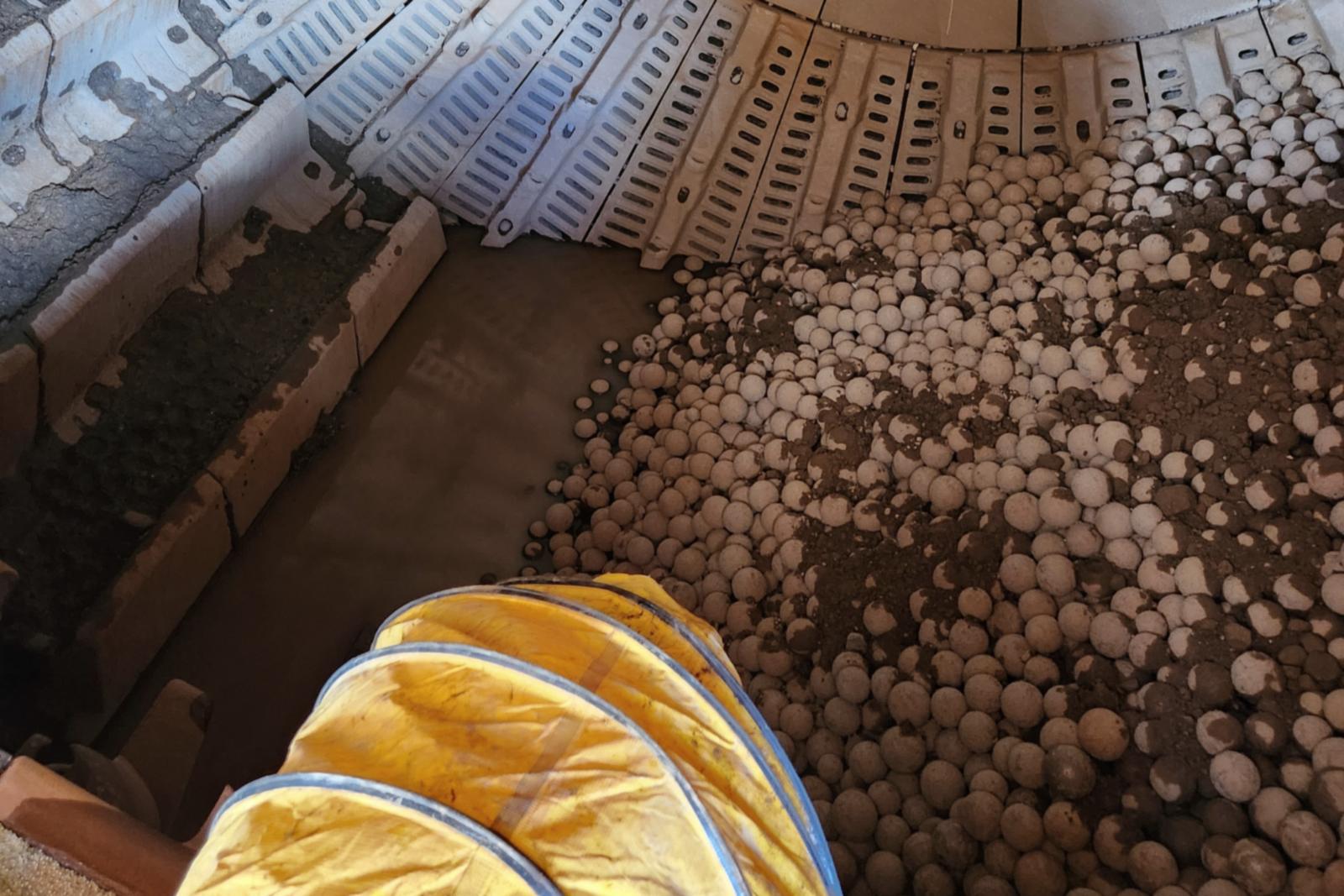
Charge Manager.
Know how much steel is in your mill between grind-outs. The Charge Manager counts every ball that goes into the mill, allows for the steel that wears away, and keeps a live estimate of the steel charge and the ball filling, so top-ups follow what the mill actually holds instead of a fixed schedule.
- Every ball counteda camera on the ball chute, each ball counted once
- Steel charge in tonnesand ball filling as a share of the mill volume
- Between grind-outsballs added in, wear taken out, all shift long
- Straight to your DCSModbus TCP or OPC UA, every cycle
The screens below come from ProcessOpt running a Charge Manager on recorded images of a real ball chute, played back on a simulated SAG mill. Tap any screen to open it full size.
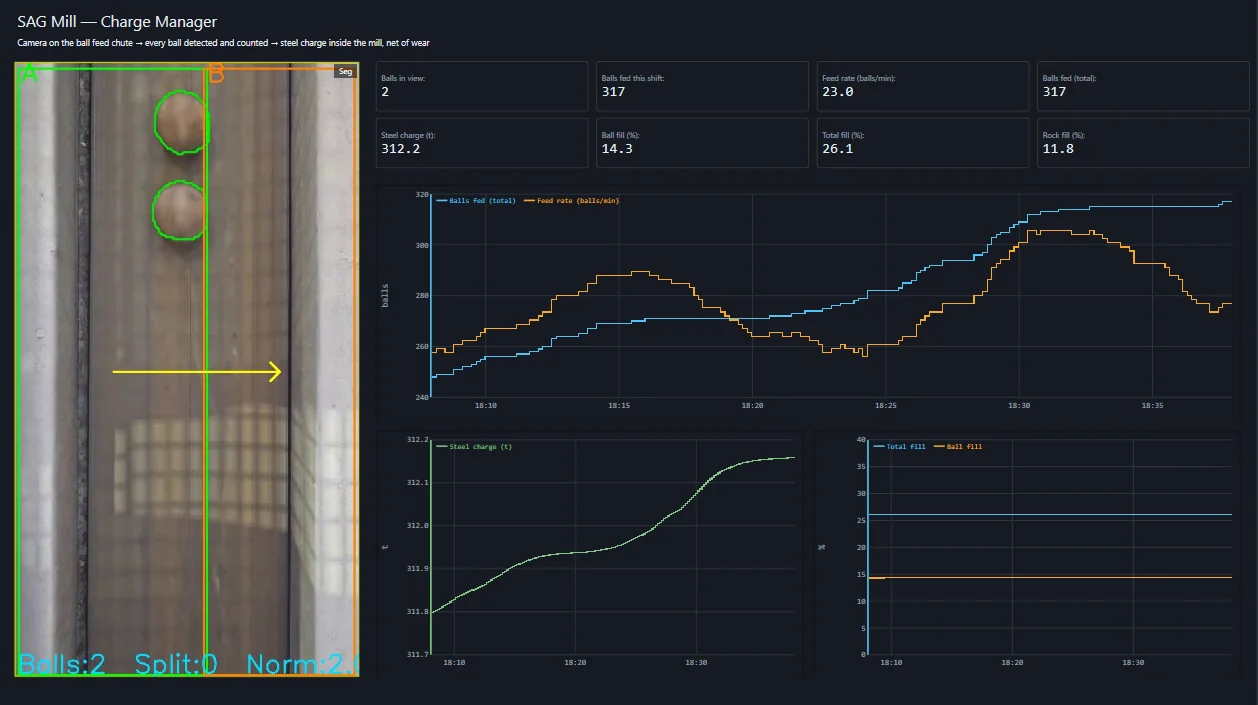
Every ball going into the mill, counted
The operator page shows the ball chute as the camera sees it, with each ball outlined as it passes, next to the balls fed this shift, the feed rate, the steel charge and the mill fill. Whether the ball feeder runs as planned, slows down or stops is visible at a glance, not discovered at the end of the shift.
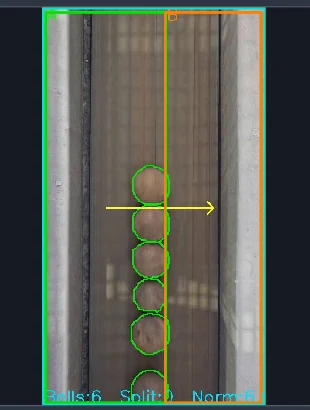
Each ball counted once
Balls bunch up, roll together and sometimes split. The Charge Manager follows each ball through two counting zones on the chute and counts it only once it has crossed, so a slow ball is not counted twice and two balls touching are still two balls. Split balls are recognised and counted separately, an early sign of a media quality or impact problem.
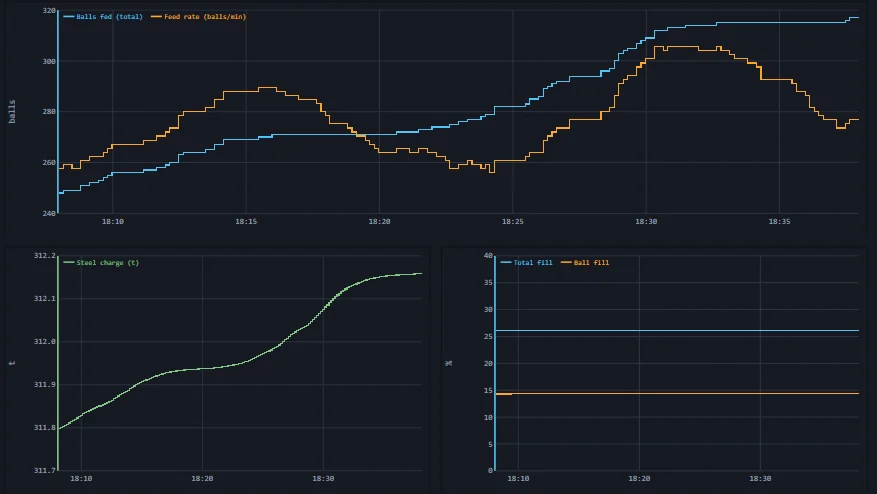
Steel charge, net of wear
Each ball counted adds its steel to the charge; wear takes steel away hour by hour. The result is a running estimate of the steel in the mill, in tonnes and as ball filling, which the metallurgist can follow through the shift and compare with the plan. A drifting charge shows up here long before it shows up in throughput or liner wear.
Calibrated with your own checks
The estimate is anchored to what your plant already measures: crash stops, grind-outs and liner scans. Each time one happens, your team records the result and the Charge Manager compares it with what it estimated, so the wear allowance is tuned to your mill and your media. Your engineers choose which value to trust when two disagree.
The steel reference for the grinding circuit
The ball charge is the slowest part of the mill load to change and the hardest to hear. The Fill Analyzer takes it from the Charge Manager, so sound and power are left to explain the rock and the slurry. The Digital Twin and the Optimizer use it to keep their picture of the mill current.
Where it pays off
- Top-ups that follow the mill — additions planned from the steel the mill holds, not only from a fixed schedule
- A charge that stays where it works best — ball filling held near its target between grind-outs, so throughput and grind stay steady
- Liner life — when the charge runs low, balls start to strike bare liner; seeing it early protects the liners
- Media quality — a rising share of split balls is a measured record to discuss with the supplier
- More from every kilowatt-hour — as part of a controlled grinding circuit, typically +1–3% throughput and 3–8% lower kWh/t, which also means less CO₂ per tonne
Installation
- An industrial camera and lighting over the ball chute or ball feed conveyor, with no contact with the balls
- A computer on site does all the processing; no cloud connection and no per-measurement fees
- Ball count, feed rate, steel charge and ball filling reach your DCS or historian over Modbus TCP or OPC UA
- Calibration against crash stops, grind-outs and liner scans is part of the product, and the counting is retrained on your own balls when needed
- A 7-day free trial on your own mill, so you can judge the results before you commit
See what the steel charge in your mill looks like.
Request a demo