
Process Digital Twins for Concentrators: From Flowsheet Model to Live Advisor
What a concentrator digital twin really is, the four levels it comes in, and what it takes to keep one true to the plant
Why the term needs pinning down
Few phrases in mineral processing have stretched as far as "digital twin". A 2025 framework paper from the University of Pretoria (Van Eyk and Heyns) starts from the observation that the mining industry has no shared understanding of what a digital twin is, and proposes classifying twins by their dimensions, model types (physics-based, data-driven or hybrid) and properties.
The examples in the literature show why. A recent SAG mill study (Quintanilla et al., 2025) built its twin from a small neural network trained on historian data, with no breakage or power physics at all. An ABB study at Boliden Aitik coupled a first-principles dynamic model to a copy of the plant control system. A Chalmers thesis (Li, 2024) combined a population balance SAG model with data-driven power and pebble predictions. An AusIMM Bulletin series by Vagenas separates "asset" twins (3D and visual) from "process" twins that simulate the ore's path, and places the process twin in the plant information layer rather than in engineering.
All of these are reasonable. They simply answer different questions, so it helps to describe a twin by what it does rather than by the label.
Four levels of a concentrator twin
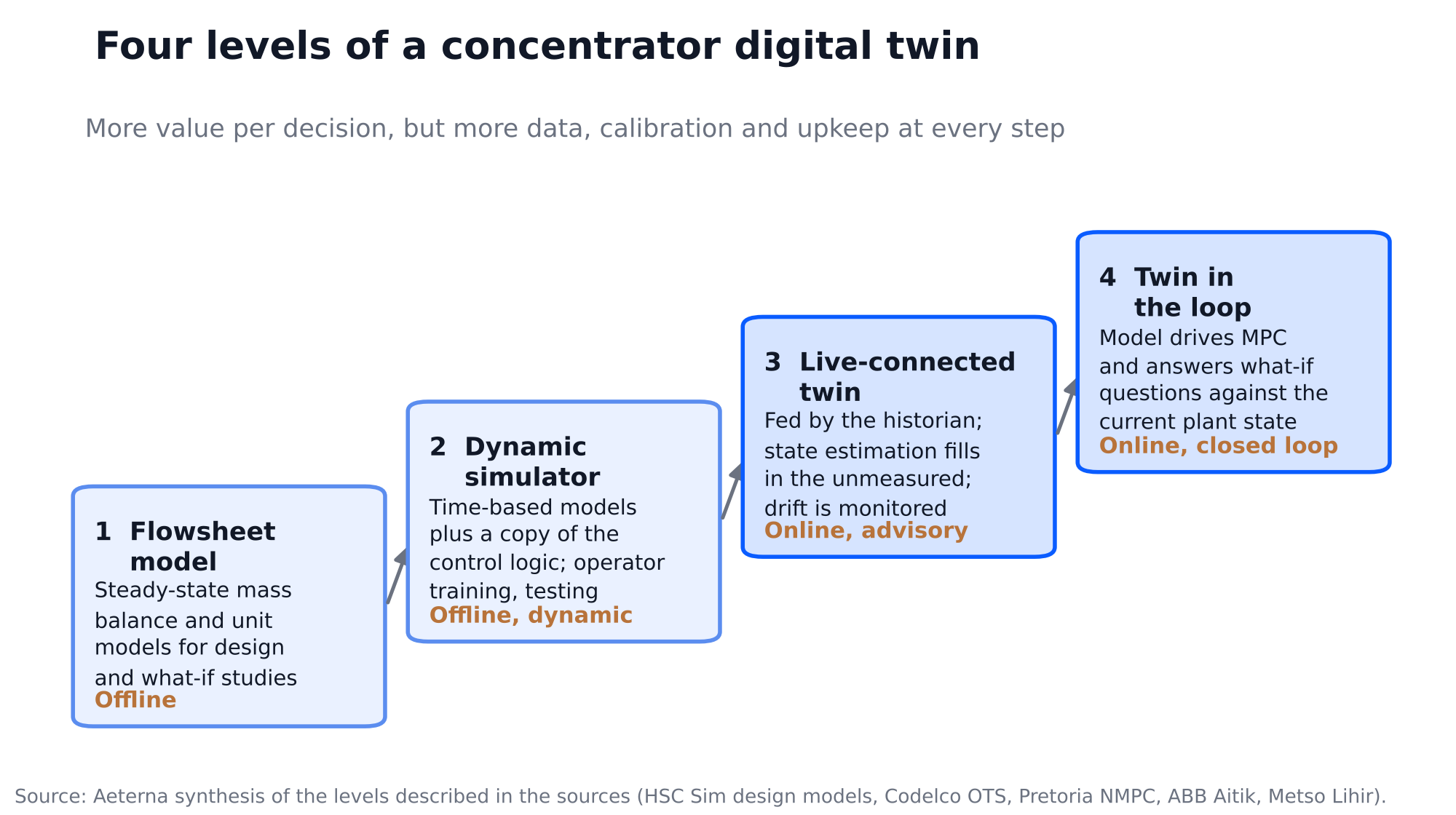
Level 1 is the steady-state flowsheet model used for design and what-if studies. A 2014 IFAC paper from the University of Oulu shows the type: HSC Sim models of grinding, classification and flotation (with floatability classes linked to bubble surface area flux) that matched measured copper grade at a Finnish concentrator with an R-squared of 0.83, which the authors called preliminary.
Level 2 adds time. A dynamic simulator, usually with a copy of the plant's control logic, lets engineers test controllers and lets operators practise upsets. An industrial simulator presented at a Codelco technical seminar modelled a 40 ft SAG mill, two ball mills and four cyclone batteries with population balance and Plitt models fitted to plant size distributions, and trained operators on scenarios such as SAG overload and pump failure.
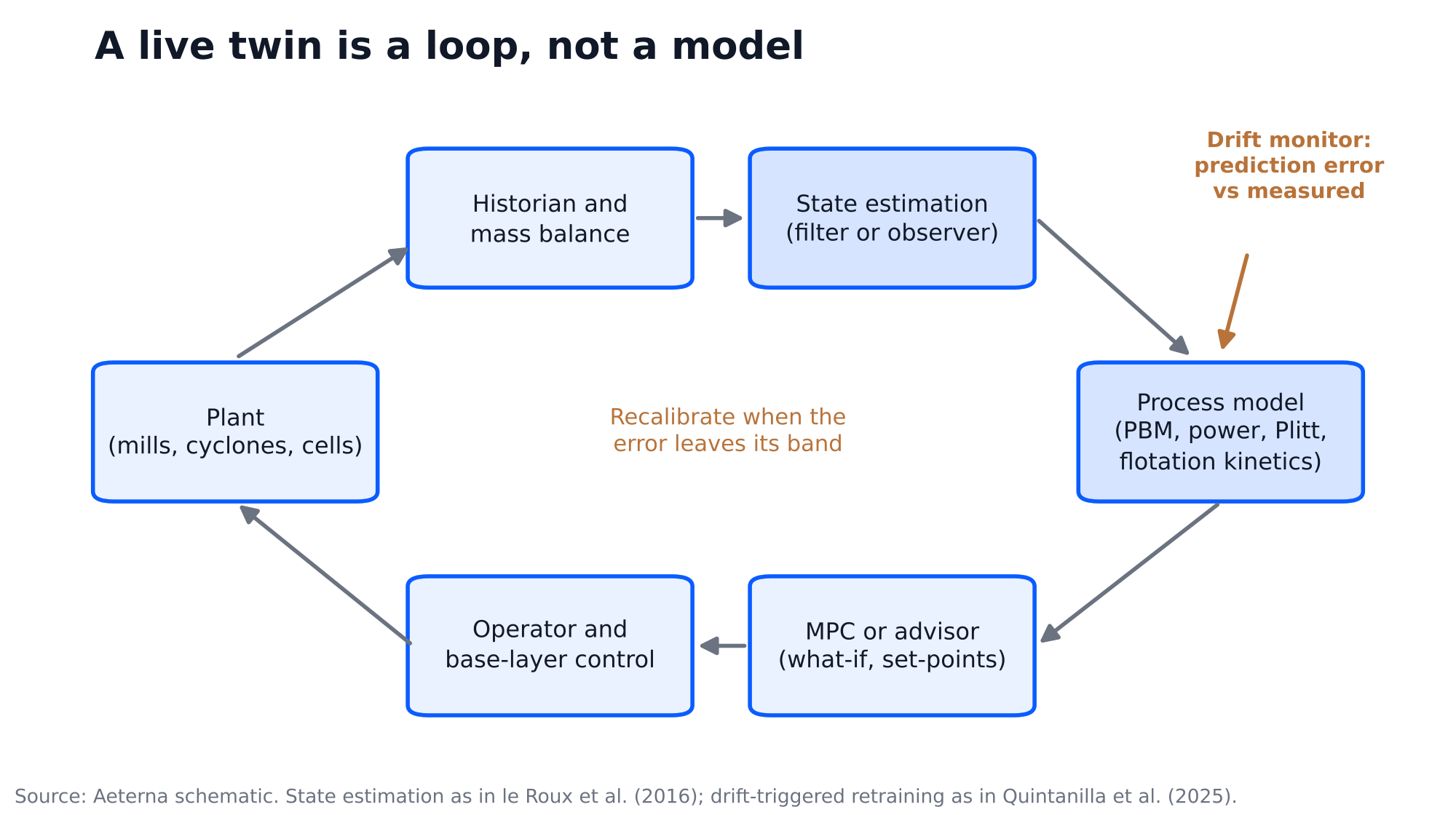
Level 3 connects the model to live data. State estimation, for example a particle filter as used in a University of Pretoria nonlinear MPC study (le Roux et al., 2016), fills in variables that are not measured, such as rock and ball load inside the mill. The twin now shows what the plant is doing, not what it would do.
Level 4 lets the model act: it supplies predictions to MPC or answers what-if questions from the current plant state. The Aitik study ran ABB's MPC against the twin, and Metso describes a twin at Newmont's Lihir operation in Papua New Guinea, the nearest documented example to Southeast Asia that we found, which adapts its own parameters when plant and simulation diverge.
What goes inside
The unit models are familiar to any metallurgist: population balance models for SAG and ball mills, a power model (Morrell's approach is common), Plitt-type relationships for cyclone cut size and bypass, and first-order flotation kinetics split by floatability class. A 2021 Applied Sciences paper on a flotation training simulator broke the rate constant into factors for frother, collector, air, impeller speed and particle size, which is the kind of structure that lets operators see why recovery moved.
The data side matters as much. The SAG study above used six months of 5-second historian records resampled to 30 seconds. Vagenas argues for dynamic mass balances every hour or faster instead of monthly reconciliation, and gives the example of a gold leach circuit balanced every minute, where the mismatch between measured and calculated flows exposed weightometer calibration faults. A twin that cannot balance the plant will not predict it.
The hard part: keeping it true
Plants change. In the Aitik study the model had to be re-identified with new step tests after a pebble crusher was added, and the authors list undocumented equipment upgrades and mineralogy shifts as a recurring maintenance problem. They also say plainly that high-fidelity models are costly to build and maintain, and that a model identified from step tests may be the cheaper route for control.
The SAG neural-network twin handled drift statistically: it compared recent prediction errors with their expected band and retrained when they drifted. In the authors' tests, one month of simulated liner wear did not trigger retraining, five months triggered three retrains, and a 10 % hardness increase was flagged after roughly two hours. The study is a preprint with synthetic disturbances, but the principle is sound: a live twin needs a measured error band and a rule for when to recalibrate.
What the evidence shows, and what it does not
| Source | Twin level | Reported result | Type of evidence |
|---|---|---|---|
| Codelco seminar OTS (Chile) | 2 - dynamic simulator | Use of secondary-grinding APC rose from about 20 % to about 70 % after training | Industry paper, indirect measure |
| ABB, Boliden Aitik | 4 - twin with MPC | +1-3 % throughput, >5 % lower standard deviation, in simulation | Vendor case study |
| le Roux et al., Pretoria | 3/4 - estimator plus NMPC | About 2 % tracking error on load and product size, real-time feasible | Peer-reviewed, simulation |
| Quintanilla et al. | 3 - data-driven live twin | About +/-1 % bearing pressure, +/-5 % power at 2.5 min ahead | Preprint, short validation |
| Metso, Newmont Lihir | 4 - adaptive twin with APC | Savings claimed; no figures published | Vendor case study |
Two honest conclusions follow. First, the strongest plant evidence is for training and for testing control before it goes live, not for a twin running the plant by itself. Second, the throughput numbers that circulate are mostly simulated or vendor-reported. That does not make them wrong, but it does mean a site should measure its own twin's prediction error before relying on its advice.
Practical takeaway
- Write down the question first: design option, operator training, controller testing, soft sensing or live optimisation. Each points to a different level.
- Build the lowest level that answers it. A calibrated steady-state model is often enough for design; a dynamic simulator is the right tool for training and APC commissioning.
- Fix the data before the model: balance the plant hourly, check weightometers and densitometers, and keep a log of equipment changes.
- Track prediction error as a KPI (for example bearing pressure and power a few minutes ahead) and agree in advance what error triggers recalibration.
- Keep operators in the loop. A twin earns trust when people can see why it recommends a move and compare its prediction with what then happens.
Aeterna angle
ProcessOpt is built around the same unit models described here, including population balance mills with Morrell power, Plitt cyclones, flotation cells and thickeners, and the Digital Twin runs them against live plant data alongside Model Predictive Control. If you are deciding what level of twin your concentrator needs, or want a simulator to test control changes before they reach the plant, we would be glad to talk it through with your team.
Common misconceptions
- 'A digital twin is a 3D model of the plant.' That is an asset twin; process decisions need a process twin that simulates ore, water and size.
- 'Once built, the twin stays right.' Liners wear, ore changes and equipment is modified; without a drift check the model quietly ages.
- 'More physics is always better.' High-fidelity models cost more to maintain; for control, a model identified from step tests may be enough.
- 'A twin replaces the operator.' The documented value so far is in training and testing; operators remain the ones who decide.
Where sources disagree or are uncertain
- Definitions differ: some sources call a data-driven predictor a twin, others require physics models plus a copy of the control system.
- Most throughput figures are simulated (Aitik, Pretoria) or vendor-reported (Lihir); no source reviewed shows audited plant results from a twin running in closed loop.
- The training benefit at the Codelco-seminar site is measured indirectly, as APC use rather than metallurgical performance.
- Figures 1 and 2 are Aeterna schematics, not plant data.
Ask for a digital twin scoping session: we look at the question you want answered and your plant data, and recommend the lowest level of twin that will answer it.
Talk to an engineerSources
- ABB - Case study: the use of a digital twin with Advanced Process Control at Boliden Aitik mine
- Quintanilla et al. - Digital twin with automatic disturbance detection for an expert-controlled SAG mill (arXiv 2503.04225, 2025)
- le Roux, Olivier, Naidoo, Padhi, Craig - Throughput and product quality control for a grinding mill circuit using non-linear MPC (University of Pretoria, 2016)
- Toro, Ortiz, Yutronic - An industrial simulation system for copper concentration plants (Codelco technical seminar)
- Seppala et al. - Pilot plant simulation as a tool for more efficient mineral processing (19th IFAC World Congress, 2014)
- Koteleva, Kuznetsov, Vasilyeva - A simulator for educating the digital technologies skills in industry, Part one (Applied Sciences 11(22):10885, 2021)
- Li, H. - Dynamic modeling and simulation of SAG mill circuits with pebble crushing (Chalmers PhD thesis, 2024)
- Van Eyk and Heyns - A framework to define, design and construct digital twins in the mining industry (University of Pretoria, 2025)
- Vagenas - Digital transformation for minerals processing: the fundamentals, Part 1 (AusIMM Bulletin)
- Vagenas - Digital transformation for minerals processing: the fundamentals, Part 2 (AusIMM Bulletin)
- Metso - Optimizing from mine to mill to mine with digital twin technology at Newmont Lihir