
Pebble Crushing in SABC Circuits: When Recycling Critical Size Pays Off
What critical-size pebbles are, why the recycle crusher is so often under-used, and how control, stockpiles and sorting turn the pebble stream into throughput
What critical size is
A SAG mill breaks large rocks by impact and grinds small ones by abrasion. In between sits a size band that is too large to be worn away quickly and too small to act as grinding media. These particles accumulate in the charge, take up volume and power, and limit how much new ore the mill can accept. A 2022 study in Minerals (Sun et al.) puts critical size anywhere from about 20 to 70 mm depending on the mill, and a 2024 simulation study by Li and colleagues at Chalmers and FLSmidth describes 25 to 55 mm material as the fraction that builds up.
Pebble ports in the discharge grate let this material out. It is screened off the trommel or discharge screen and either crushed and returned, or returned uncrushed. Typical pebble streams are about 5 to 25 % of fresh feed, depending on ore hardness, and Li et al. describe recycle loads of about 20 % of SAG throughput, rising to as much as 50 % in fully autogenous circuits.
Pebbles are harder than the ore they came from
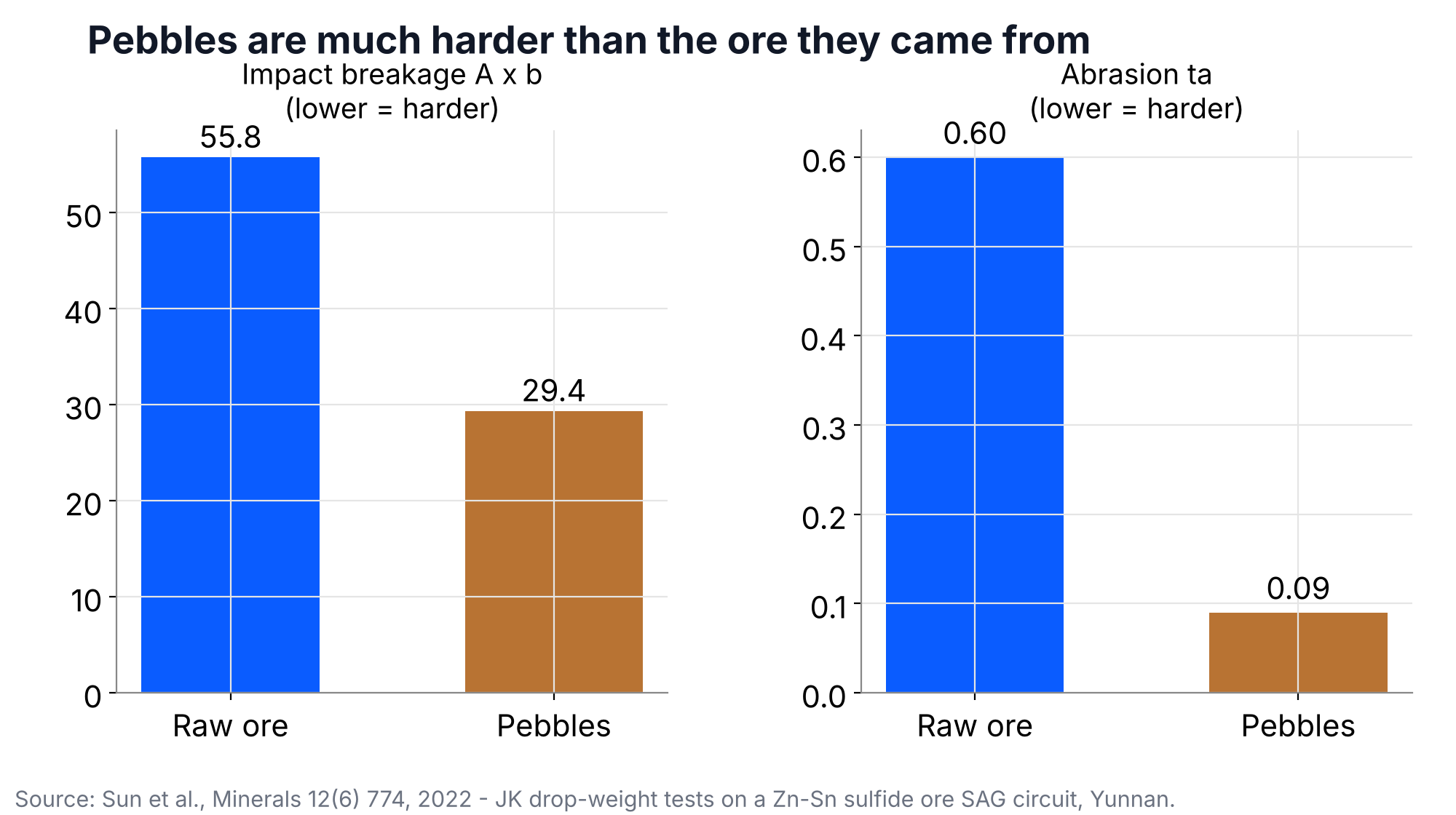
The pebble stream is a concentrate of whatever the mill finds hardest. Sun et al. compared pebbles with raw ore at a zinc-tin operation and found the pebbles were mostly harder host rock, with more chlorite (8.9 % against 3.1 %). In JK drop-weight tests the impact parameter A x b fell from 55.8 for raw ore to 29.4 for pebbles, moving them from medium into the hard to very hard range, and the abrasion parameter ta fell from 0.6 to 0.09. Returning these pebbles uncrushed simply sends the hardest rock back into the mill.
Why crushing them pays
Breaking critical-size pebbles outside the mill frees SAG volume and power for new feed. A 911 Metallurgist account of adding a pebble crusher to an autogenous circuit reports a ratio of throughput increase to pebble flow of 1.1 to 1.2 in pilot tests and 1.0 to 1.5 in industrial tests: every tonne per hour of pebbles crushed brought roughly a tonne per hour or more of extra fresh feed.
The leverage is large because the machines are so different in size. Li et al. note that a large SAG mill can draw around 20 MW, while a pebble crusher typically uses 300 to 1,000 kW. A few hundred kilowatts well spent in the recycle loop can change what the 20 MW mill achieves.
The under-used crusher
Despite this, pebble crushers are often treated as an afterthought. In a SAG Conference 2019 paper, Powell, Evertsson and Mainza observed that recycle crushers are generally poorly used: they run well below installed power, switch on and off, and are set at wide closed side settings. They argue that better design and control could raise the reduction ratio, lift SAG throughput and relieve overloaded ball mills.
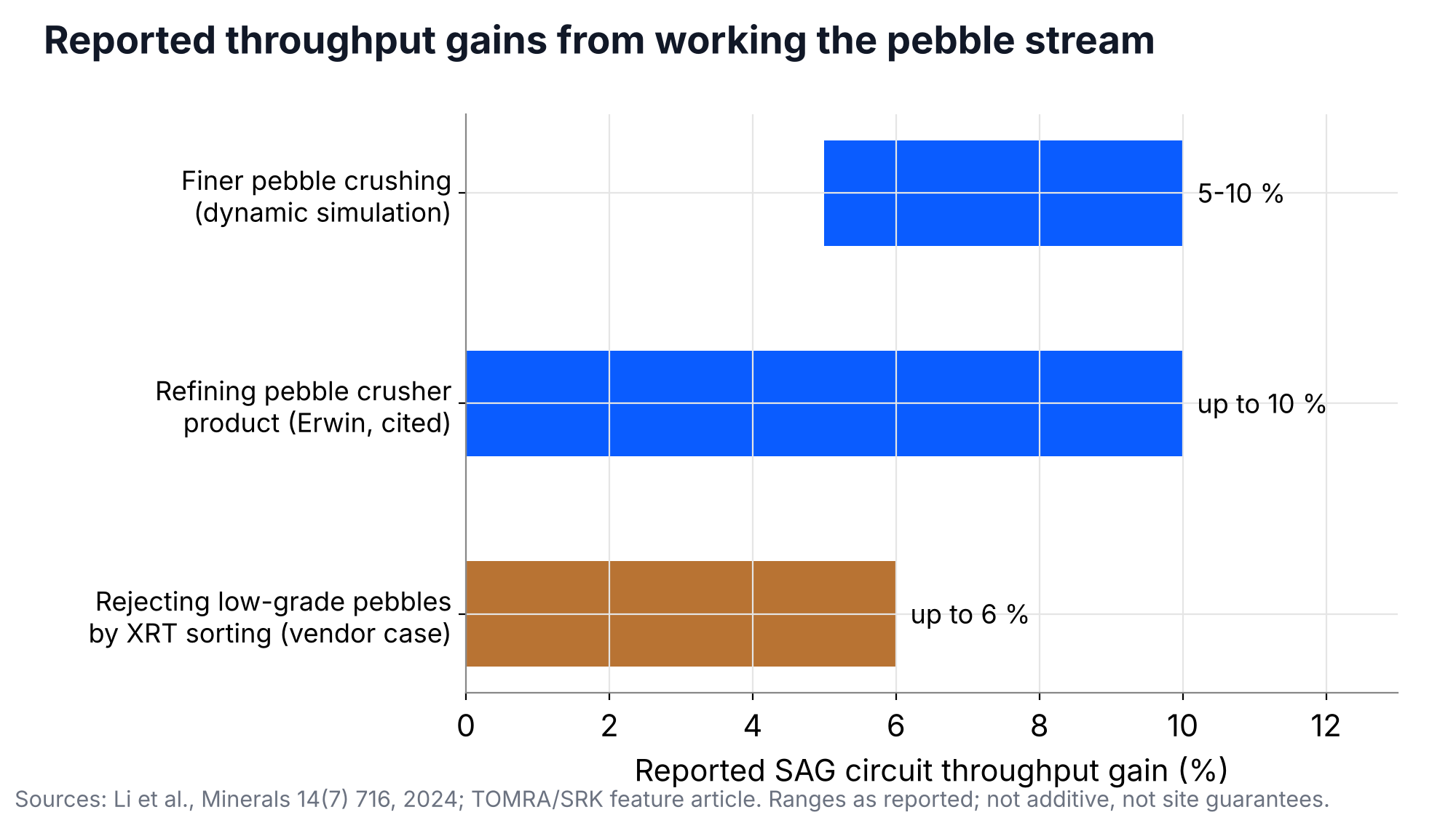
Li and colleagues tested this idea with a dynamic model of a copper SABC circuit. Running the crusher at a tight setting and higher eccentric speed (10 mm and 400 rpm against 28 mm and 280 rpm), with a controller to keep it busy, raised overall fresh feed rate by 5 to 10 % in simulation. A tighter setting reduces crusher capacity, so the study pairs it with a second crusher and a pebble stockpile: the second unit starts when the bin passes 300 t, and the stockpile smooths surges rather than adding throughput by itself. Across the simulated runs, the pebble-to-fresh-feed ratio ranged from 0.16 to 0.40, a reminder of how much this stream moves with ore hardness and feed size.
| Operating choice | What it does | Watch-out |
|---|---|---|
| Tighter CSS / higher speed | Finer crusher product; more critical size destroyed | Lower crusher capacity; more liner wear |
| Keep the crusher choke-fed and running | Uses installed power instead of cycling | Needs a buffer bin or stockpile |
| Pebble stockpile | Absorbs surges from ore changes | Does not add throughput on its own |
| Bypass back to the SAG | Keeps the mill running if the crusher trips | Recycle and mill load climb quickly |
| Return crushed pebbles to the ball mill | Unloads the SAG | Can overload the ball mill and coarsen the grind |
Protecting the crusher from steel
Grinding balls and broken liner bolts leave the SAG mill with the pebbles, and a cone crusher does not survive steel. The 911 Metallurgist account describes a design target of removing all worn and broken steel before the crusher, using self-cleaning magnets, a head pulley magnet and metal detectors interlocked with a feed gate that diverts steel back to the mill. Every trip of that protection sends pebbles uncrushed back to the SAG, so crusher availability, not only crusher setting, shows up directly in mill throughput.
Not every pebble is worth recycling
Work by SRK Consulting with TOMRA Mining has questioned whether all pebbles should go back at all. Testing pebbles from North American copper operations, SRK found a wide range of metal grades that x-ray transmission sensors could detect. TOMRA's feature article on the work states that pebbles can be up to 30 % of mill feed, that in high-pebble circuits each tonne returned can displace 0.4 to 0.7 t of fresh feed, and that a Canadian copper operation gained up to 6 % throughput by rejecting low-grade pebbles. These figures come from a vendor source, but the principle is sound: pebble grade should be measured before deciding how to treat the stream.
Where advanced control fits
The SAG mill, pebble crusher, stockpile and ball mill interact. Pushing the SAG harder raises the pebble rate; crushing finer helps the SAG but loads the ball mill; a crusher trip changes all three within minutes. That is the kind of coupled, constrained problem that model predictive control handles well. Li et al. also presented a data-driven method at the 2021 International Comminution Symposium to separate the effect of recycle load and crusher settings from everything else in plant data, the first step before tuning any strategy. For large SABC concentrators in Indonesia and the wider region, where ore hardness can change from bench to bench, a strategy that treats pebble rate as a measured, managed variable is usually worth more than a fixed crusher setting.
Practical takeaway
- Measure the pebble rate continuously with a belt scale and trend it against SAG feed rate and ore type.
- Report crusher power utilisation and running hours, not just availability; an idle crusher is lost SAG capacity.
- Check the crusher closed side setting regularly and test whether a tighter setting pays once liner wear is counted.
- Keep tramp-steel protection healthy, and log every bypass event with its duration and cause.
- Sample and assay the pebble stream at least once: if grade varies widely, sorting may be worth a study.
- Coordinate SAG load, crusher and ball mill limits in one control strategy instead of three separate loops.
Aeterna angle
ProcessOpt Model Predictive Control coordinates SAG load, pebble crusher and ball mill power within their limits, and the Fill Analyzer and Rock Analyzer give it the mill-load and feed-size signals that drive pebble generation. If you run an SABC circuit and want to know whether your pebble crusher is earning its keep, we would be happy to look at your data with you.
Common misconceptions
- 'The pebble crusher is a support machine.' Its few hundred kilowatts can decide what a 20 MW SAG mill achieves.
- 'Available means useful.' A crusher that is available but idle or set wide is not destroying critical size.
- 'A stockpile raises throughput.' It smooths surges; the throughput comes from crushing.
- 'All pebbles carry the same value as the feed.' Sorting studies report a wide grade spread within the pebble stream.
Where sources disagree or are uncertain
- Critical-size ranges differ by source (about 20 to 70 mm versus 25 to 55 mm) because they depend on mill size, grate and ore.
- The 5 to 10 % gain from finer pebble crushing is a dynamic simulation result, not a reported plant trial.
- The sorting figures (0.4 to 0.7 t displaced, up to 6 % gain) come from a vendor feature article.
- The 1.0 to 1.5 throughput ratio comes from an older autogenous circuit account and may not transfer directly to modern SABC circuits.
Ask for an SABC recycle review: we look at pebble rate, crusher utilisation and ball mill load together and show where the throughput is.
Talk to an engineerSources
- Sun, Yang, Li, Liu and Ma - Differences in properties between pebbles and raw ore from a SAG mill at a zinc, tin-bearing mine (Minerals 12(6) 774, 2022)
- Li, Asbjornsson, Bhadani and Evertsson - Investigating dynamic behavior in SAG mill pebble recycling circuits: a simulation approach (Minerals 14(7) 716, 2024)
- Li et al. - Investigating dynamic behavior in SAG mill pebble recycling circuits, full text (Chalmers)
- Powell, Evertsson and Mainza - Redesigning SAG mill recycle crusher operation (SAG Conference, Vancouver, 2019)
- Li, Evertsson, Lindqvist, Hulthen and Asbjornsson - Dynamic modeling and simulation of a SAG mill-pebble crusher circuit by controlling crusher operational parameters (Minerals Engineering 127, 2018)
- Li, Evertsson, Lindqvist and Asbjornsson - Isolating the impact of pebble recycling on AG/SAG circuit: a data-driven method (12th International Comminution Symposium, 2021)
- 911 Metallurgist - Crushing SAG mill critical size material
- SRK Consulting - Pebbles: what are we really sending back to our mills? (CMP 2025)
- TOMRA Mining - From waste to value: how SRK Consulting and TOMRA Mining are redefining pebble processing