
On-Stream Analysers in Flotation: Sampling, Calibration and Assays You Can Control On
How slurry XRF and probe analysers work, why the sampler matters as much as the analyser, and what it takes to turn minute-by-minute assays into better grade and recovery
Why flotation needs fast assays
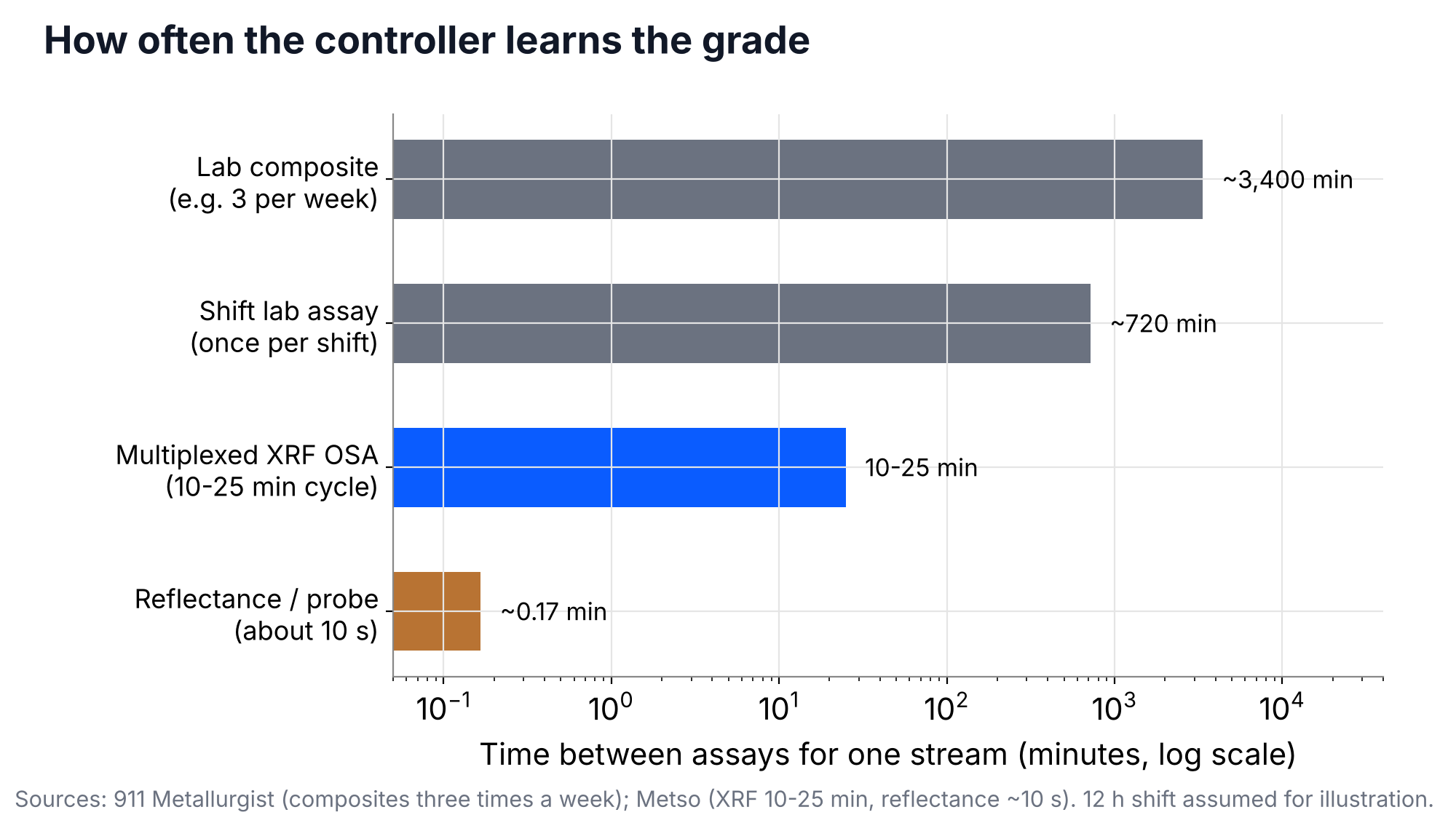
Flotation is controlled to hit a concentrate grade while losing as little metal as possible to tailings. Without online measurement, the only grade information comes from shift samples or weekly composites, which arrive long after the ore that produced them has left the plant. A 911 Metallurgist account of an on-stream analyser (OSA) installation describes metallurgical composites analysed three times a week, with on-stream assays filling the gaps and the balances corrected when composites disagreed.
An OSA shortens that loop from days to minutes. Metso, which supplies centralised XRF analysers, gives a typical sampling interval of 10 to 25 minutes per stream, and reports that adding a reflectance measurement in the same sampling system brings the update down to about 10 seconds. The faster signal also reveals behaviour a slow one hides: Metso notes oscillations with a period of a few minutes that the XRF cycle alone cannot see.
Two ways to build an analyser system
In a centralised system, primary samplers on each stream feed a multiplexer that presents one stream at a time to a single measuring cell, with the rest returned to process. A training deck on process-control samplers published by 911 Metallurgist lists launder, pressure and poppet samplers for this duty, notes that an analyser needs a continuous sample of about 8 to 12 m3/h, and stresses that velocity through the cutter should match the main stream. One analyser can serve many streams, which keeps cost down, but each stream waits its turn.
In a distributed system, a probe sits on or beside each stream and measures it continuously. Thermo Fisher describes probe analysers using low-power, air-cooled X-ray tubes instead of radioisotope sources, with silicon drift detectors and multi-stream units handling up to 12 slurries, each in its own tank with de-aeration and a cross-cut sampler for calibration. Reflectance (VNIR) probes and image-based analysers are a third option for high-grade streams; Metso positions reflectance mainly for rougher and final concentrate, where grades are high enough to see.
| Design | Update rate per stream | Strengths | Watch-outs |
|---|---|---|---|
| Centralised XRF with multiplexer | Typically 10-25 min | One analyser, many streams; full elemental range | Long sample lines, blockages, waiting time |
| Dedicated XRF probe per stream | About a minute | Fast, no multiplexer queue | Cost per stream; each probe to calibrate |
| Reflectance / spectral probe | Seconds | Very fast trend; good on concentrates | Needs frequent recalibration against XRF or lab |
| Laboratory composites | Shift to days | Most accurate; legal and accounting basis | Too slow for control |
The sampler is half the instrument
An analyser can only be as good as the slurry it sees. In a Sampling 2010 paper, von Alfthan and Kongas describe slurry sampling as a compromise between representativeness, reliability, cost and layout. Gy's principle, that every particle should have an equal chance of being selected, is met most closely by a correctly designed cross-stream cutter, while a fixed vertical cutter in well-mixed turbulent flow is often acceptable for control purposes. They note that online sampling problems usually trace back to the design or installation of the piping to the analyser, and that many sampling systems have fallen out of use because they were hard to maintain.
Plant experience supports the point. At a copper-nickel flotation plant, Lohilahti and colleagues (Sampling 2014) used variographic analysis to separate sampling and measurement errors and reported metallurgical samplers on the main flows running with zero downtime and no sanding. They also highlight the tailings stream as the most important single measurement for recovery, which is also the hardest to assay at low grade.
Calibration, accuracy and availability
XRF measures slurry, not dried and ground pulp, so particle size, mineralogy, solids density and aeration all influence the reading. The analyser is calibrated by regressing its readings against laboratory assays of samples cut at the same time from the same stream. Von Alfthan and Kongas state that relative accuracy better than 3 % (one standard deviation) is reached only in special cases, and that availability below 95 % limits the use of assays for control. Metso adds that static calibrations rarely stay valid for spectral probes and describes recursive updating against new XRF assays, gradually forgetting older pairs.
- Take calibration samples from the analyser's own cutter, at the same moment as the reading, and over the full grade range the stream sees.
- Recheck bias against shift or daily composites and recalibrate when the bias trend moves, or when ore type or reagent scheme changes.
- Track sample flow, pressure and blockages as alarms; a starved cell reports a number that looks valid.
- Report analyser availability and calibration error monthly, alongside the control KPIs.
What controlling on assays has delivered
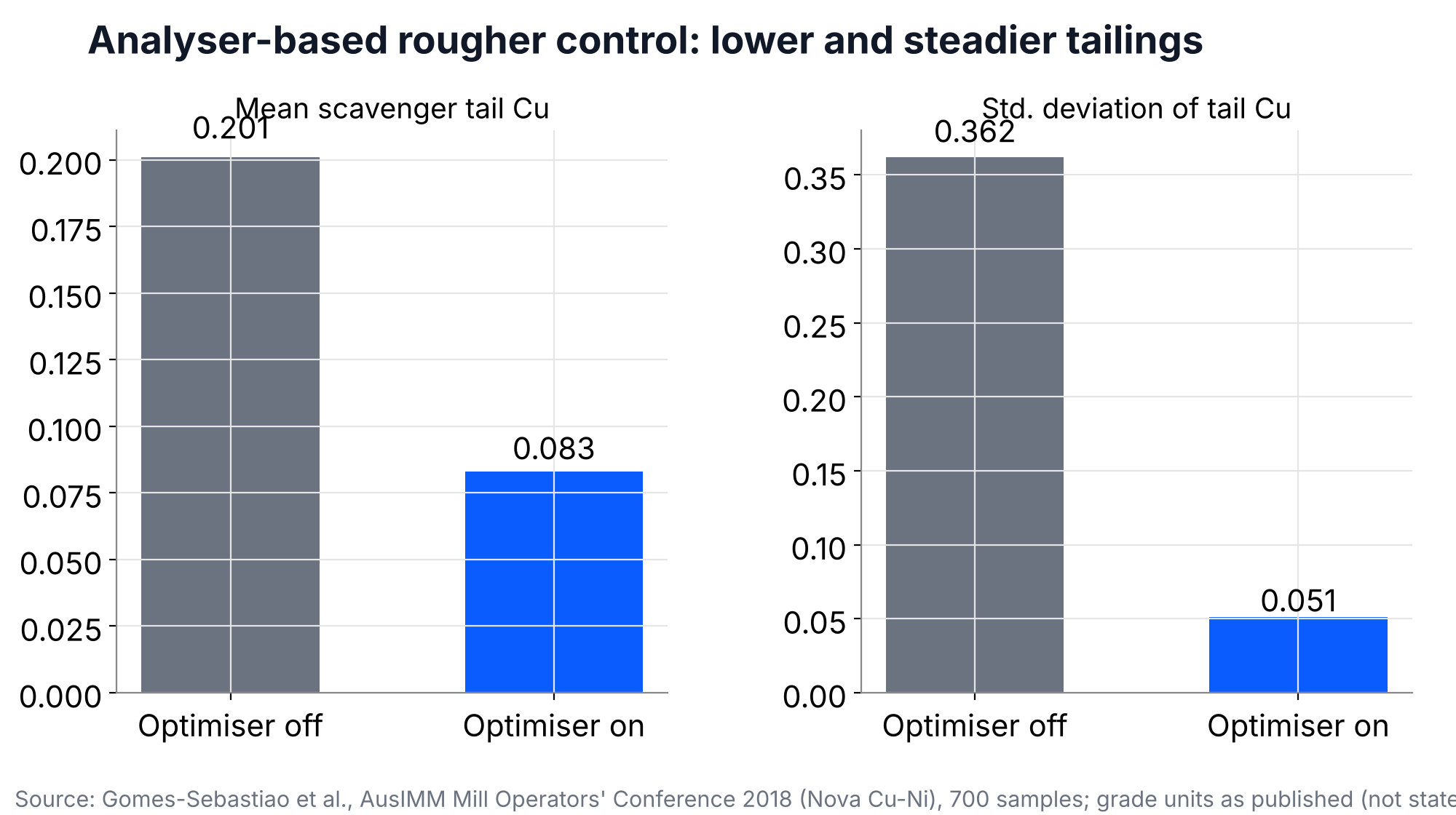
The benefit of an analyser appears when its assays drive decisions. At IGO's Nova copper-nickel operation in Western Australia, a 2018 Mill Operators' Conference paper describes a copper rougher-scavenger optimiser using slurry and froth analysers. Over 700 samples, mean scavenger tail copper was 0.083 with the optimiser on against 0.201 with it off, with far less scatter, and lab-based recovery moved from about 80 to 85 % before to 85 to 90 % after. The authors note normalised data and no concurrent control group, so the figures are indicative.
Closer to Indonesia, a 2014 AusIMM paper on Porgera in Papua New Guinea reported a 1.98 % increase in flotation recovery after a single slurry analyser on the final concentrate was combined with an advanced control upgrade. A Metso case study from RTB Bor's Veliki Krivelj concentrator in Serbia credits advanced control using froth cameras and online analysers with a further 3 % recovery gain after a flotation cell upgrade. The cost of going without is visible too: the 911 Metallurgist account describes a plant whose two analysers were down for about three days, with estimated losses of 2.3 % of copper and 3.0 % of zinc concentrate value over that period. For the many copper-gold concentrators in Indonesia and Southeast Asia, where grade and recovery targets are tight and ore changes quickly, these results show why an analyser is worth looking after.
Practical takeaway
- Decide which streams the controller actually needs: usually feed, rougher concentrate, final concentrate and final tails. Measure those well before adding more.
- Spend on sampling: correct cutters, short and steep sample lines, flushing, and easy access for maintenance.
- Calibrate against good composite samples and trend the bias; do not wait for a disagreement with the monthly balance.
- Give the analyser an owner and a KPI for availability; aim for 95 % or better before closing loops on it.
- Design the controller to degrade gracefully: hold last good values, widen limits, or fall back to manual targets when assays are stale.
Aeterna angle
ProcessOpt Model Predictive Control and soft sensors use on-stream assays together with Froth Analyzer measurements and plant data, check them for staleness and bias, and keep control stable when an assay is missing, so you stay in control. If your analyser is installed but rarely trusted, we would be glad to help you put it back to work for grade and recovery.
Common misconceptions
- 'The analyser is accurate because it is X-ray.' Most of the error usually comes from sampling and calibration, not the detector.
- 'Calibrate once at commissioning.' Ore type, particle size and reagent changes shift the calibration; trend the bias.
- 'More streams means more value.' A few well-sampled, well-calibrated streams that the controller uses are worth more than many ignored ones.
- 'If the analyser is down, control must stop.' A well-designed controller falls back gracefully and alarms on stale assays.
Where sources disagree or are uncertain
- Update rates and analyser capabilities quoted from Metso and Thermo Fisher are vendor statements.
- The Nova and Porgera recovery gains combine analysers with advanced control; the analyser's share cannot be separated, and Nova's data are normalised without a concurrent control group.
- The Porgera paper's year is listed as 2014 in the proceedings title but 2013 in the page metadata.
- The 3 % accuracy figure is a general statement from one sampling paper; achievable accuracy varies widely with grade, element and stream.
Ask for an analyser-to-control review: we look at sampling, calibration bias and availability, and show which loops your assays can safely drive.
Talk to an engineerSources
- 911 Metallurgist - On-stream analysers benefits
- Metso - Improving flotation control with rapid slurry measurement
- Metso - RTB Bor improves recovery at the Veliki Krivelj concentrator plant (case study)
- von Alfthan and Kongas - Practical sampling for online analysis and composite samples of slurries: the art of compromises (AusIMM Sampling 2010)
- Lohilahti, Korpela, Minkkinen and McPherson - Analysis of slurry sampling arrangements at a froth flotation plant (AusIMM Sampling 2014)
- Kewe et al. - Evaluation of the Blue Cube MQi slurry analyser for advanced control of a gold sulfide flotation circuit (AusIMM 12th Mill Operators' Conference, 2014)
- 911 Metallurgist - Introduction to sampling for mineral processing, part 5: process control samplers
- Joyce (Thermo Fisher Scientific) - A deep dive into real-time analysis (Global Mining Review, 2026)
- Gomes-Sebastiao et al. - Nova copper-nickel project: optimisation of the copper rougher-scavenger circuit through advanced measurement and control (AusIMM Mill Operators' Conference, 2018)