
Vibrating Screen Fundamentals: Stroke, Frequency and Efficiency
How a vibrating screen stratifies, separates, and how to tell whether it is doing its job
What a vibrating screen does
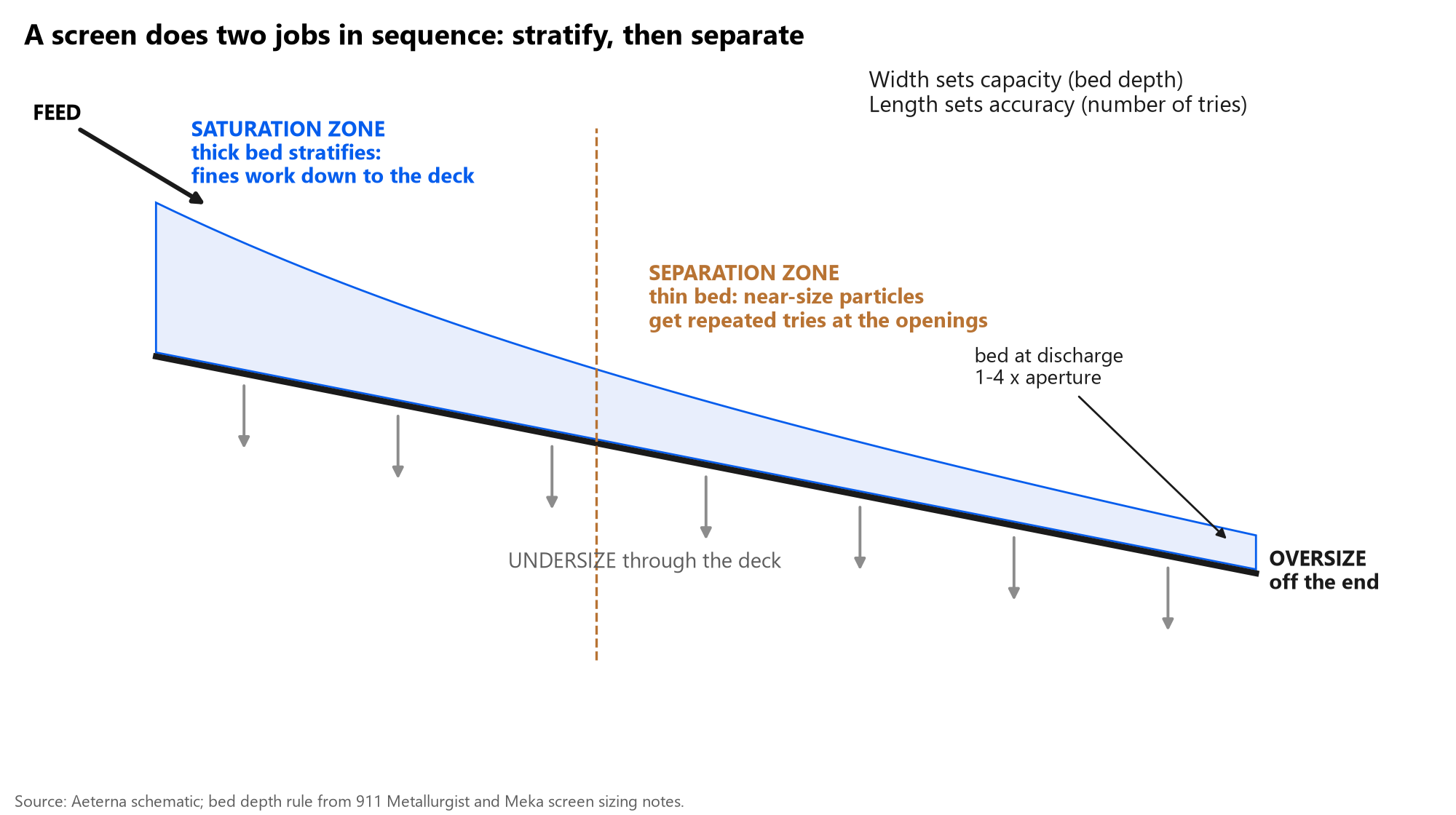
Feed lands on the deck as a thick bed. Vibration loosens the bed so that small particles fall through the gaps between larger ones and reach the deck: this is stratification, and it happens mainly in the first third of the screen (the saturation zone). Further along, the bed thins and particles near the aperture size get repeated chances to pass: this is the separation zone.
Screen width controls bed depth and therefore capacity; screen length controls the number of chances and therefore accuracy. A rule used by most manufacturers is that the bed at the discharge end should not exceed about four times the aperture (five times for heavier material), and should not be thinner than the aperture, or particles bounce instead of stratifying.
Stroke, speed and g-force
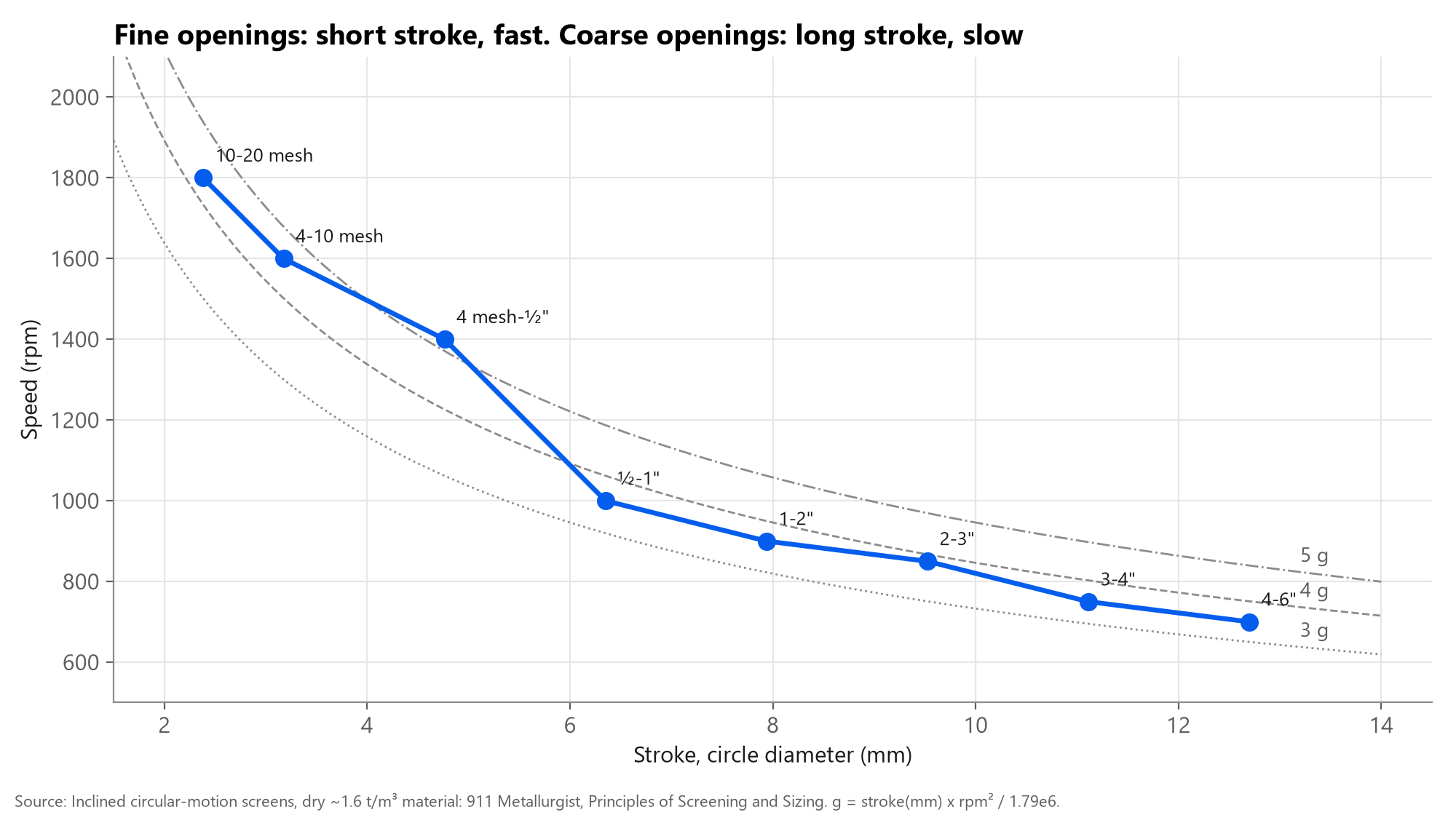
Circular-motion inclined screens are set by stroke (the circle diameter), speed and slope. The rule is short stroke and high speed for fine openings, long stroke and low speed for coarse openings: for example about 3 mm at 1,600 rpm for 4-10 mesh and about 13 mm at 700 rpm for 4-6 inch openings, on slopes of roughly 18-30°.
The acceleration of the deck is g = stroke (mm) x rpm² / 1.79 million. Circular-motion screens usually run near 3.5-4 g, linear-motion (horizontal) screens 4.5-5.7 g. Too much stroke on fine screening throws fines over the bed before they reach the deck; too little lets the bed pack and blind. Speed and stroke must stay within the machine's acceleration limits to protect side plates and bearings.
Probability of passage and near-size particles
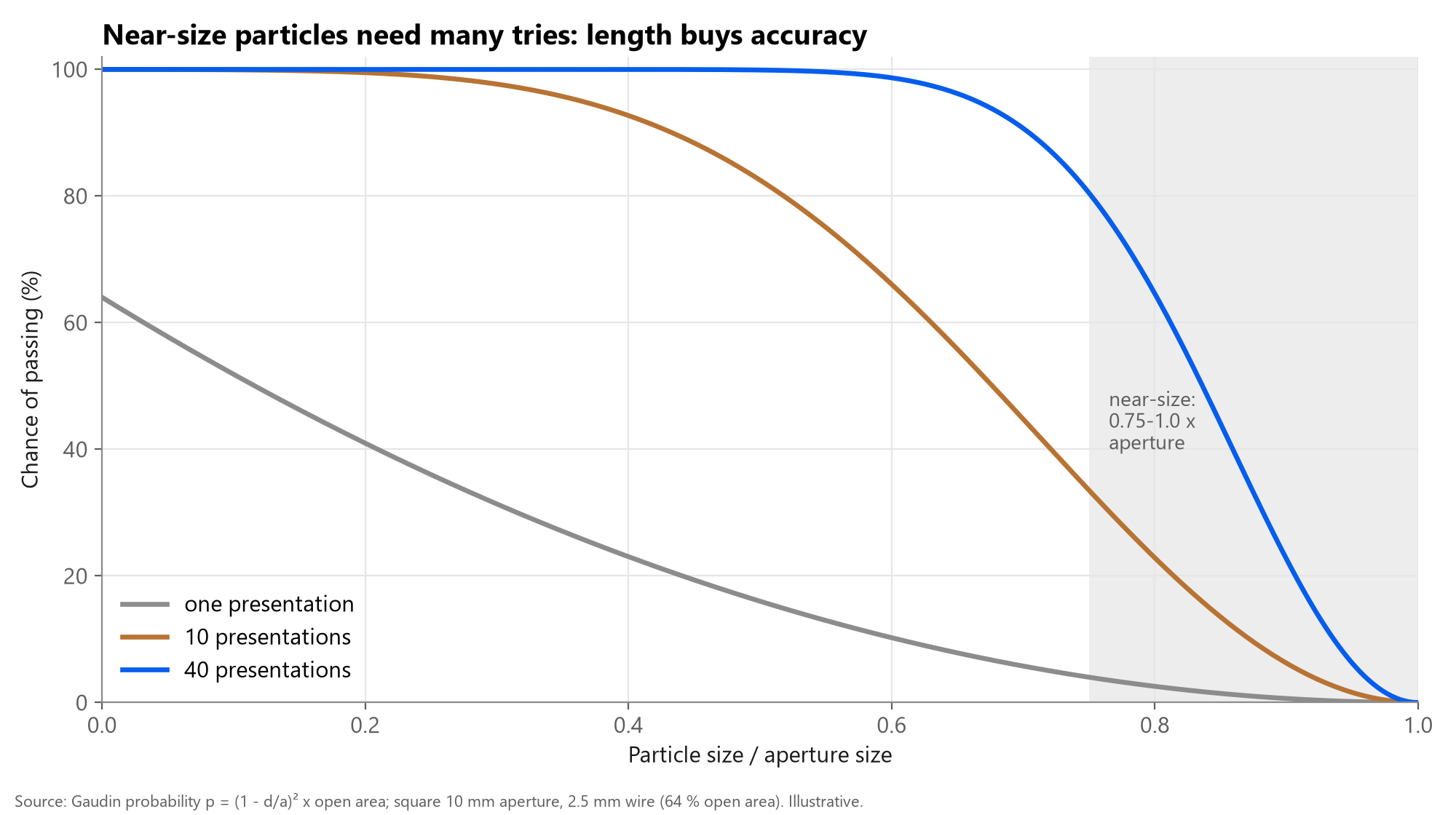
Gaudin's model gives the chance that a particle of size d passes a square opening of size a with wire diameter w in one presentation: p = ((a - d)/(a + w))², which is the open area times (1 - d/a)². A particle half the aperture size has a 16 % chance per try on a 64 % open-area deck; a particle at 0.9 x aperture has under 1 %.
After n presentations the chance of passing is 1 - (1 - p)^n. Fine particles pass almost immediately; near-size particles (0.75-1.0 x aperture) need tens of presentations. They limit both capacity and efficiency, and they are also the particles that peg the openings.
Screen efficiency: how to measure it
There is no universally accepted definition. Two recoveries are used: undersize efficiency, the fraction of the feed's undersize that ends up in the undersize product; and oversize efficiency, the fraction of the feed's oversize that ends up in the oversize product. Their product gives an overall efficiency. Because very little oversize leaks through an intact deck, undersize efficiency is usually the number that matters.
A quick plant check: efficiency is about 100 minus the percentage of true undersize in the oversize product. Values around 90-95 % are achievable on well-run screens (a 2024 IMPC study measured 91-92 % on a dry high-frequency screen); a damaged deck shows up as oversize in the fines product instead.
What changes capacity and accuracy
| Factor | Effect | Source |
|---|---|---|
| More half-size in feed | Increases capacity | 911 Metallurgist |
| More oversize in feed | Reduces capacity | 911 Metallurgist |
| Wet screening (sprays) | Increases capacity at fine cuts | 911 Metallurgist |
| Slotted openings | Increases capacity | 911 Metallurgist |
| More open area (finer wire) | Increases capacity and efficiency; shorter media life | 911 Metallurgist |
| Moisture in dry screening | Reduces capacity and efficiency (blinding) | 911 Metallurgist |
| Elongated particles | Reduces capacity and efficiency | 911 Metallurgist |
| Near-size material | Reduces capacity and efficiency; causes pegging | 911 Metallurgist |
| Bed depth at discharge | Keep 1-4 x aperture | 911 Metallurgist; Meka |
Screens in grinding circuits
Fine wet screens (for example multi-deck stack sizers, down to about 100 µm) can replace cyclones to close ball mills. Because a screen separates by size rather than mass, dense minerals are not recycled to the mill simply for being heavy, and fines are not dragged to the underflow with the water. Published examples report circulating loads falling from cyclone-typical levels near 350 % and capacity gains; at Minera Saucito, replacing cyclones with screens gave about 20 % more grinding throughput and galena recovery rose from 82 % to 88 % (UQ/Newcrest summary).
The trade-off is screen area, media wear and maintenance; Jankovic and Valery (MetPlant 2013) compare the two options on equipment size and economics. This links to R-027 on circulating load.
Instrumentation and control angle
Screens are mostly run open loop: the operator sets feed rate and the media does the rest. Useful measurements are feed rate (belt scale), oversize and undersize rates, and product size on the belt. A camera-based size analyser on the screen undersize or oversize belt, such as the Aeterna Rock Analyzer, shows torn panels (oversize in the fines) and blinding (fines in the oversize) within minutes instead of at the next sample. Tie-in should stay light for this fundamentals piece.
Common misconceptions
- 'A longer stroke always screens better.' For fine openings it throws fines over the bed.
- 'Wider screens are more accurate.' Width adds capacity; length adds accuracy.
- 'Efficiency is the % of feed that passes.' It is the % of the feed's undersize that passes.
- 'Pegging means the media is wrong.' It usually means a lot of near-size material; panel choice can help, but the feed matters.
Where sources disagree or are uncertain
- The g-force constant appears as 1.79 and 1.80 million (and other forms); the difference is under 1 %.
- Manufacturer basic-capacity tables differ and can be optimistic; VSMA incline and deck factors were not found in open sources.
- Efficiency targets of 90-95 % are commonly quoted but not standardised; definitions differ between Taggart, Tyler and Wills.
- Screen-vs-cyclone gains (Saucito, stack sizer cases) are site-specific and partly vendor reported.
Talk to us about measuring size on your screen product belts.
Talk to an engineerSources
- Principles of Screening and Sizing (stroke, speed and slope table; bed depth; application factors), 911 Metallurgist
- Screen Capacity (VSMA-style method), 911 Metallurgist
- Vibrating screen capacity calculations, Meka
- G-factor reference and amplitude discussions, Bulk-Online forum (screen engineers)
- Common formulas: classifier and screen efficiency, 911 Metallurgist
- Determination of Industrial Screening Efficiency, AIME / OneMine, 1975
- High-frequency screen efficiency tests, IMPC 2024 Proceedings, SME, 2024
- Poor classification costing the minerals industry significant revenue (Saucito screens case), University of Queensland SMI, 2020
- Energy efficient ball mill circuit - equipment sizing considerations, Jankovic & Valery, AusIMM MetPlant, 2013