
Screen Panel Wear and Blinding: Inspection Routines
Keep the cut honest: read the deck, measure the apertures, fix the root cause
Background - three ways a screen deck loses its edge
Screens decide what goes back for more breakage and what moves on, so the condition of the screening surface sets the size of everything downstream. A deck can lose performance in three distinct ways, and the fix for one can make another worse.
Blinding is a moisture problem. Damp fines and clays stick to the media, bridge the apertures and build a continuous crust; stratification stops, the bed thickens and fines ride over into the oversize. Very fine dry dust can also blind steel wire through electrostatic charging (Haver & Boecker).
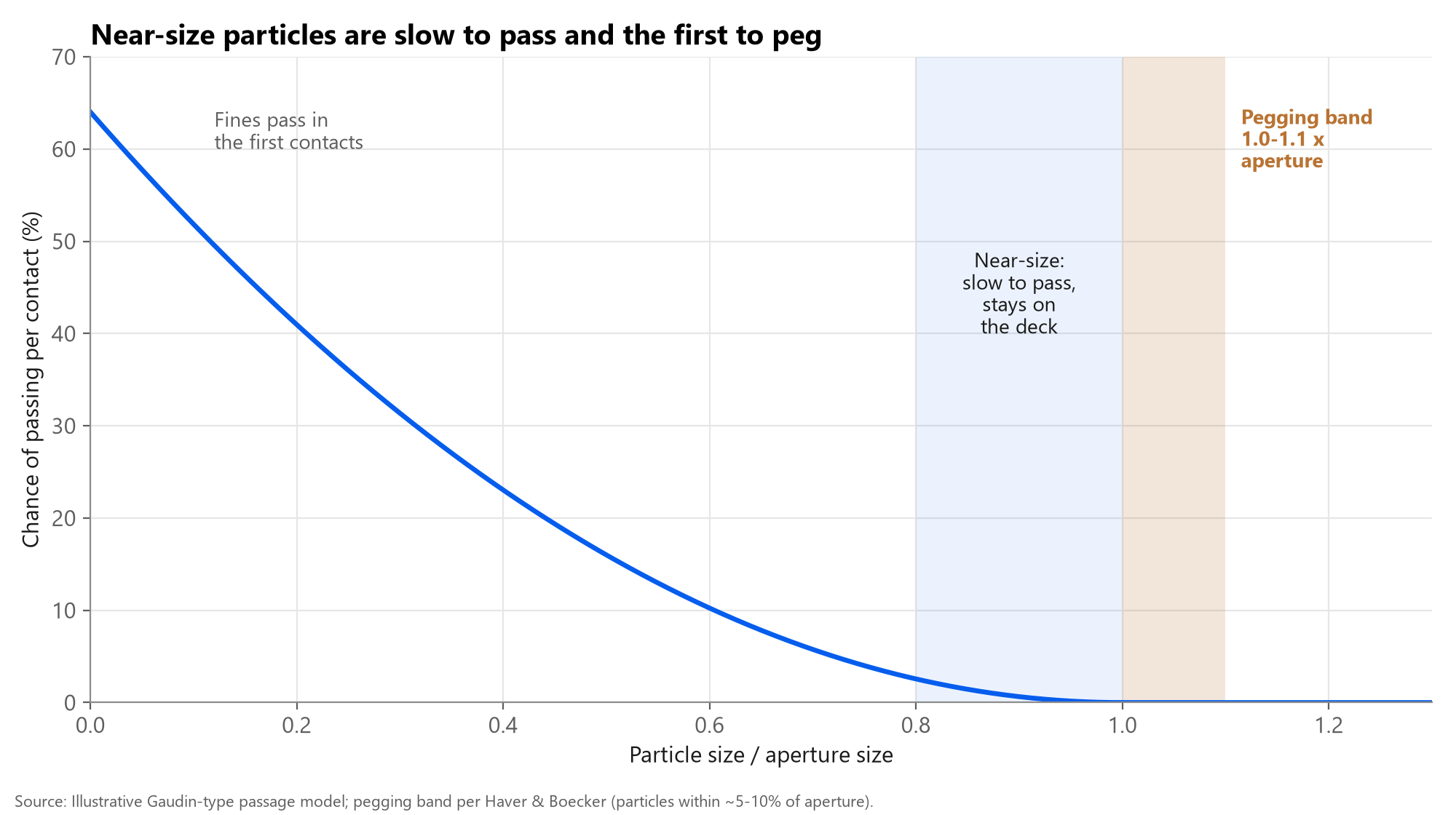
Pegging is a geometry problem. Hard particles just larger than the opening are driven into the apertures and wedge there, leaving a surface studded with rock. Elongated, angular and cubical particles are the worst offenders, and the risk rises steeply when much of the feed lies within about 5-10% of the aperture size (Haver & Boecker).
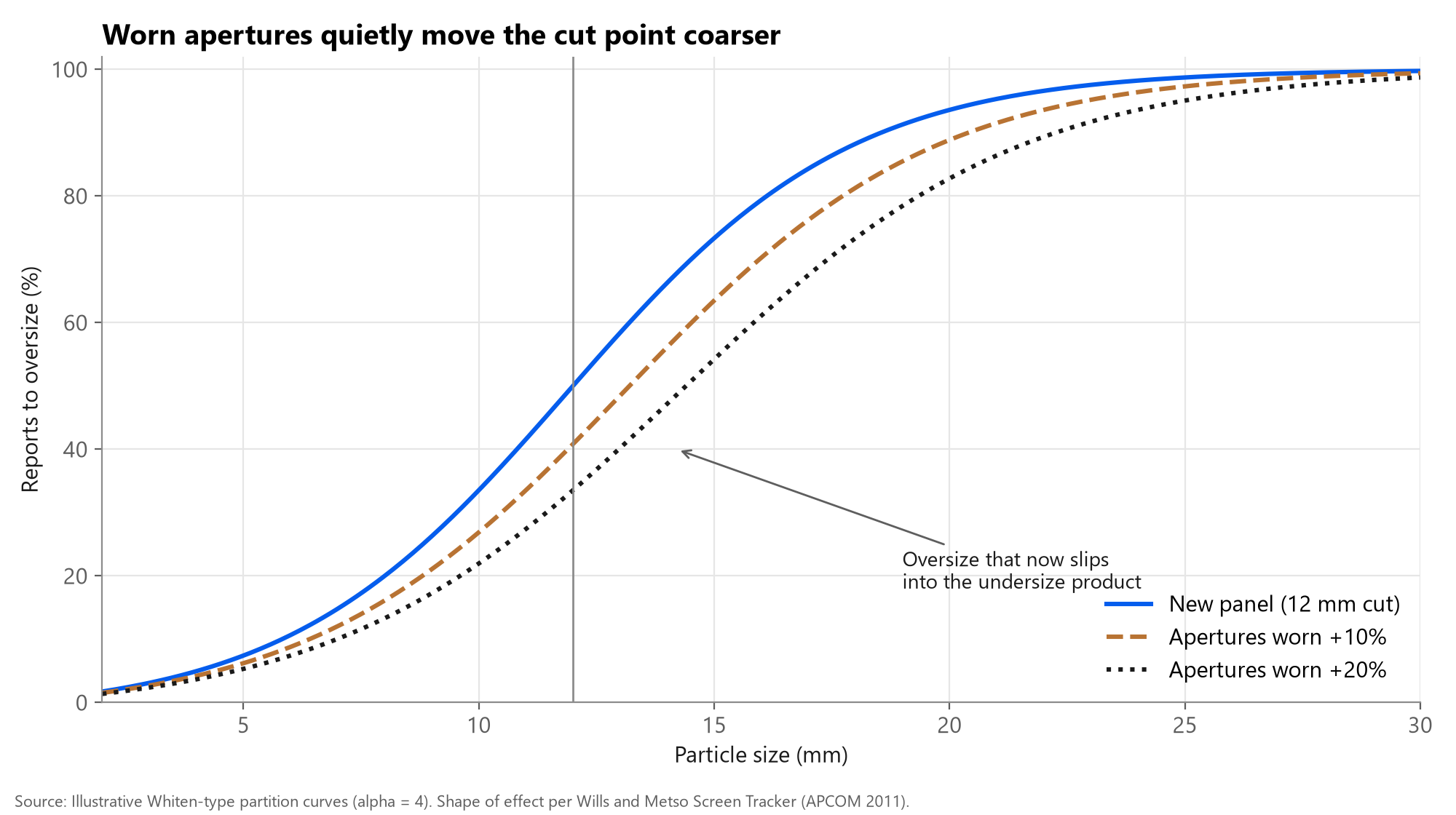
Wear is a time problem. Abrasion opens the apertures, the effective cut moves coarser and oversize begins to report to the undersize product. Unlike blinding and pegging, it does not announce itself on the deck; it shows up downstream.
How wear and blinding change the separation
Worn apertures shift the partition curve to coarser sizes. Even a 10% growth in opening moves the cut by a similar proportion and lets a tail of oversize into the undersize product. Classic screening texts note that undersize grows coarser as media wears, which is why test sieves and plant screens should be compared at a similar state of wear (Wills; 1924 AIME milling discussion).
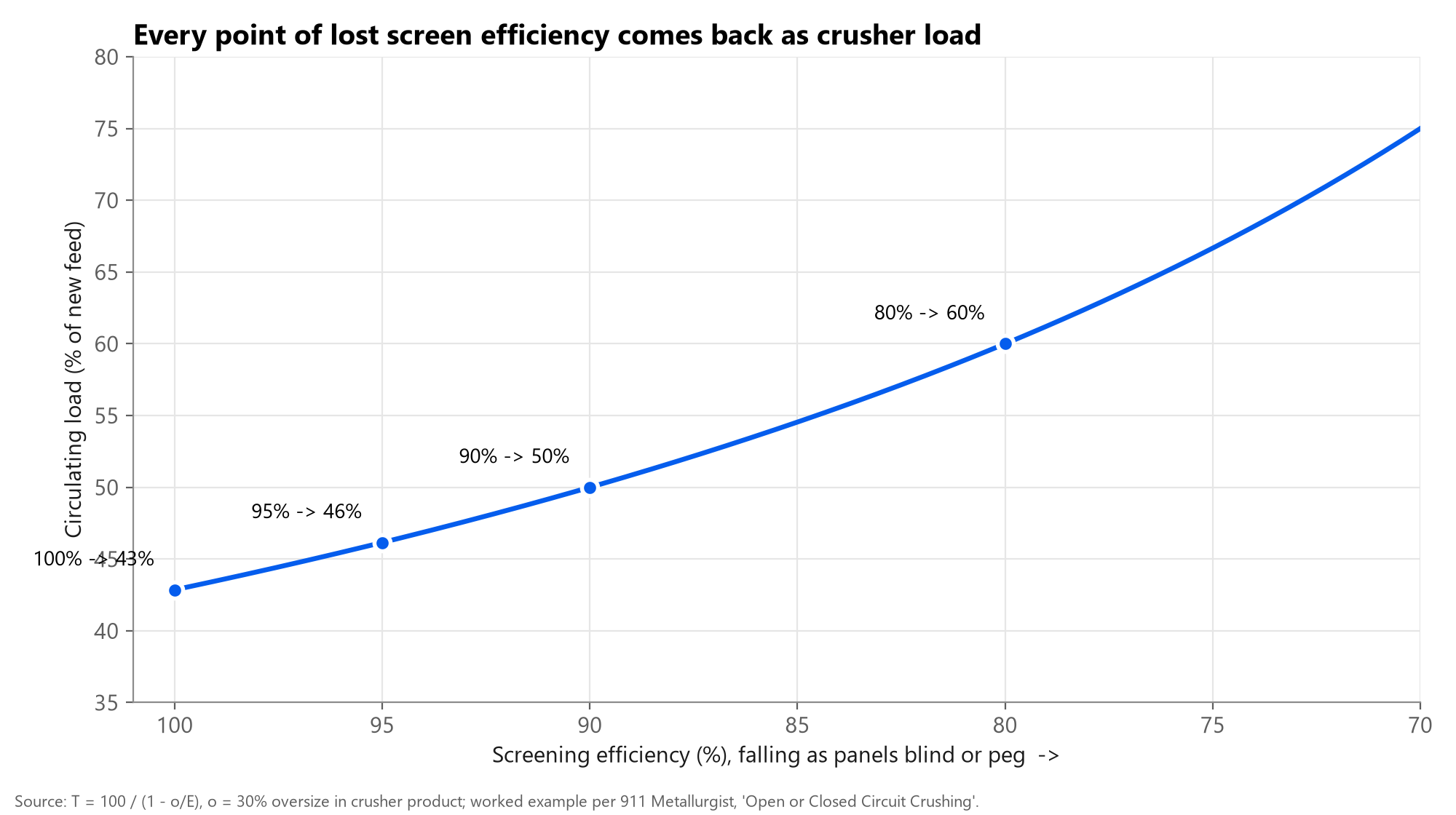
Blinding and pegging do the opposite: lost open area means fines cannot pass fast enough, so they stay on the deck and report to the oversize. In a closed crushing circuit that material comes straight back to the crusher. Using the classic relation T = 100 / (1 - o/E), with 30% oversize in the crusher product, circulating load is ~43% of new feed at 100% efficiency, ~46% at 95%, ~50% at 90% and ~60% at 80%.
For SAG mill trommels and discharge screens the downstream cost is in the grinding circuit: an opening that is too large, or worn too far, sends coarse rock to the ball mill, where it can bury the charge, and to the cyclone feed pumps. One practical guideline is that no rock larger than about 16 mm should reach the ball mill (911 Metallurgist).
Lost efficiency returns as circulating load
The circulating-load relation makes the cost of a blinded or pegged deck visible in the units a crushing supervisor already uses. Most of the lost capacity is hidden: the crusher still runs, but a growing share of its work is re-crushing material that should have passed the screen the first time.
Key numbers and rules of thumb
| Item | Typical value / practice | Source |
|---|---|---|
| Pegging-prone particle size | ~1.0-1.1 x aperture; feeds rich in particles within 5-10% of the opening peg far more | Haver & Boecker |
| Aperture selection | Slightly larger than the target cut, to limit pegging of near-size material | Wills; screening texts |
| Large vs small apertures | Above ~30 x 30 mm: blank areas over cross-beams and pattern changes; below: flexibility, thinner media, self-cleaning designs | Metso (2024) |
| Blinding vs media softness | Softer, thinner, more flexible media blinds less but wears faster under heavy load; balance hardness and support | Metso (2024) |
| Spray water (wet screening) | ~3-5 US gpm per st/h feed (~0.7-1.1 m3/h per t/h); ~1/3 at feed box, ~2/3 on spray bars; measure pressure at the bar | Polydeck (Caruana, 2020) - secondary summary, verify |
| Spray nozzle pressure | Polyurethane flood / spray nozzles rated to ~4 bar; set flow from the maker's flow-pressure chart | Tema Isenmann / Multotec nozzle data |
| Efficiency vs circulating load | 100% -> ~43%, 95% -> ~46%, 90% -> ~50%, 80% -> ~60% of new feed (30% oversize) | 911 Metallurgist worked example |
| SAG trommel / ball mill protection | Openings ~12.7 mm max; no rock > ~16 mm to the ball mill | 911 Metallurgist |
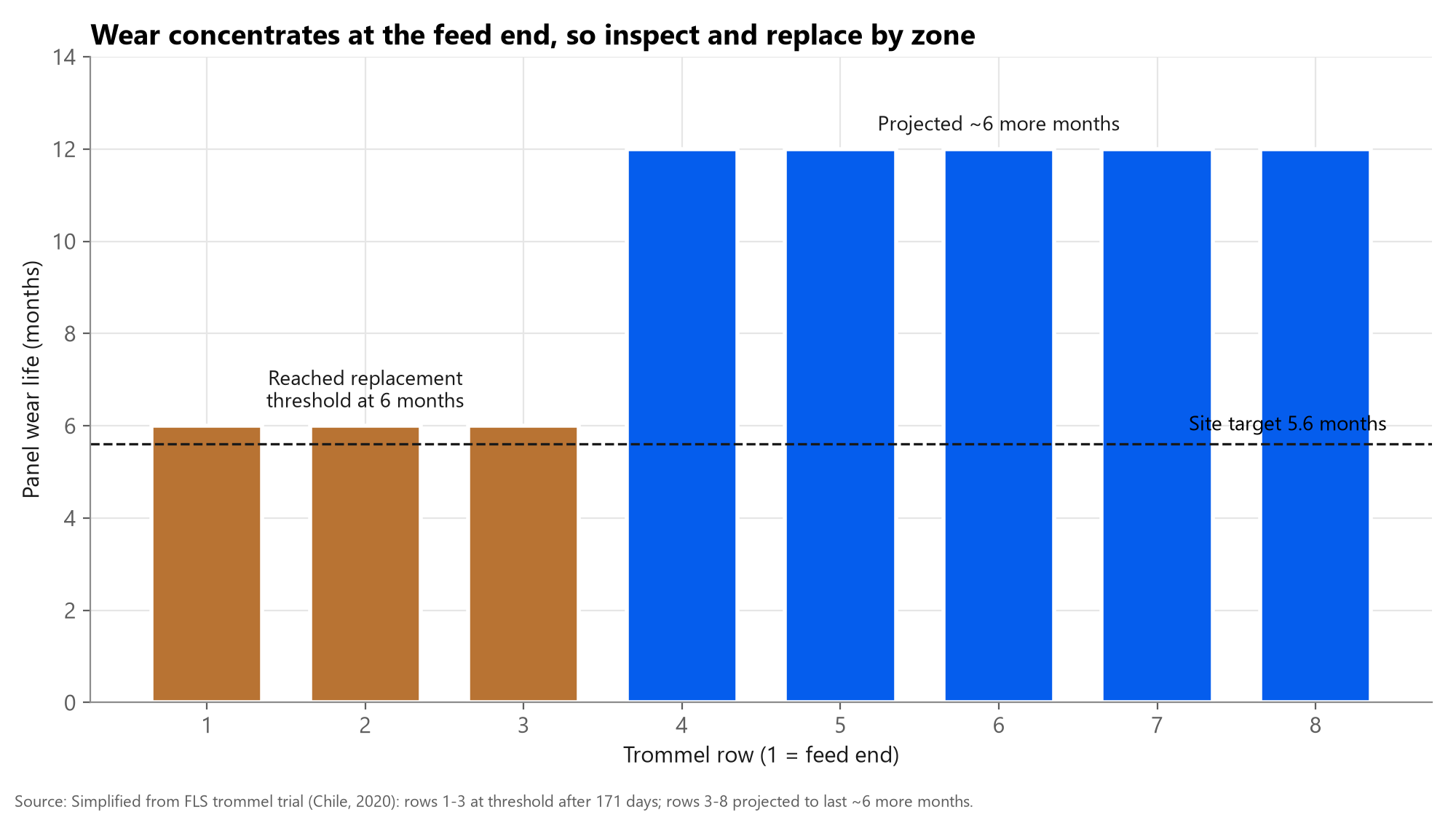
| Wear distribution | Fastest wear at the feed end; FLS trommel trial: rows 1-3 at threshold after 171 d, rows 3-8 with ~6 months left | FLS (2023) |
| Replacement threshold | No universal %; set from the size the downstream process tolerates and the panel's wear allowance | Metso patent US8330610; this brief |
Panel materials - match the media to the duty
There is no universally best screen panel. Polyurethane typically allows a finer ligament (more open area) and good resistance to sliding abrasion; rubber is softer and more resilient and handles impact and sticky feeds well; woven wire gives the most open area but pegs and blinds more readily because it is stiff (Metso; FLS).
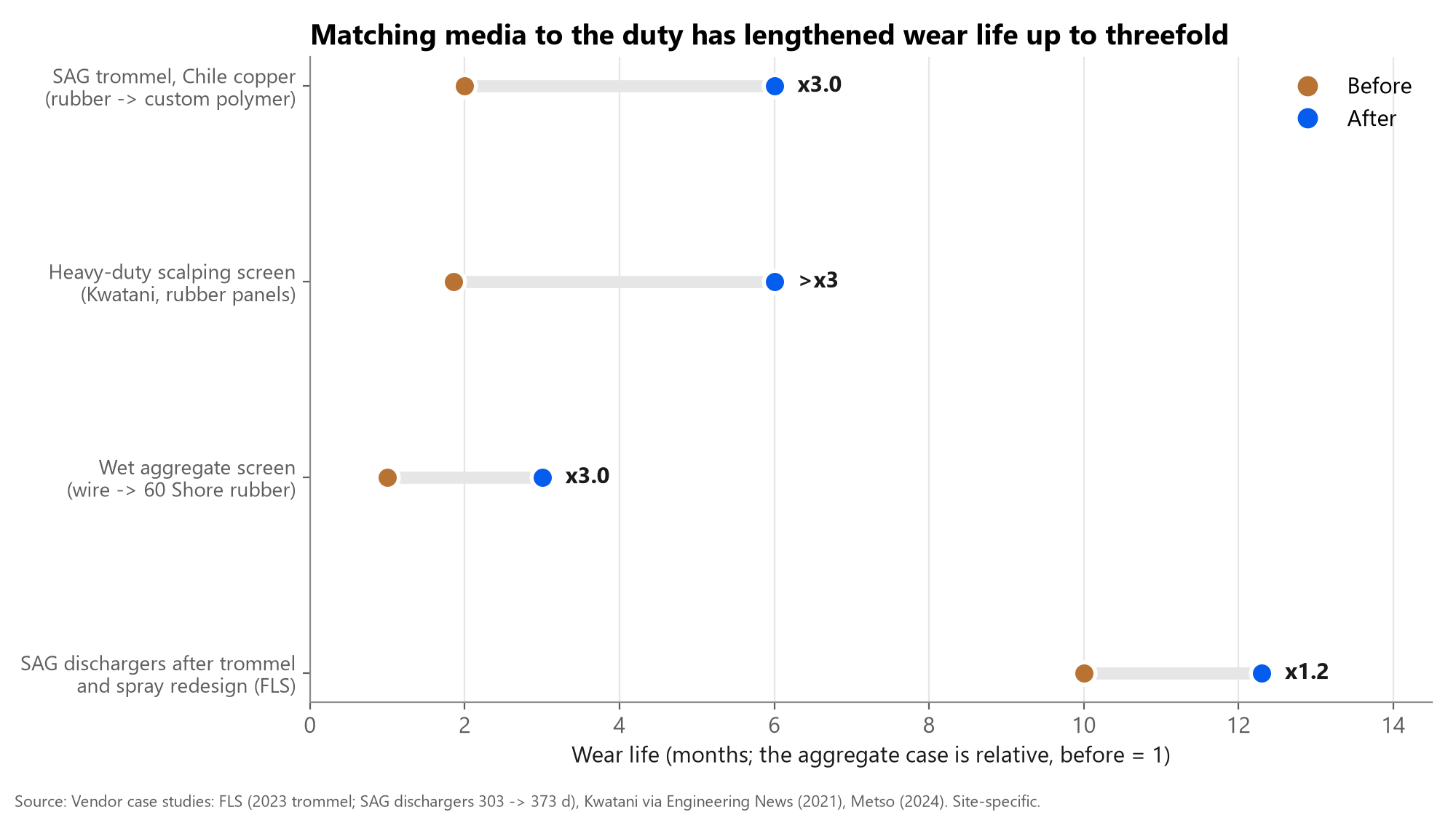
Published trials point both ways. On a SAG mill discharge screen, dimensionally identical polyurethane panels lasted 10-20% longer than rubber, with the gain concentrated at the discharge end (FLS). In heavy-duty scalping, Kwatani found polyurethane apertures too stiff and prone to blinding, and moved to rubber, lengthening panel life from about eight weeks to more than six months. At a Chilean copper SAG trommel, a custom polymer grade replaced rubber that lasted only two months and reached the six-month target (171 days, about 3.7 Mt treated), with less pegging (FLS).
Media hardness has to be balanced against load. Metso describes 'no blinding with a panel that is too soft', but notes that a heavily loaded soft membrane bends, wears and fails early; stiff, strongly supported areas blind instead. In one wet aggregate case, replacing wire mesh with 60 Shore rubber removed pegging and blinding and gave about three times the wear life (Metso).
All the wear-life figures above are vendor case studies at single sites. They show what is possible when media is matched to the duty, not what to expect by default.
Operating practice - an inspection routine that keeps the cut honest
The routine below is a synthesis of supplier guidance and plant practice; frequencies should be tuned to the measured wear rate of each deck.
Every shift (running): walk by, look and listen. A dull thud with a short stroke points to deck loading from blinding; a metallic rattle with a normal stroke points to pegging (Haver & Boecker). Check that every spray nozzle is flowing and the pressure at the spray bar is in range. Glance at the oversize for fines and at the undersize for coarse rock.
Planned stop (weekly or per shutdown cycle, isolated and locked out): inspect the deck by zone - feed, middle, discharge - and photograph the same positions each time. Record pegging, crusting, torn or missing panels, lost fixings and holes. Wear concentrates at the feed end, so plan to replace by zone rather than by deck (FLS).
Measured wear (interval set by wear rate): measure apertures in the fastest-wearing zone with a gauge or an image-based tool and compare with a written replacement threshold. Manual probing can distort elastomer apertures, and visual estimates are subjective, which is why image-based measurement was developed (Metso Screen Tracker, APCOM 2011).
At every change-out: check support profiles, stringers and capping rubber, tension (for tensioned media) and feed distribution across the deck. Metso notes that worn supports, wrong tension and off-centre feeding are frequent root causes that are blamed on the media.
Monthly or on change: take a screen survey - undersize in the oversize (efficiency) and oversize in the undersize (breakthrough) - and trend both. These two numbers tell you which of the failure modes is costing the most.
Fixing blinding and pegging at the root
- Blinding: soften or thin the media where load allows, minimise blank area where it is not protecting structure, add or repair spray water, and look upstream at clay and moisture (Metso; Haver & Boecker).
- Pegging: check how much of the feed is near-size; adjust aperture shape (slots, tapered openings) or size; add blank areas over cross-beams for large apertures; choose more flexible media for small apertures (Metso).
- Spray water: measure pressure at the spray bar, not at the pump, and keep nozzles clear; split water between the feed box and spray bars (Polydeck guidance).
- Stroke and speed: low stroke gives too little acceleration to release trapped particles; confirm the motion before changing media (Haver & Boecker; SPM Instrument corner-orbit monitoring).
- Feed: centre the feed and spread it across the full width so the feed-end panels are not overloaded on one side (Metso).
APC and instrumentation angle
Screen media condition is a maintenance responsibility, but its effects show up in process signals that instruments can watch continuously. An ore-size camera on the screen undersize (or ball mill feed) belt sees coarse breakthrough as apertures wear, giving the maintenance team an early, objective trigger rather than waiting for a ball mill or pump problem. On the oversize or crusher-return belt, a rising fines fraction points to blinding or pegging.
Trending circulating load, crusher power and screen corner motion alongside those size measurements helps separate a screen problem from an ore change. Where a model predictive controller manages the crushing or SAG-pebble circuit, it can hold feed rate and crusher settings against the true size signal while the deck condition drifts, and flag when the drift exceeds what control can absorb.
Aeterna's Rock Analyzer fits here as the size sensor; MPC is relevant where the screen sits in a controlled closed circuit. The tie-in should stay light: the routine itself is people, procedures and the right media.
Common misconceptions
- 'Polyurethane always lasts longer than rubber.' It depends on the duty: trials show polyurethane ahead on some SAG screens and rubber ahead in heavy-impact scalping.
- 'If the deck looks fine, the cut is fine.' Aperture growth is invisible from the walkway; only measurement or downstream sizing reveals it.
- 'Blinding needs harder media.' Usually the opposite: softer, more flexible media sheds fines, at the cost of faster wear.
- 'Replace the whole deck at once.' Wear is strongly zoned; replacing by zone saves panels and downtime.
- 'Media problems are media problems.' Worn supports, wrong tension, uneven feed and blocked sprays are common root causes.
Where sources disagree or are thin
- Spray water rate: the 3-5 US gpm per st/h figure comes from a Polydeck presentation seen only through a secondary summary; one nozzle vendor quotes a figure orders of magnitude lower that appears to be an error. Treat it as a starting point and confirm with the screen supplier.
- Wear-life gains (2-6x) are vendor case studies at single sites, chosen to show success; independent comparisons with matched aperture and open area are rare (the FLS SAG screen trial is one).
- No published universal replacement threshold (e.g. % aperture growth) was found; thresholds are panel- and process-specific.
- The moisture level that triggers blinding (one supplier cites ~5-8% surface moisture) varies strongly with clay content and particle size.
Ask us how continuous size measurement on your screen products can turn deck wear into a planned job rather than a surprise.
Talk to an engineerSources
- Screening media challenges and how to solve them (pegging, blinding, maintenance), Metso, 2024
- Screen media optimisation triples panel wear life (SAG trommel, Chile), FLSmidth, 2023
- Screen deck media - polyurethane case study (SAG mill screen), FLSmidth, n.d.
- NexGen polyurethane screening media - iron ore case study, FLSmidth, 2024
- SAG mill dischargers collaboration case study, FLSmidth, 2024
- Innovative scalping screens triple panel wear life (Kwatani), Engineering News, 2021
- Causes of blinding and pegging in vibrating screen sections, Haver & Boecker Niagara, n.d.
- Screen media aperture size measurement using Metso's Screen Tracker, AusIMM, 35th APCOM Symposium, 2011
- US8330610B2 - System, method and apparatus for detecting wear in a screening arrangement, Google Patents, 2012
- Screening Problems Solved (A. Caruana), Polydeck Screen Corporation, 2020
- Polyurethane flood and spray nozzles, Tema Isenmann, n.d.
- SAG Mill Trommel Screen, 911 Metallurgist, n.d.
- Open or Closed Circuit Crushing, 911 Metallurgist, n.d.
- SPM Instrument launches process optimization for vibrating screens, SPM Instrument, n.d.
- The effect of different aperture shape and material of screen deck on screening efficiency (Davoodi & Evertsson), Chalmers University of Technology, 2018
- Wills' Mineral Processing Technology, 8th ed. (Wills & Finch) - Industrial screening, Butterworth-Heinemann, 2016