
SAG Mill APC: Bearing Pressure, Sound, Power and Circuit Constraints
How a constraint-aware expert system uses bearing pressure, sound and power together - with Rock Analyzer feed-forward and neural-network foreign-object protection
The SAG operating window and its edges
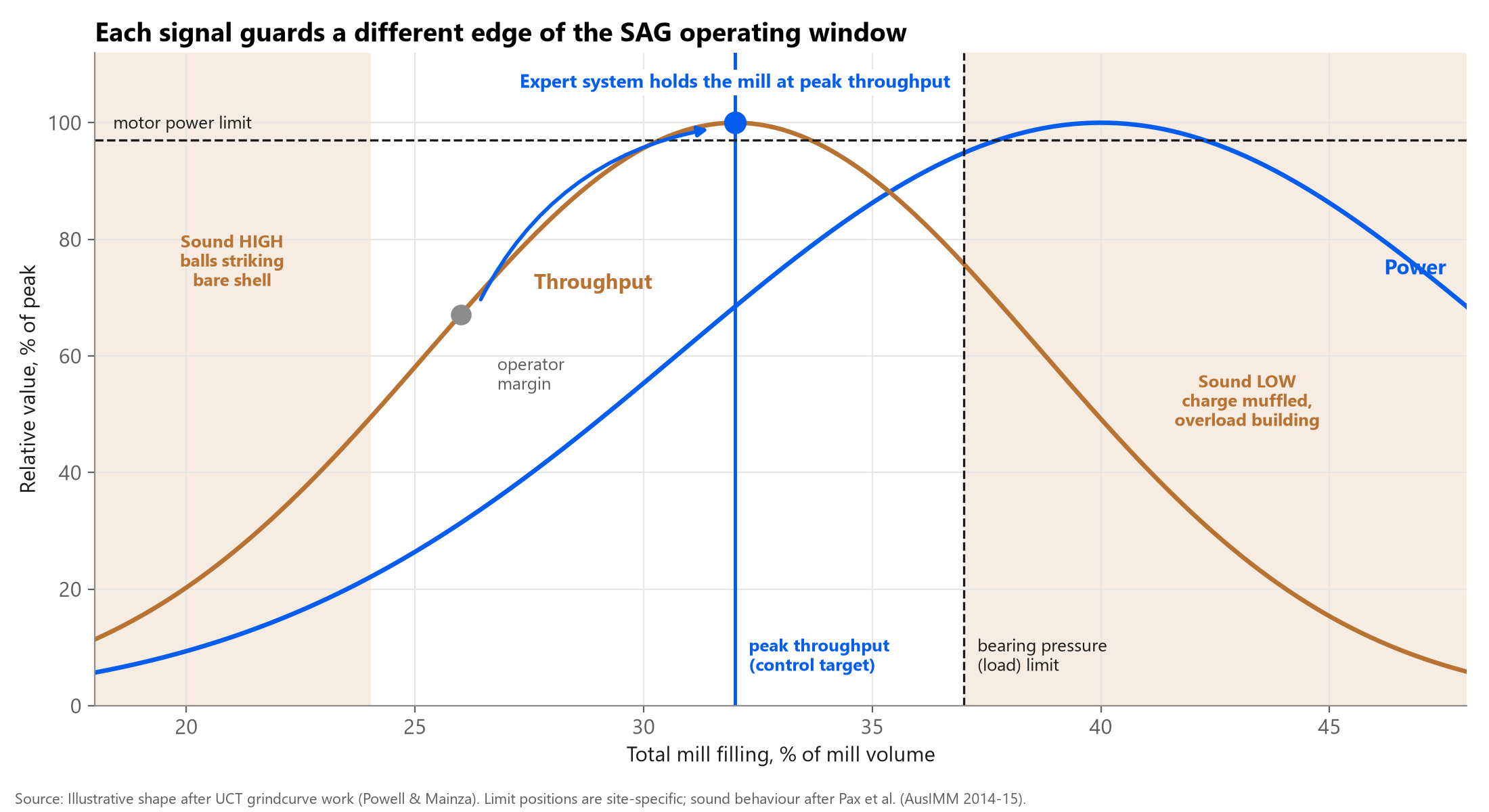
Throughput, power and grind each peak at a different mill filling, and throughput usually peaks before power (UCT grindcurve work). Good SAG operation therefore holds a stable load on the rising side of the power curve. The edges of the window are set by different signals: bearing pressure or load cells at high load, motor power at the top, shell impacts at low filling (balls landing on bare liner) and a muffled, overloading charge at high filling. Behind the mill sit circuit limits: pebble recycle and crusher capacity, sump level, cyclone pressure and product size.
The classic overload signature is load or bearing pressure still rising while power flattens or falls (SAIMM, 1980). By the time power shows it, the mill is already over the peak. That delay is why operators run with a margin.
Three signals, three jobs
- Bearing pressure: weighs the whole mill, so it is the trusted overload constraint. It lags, drifts with temperature and liner wear, and at MMG Century was described as noisy and lacking sensitivity (Pax et al., 2014).
- Motor power: a hard limit on the drive and an energy measure. On its own it cannot tell under-filled from over-filled, because it reads the same on both sides of its peak.
- Sound level and impact position: respond within seconds. High, ringing sound means balls striking bare shell at low fill; low, muffled sound means slurry and rock cushioning an overload. Used as a constraint, sound protects liners at the low side and warns early at the high side.
- Fused, they give total fill Jt and ball fill Jb (Fill Analyzer, see R-037) - the variables the controller actually wants to hold.
How the Aeterna SAG APC works
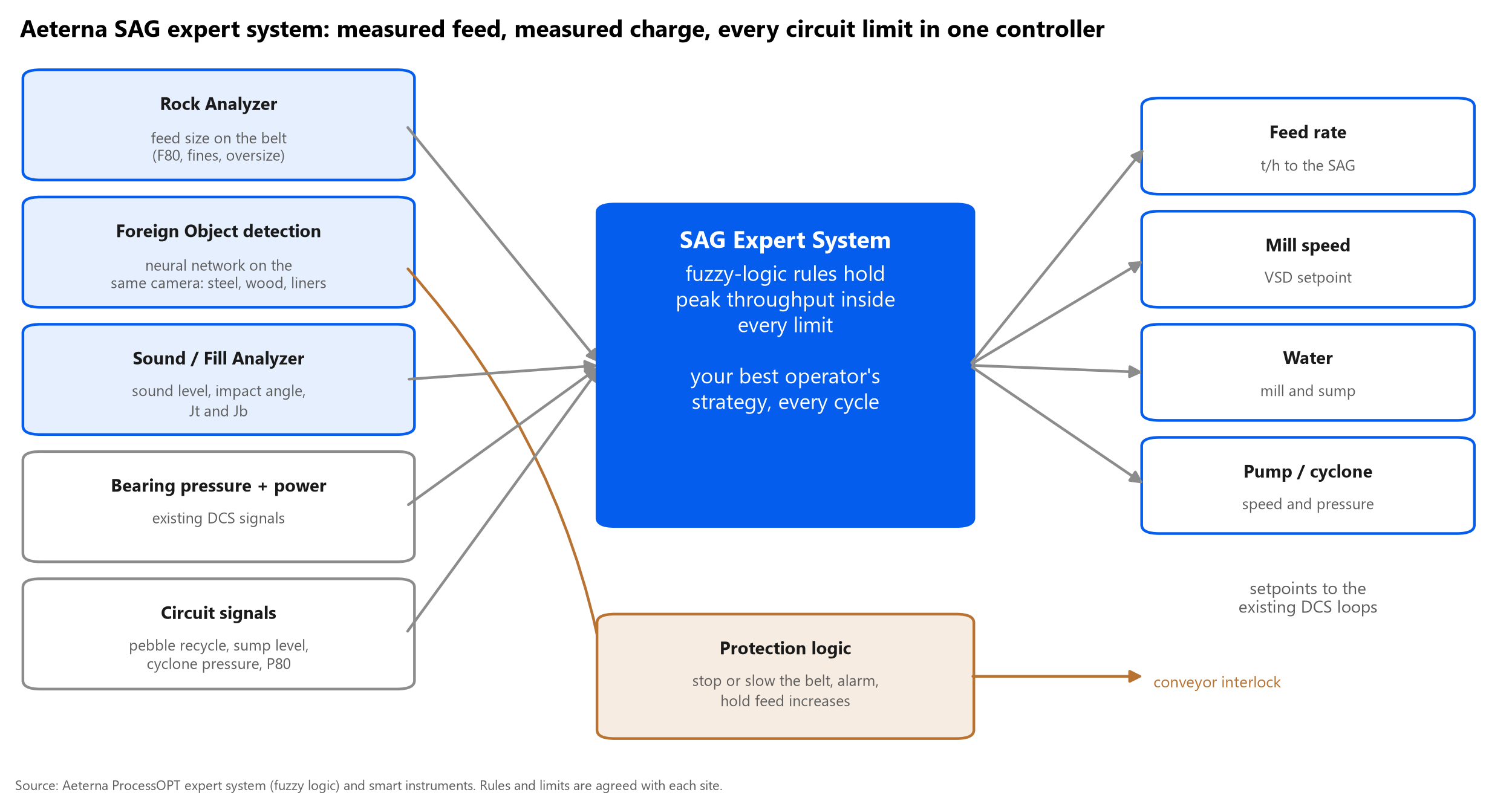
The controller sits above the existing DCS and writes setpoints to its loops. Every cycle the expert system evaluates fuzzy rules written in operator language (for example, if the SAG charge is low and falling, raise feed in a large step) against every signal, and moves to hold peak throughput inside every constraint. Manipulated variables are feed rate, mill speed, mill and sump water, cyclone feed pump speed and cyclone pressure. Controlled variables and constraints include mill load (held at peak throughput, inside its limit), motor power (never breached), sound and impact limits, product P80, sump level and pebble recycle.
Because one rule set coordinates the moves, the loops stop fighting: raising feed to chase tonnes no longer pulls the load loop against it, and adding water to manage density no longer upsets the sump and cyclone through separate PID loops. This is the practical difference between a coordinated expert system and stacked PID loops. Where a dynamic model pays, ProcessOpt also offers MPC on the same platform.
A healthy base layer comes first - tuned feed-rate, water and speed loops and trusted weightometers - as the Mipac SAG guide and the Raglan experience both stress.
Why tighter control means more ore
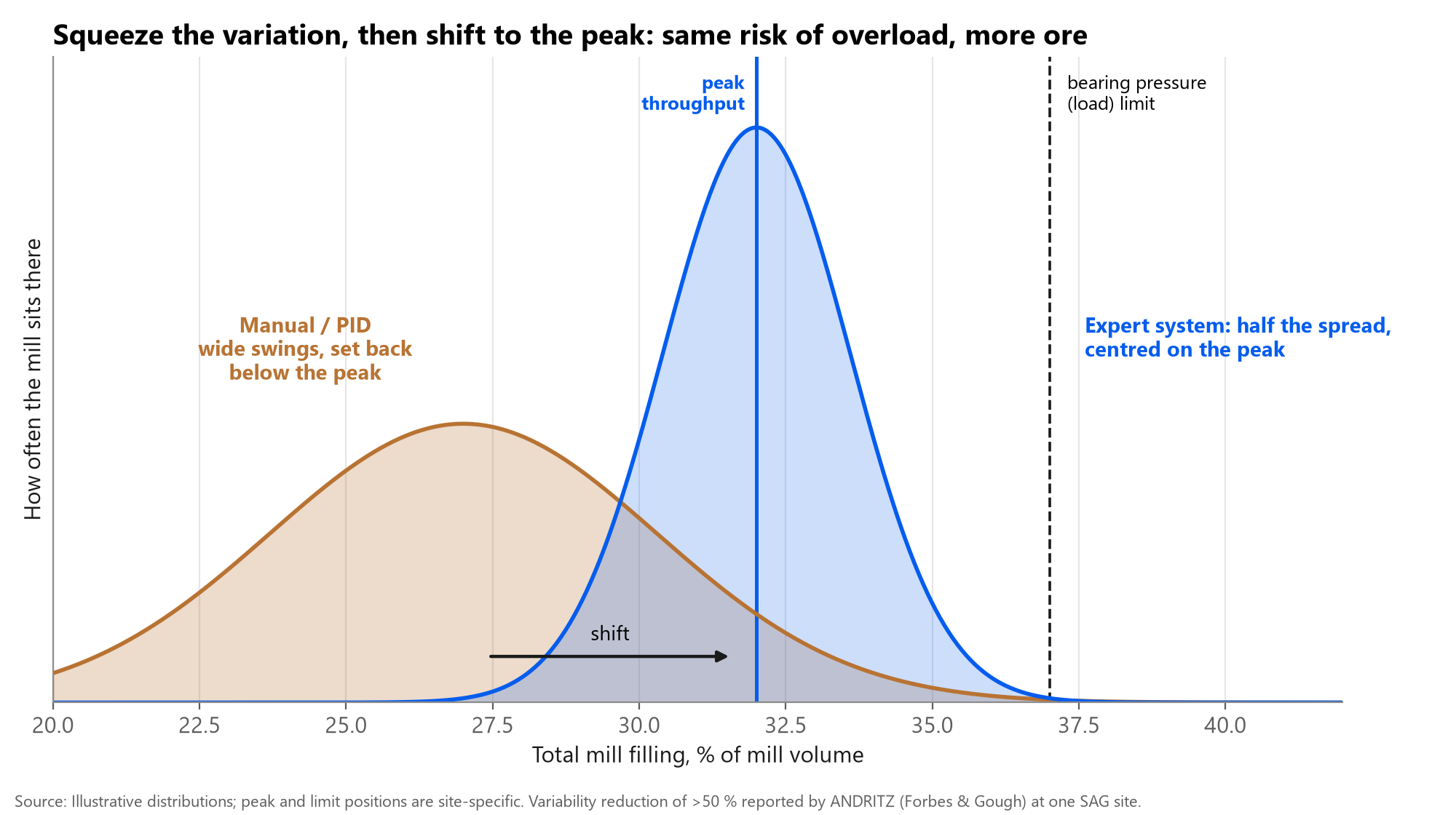
The gain from advanced control comes from 'squeeze and shift'. Lower variability in the load lets the average move up to peak throughput with the same chance of reaching the bearing pressure limit. ANDRITZ reported more than 50 % lower variability in feed, power and noise at one site, and ~1.5-2 % throughput for MPC over existing expert systems at three; a fuzzy expert supervisor at Sungun reported ~1.8 %. These are the realistic numbers to quote.
Circuit constraints
| Signal / limit | What it protects | Typical role in the expert system | Watch out for |
|---|---|---|---|
| Bearing pressure (or load cells) | Mill structure; overload | Upper constraint on load; slow but trusted | Drifts with liner wear and temperature; lags |
| Sound level / impact angle | Liners and balls (low load); overload (muffled) | Fast lower and upper guard on charge motion | Calibration, mic position, background noise |
| Motor power | Motor and drive | Hard upper constraint; never breached | Two-sided: same kW either side of the peak |
| Total fill Jt (Fill Analyzer) | Productive filling window | Controlled variable held near its optimum | Needs geometry, liner wear, calibration |
| Pebble recycle load | Pebble crusher and SAG choking | Upper constraint; ore hardness signal | Crusher availability |
| Sump level, cyclone pressure | Pumps and classification | Kept in band | Pump wear, cyclone roping |
| Product P80 | Downstream recovery | Upper constraint on grind | Analyzer or soft-sensor quality |
Rock Analyzer: feed size into the model
Feed size is the largest disturbance most SAG mills see (Cadia: F80 92 to 70 mm gave 10-15 % throughput; see R-036). The Rock Analyzer segments rocks on the SAG feed belt every few seconds and reports F80, F50, top size and fines.
How to use it matters. At Freeport, a feed-size analyzer was justified on feed-forward throughput control; after commissioning, analysis showed simple feed-forward would not succeed, and the value came from feeding a model-based estimator of ore parameters and work index instead. At Cannington, vision measurements were built into an expert system with a dynamic mill model. Aeterna follows the same lesson: feed size updates the breakage model and the controller's ore estimates, rather than driving feed rate directly.
Foreign object detection with a neural network
Steel - digger teeth, drill rods, liner bolts and plates - and timber reach the SAG feed and pebble crusher belts at every mine. Metal detectors and magnets catch much of it; non-magnetic steel, wood and large plastics are harder. Damage costs are high: vendor-reported examples put a belt rip at US$12-80k and crusher repairs at 8-48 hours of downtime (vendor figures, not independently verified).
Object detectors trained for conveyors (YOLO family) now run at video rate on edge hardware: ~74 frames a second for an edge-tuned YOLOv8, ~97 % mean accuracy for a YOLOv5 model on a Jetson Xavier NX, and ~91 % mAP on a molybdenum-mine belt, all on the authors' test sets. The Rock Analyzer camera can run a multi-class model alongside sizing, so one camera both sizes the feed and flags foreign objects.
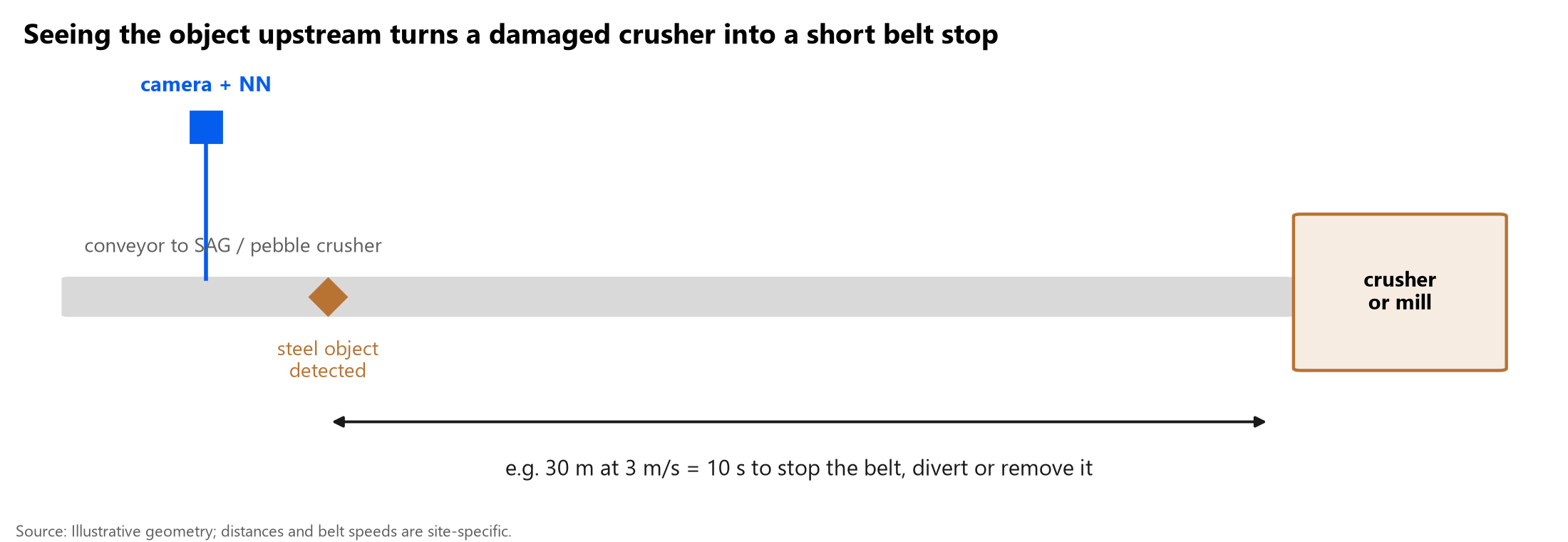
Placement buys time: a camera 30 m upstream on a 3 m/s belt gives about 10 seconds to stop, divert or remove the object. The protection logic acts on the conveyor interlock and holds feed increases while the belt is stopped, so control and protection do not fight.
Estimated return on investment
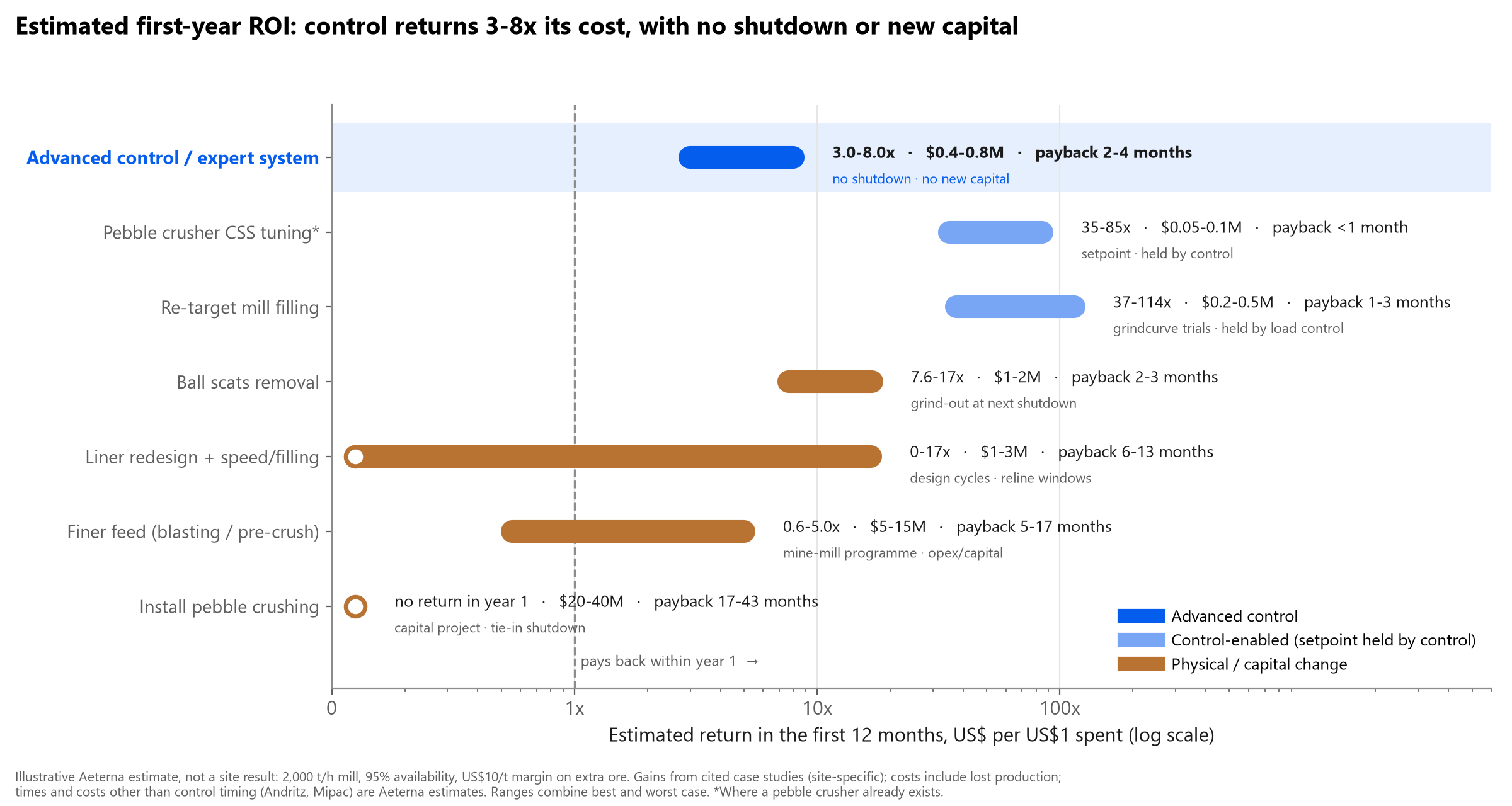
On a reference mill (2,000 t/h, 95 % availability, US$10/t margin) control returns roughly 3-8x its cost in the first year and pays back in 2-4 months with no shutdown or new capital. Setpoint changes that control holds in place - mill filling, pebble crusher setting - return the most; large physical projects give bigger steps but pay back over 6-43 months. These are illustrative Aeterna estimates using the gains cited in R-036, not site results.
| Lever | Reported gain | Est. cost (incl. lost production) | Time to value | Payback | Year-1 return per $1 |
|---|---|---|---|---|---|
| Advanced control / MPC | 1.5-2 % | $0.4-0.8M | 1-2 weeks | 2-4 months | 3.0-8.0x |
| Pebble crusher CSS tuning* | 2.2-2.6 % | $0.05-0.1M | 1-2 weeks | <1 month | 35-85x |
| Re-target mill filling | 15 % | $0.2-0.5M | 1-3 months | 1-3 months | 37-114x |
| Ball scats removal | 11 % | $1-2M | 1-2 months | 2-3 months | 7.6-17x |
| Liner redesign + speed/filling | 19-20 % | $1-3M | 6-12 months | 6-13 months | 0-17x |
| Finer feed (blasting / pre-crush) | 10-20 % | $5-15M | 3-6 months | 5-17 months | 0.6-5.0x |
| Install pebble crushing | 15-30 % | $20-40M | 12-24 months | 17-43 months | none in year 1 |
Common misconceptions
- 'Advanced control replaces the operator.' The expert system encodes the operators' own strategy and holds the window so operators can manage the plant; their limits and judgement set the constraints.
- 'Maximise power to maximise tonnes.' Throughput usually peaks before power; chasing power invites overload.
- 'Feed-size cameras pay through feed-forward.' Evidence is mixed; they pay most when they keep the model's ore parameters current.
- 'A metal detector is enough.' It misses non-magnetic steel and wood; vision adds a second layer.
Uncertainties and limits
- Throughput gains from advanced control are vendor-reported (ANDRITZ, MPC) or single-site (Sungun, fuzzy expert system); we quote 1.5-2 %, and Aeterna's own published range (+1-3 %) should be presented as a range until site cases are published.
- Foreign-object accuracies come from coal and metal-mine research datasets; site performance depends on lighting, belt speed and training data.
- Crusher and belt damage costs are vendor figures from quarry and cement plants; treat them as indicative.
- Freeport's experience shows feed-size feed-forward can disappoint; set expectations accordingly.
Want to see how close your SAG mill can run to its limits? Ask us about a grinding circuit review.
Talk to an engineerSources
- Model predictive control of SAG mills and flotation circuits, M.G. Forbes & W.A. Gough, ANDRITZ Automation
- SAG mill optimization using model predictive control, W.A. Gough, ANDRITZ
- A practical guide to SAG Mill Management, Mipac, 2025
- Evolution of SAG mill process control at the Xstrata Nickel Raglan plant, WipWare (paper)
- The control of autogenous and semi-autogenous mills, Journal of the SAIMM, vol. 80 no. 11, 1980
- AG & SAG mill grinding circuit automatic control, 911 Metallurgist
- Implementation of acoustic arrays for SAG mill operation, Pax et al. - 12th Mill Operators' Conference (AusIMM), 2014
- Milling curves as a tool for characterising SAG mill performance, Powell, Mainza et al. (UCT)
- Supervisory fuzzy expert controller for SAG mill grinding circuits: Sungun, ResearchGate
- Application of the Split-Online SAG feed size analyzer at P.T. Freeport Indonesia, OneMine
- An integrated expert and vision system at BHP Billiton Cannington, OneMine
- Optimisation of the Cadia Hill SAG mill circuit, SMC Testing
- A faster and lighter detection method for foreign objects in coal mine belt conveyors, Sensors (PMC10383480), 2023
- Foreign object detection of coal mine conveyor belt based on improved YOLOv8, Gong-kuang zidonghua, 2024
- Conveyor foreign object detection on Jetson Xavier NX (YOLOv5), LAPSE 2024.0014, 2024
- Anchor-free foreign object detector for molybdenum mine belts, Applied Sciences (DOAJ), 2024
- How choosing the right equipment can save uptime (Magnesita / Eriez), Pit & Quarry
- AI vision foreign object detection on cement plant conveyors, Oxmaint (vendor blog)
- Real-time estimation of SAG mill charge characteristics, Toor, Valery, Morrell, Duffy (Hatch) - SAG 2023, 2023
- Model Predictive Control; Rock Analyzer (product pages), Aeterna Automation, 2026