
ProcessOpt tutorial: Plitt Hydrocyclone Model
Configure a hydrocyclone cluster with the Plitt model - step by step in ProcessOpt
1 Fundamental
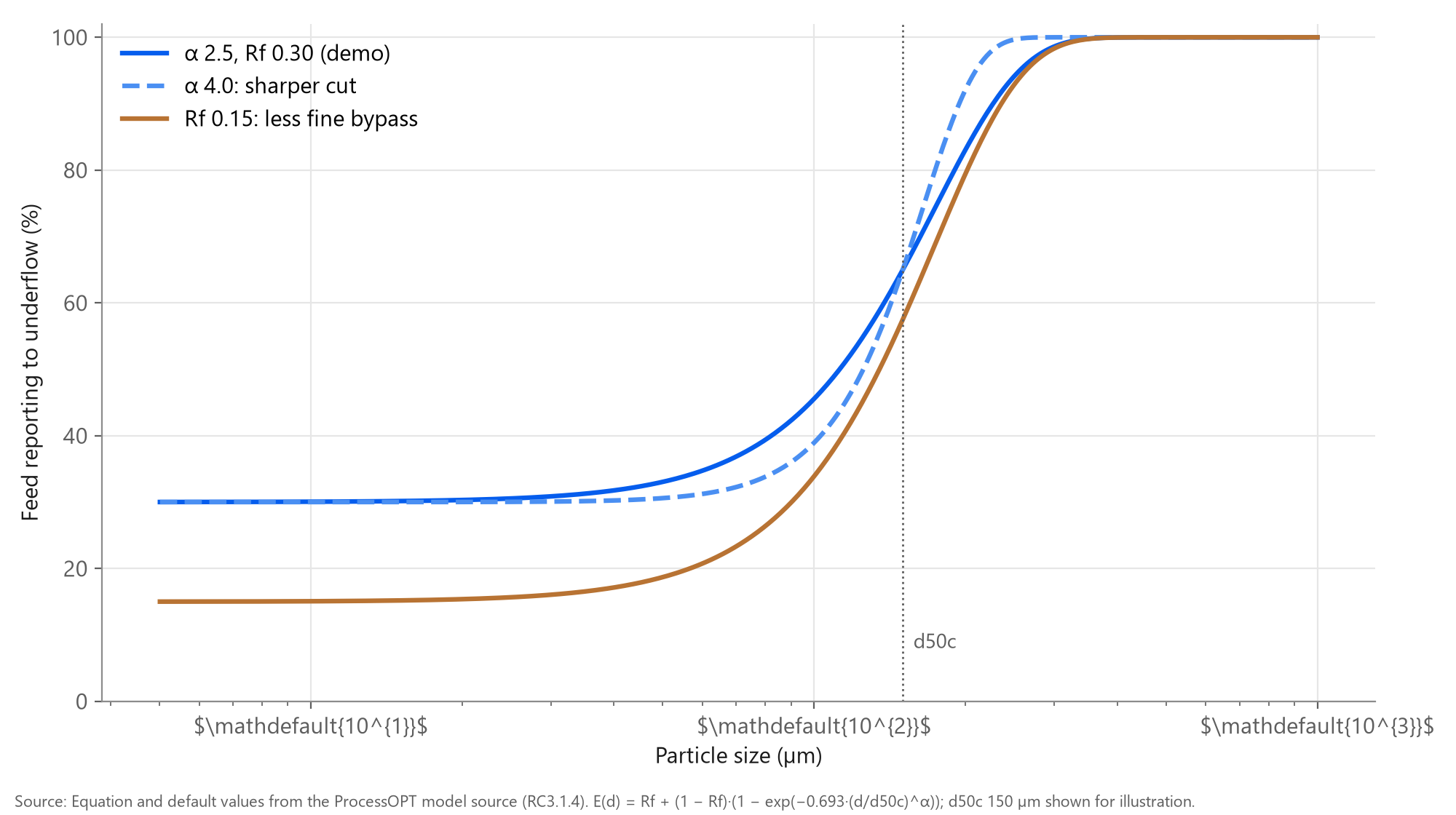
Every size has a probability of reporting to the underflow; Plitt's correlation sets where the cut falls.
The partition curve: cut size, sharpness and bypass
E(d) = Rf + (1 − Rf)·(1 − exp(−0.693·(d/d50c)^α)). The geometry fields feed Plitt's d50c correlation, so changing the spigot or vortex finder in the model moves the cut the way it would on the plant.
2 Objective
A cyclone cluster model that closes the ball mill circuit and responds to pressure, density and cyclones open.
By the end you will have
- A Plitt cyclone node for a whole cluster
- Overflow and underflow t/h, % solids, P80 and d50c as tags
- A partition curve fitted to your survey
- A closed ball mill circuit when combined with the ball mill tutorial
3 Step by step
Every screen below is a real ProcessOpt screenshot.
Step 1 - Add a Simulation node and wire it into the scan
Every model in ProcessOpt runs inside a Simulation node. The node is executed once per scan cycle in the order of the graph, so place it after the logic that writes its inputs and before the logic that reads its outputs.
- Project Configuration > Logic Editor
- Right-click the canvas > add a Simulation node, name it Cyclones
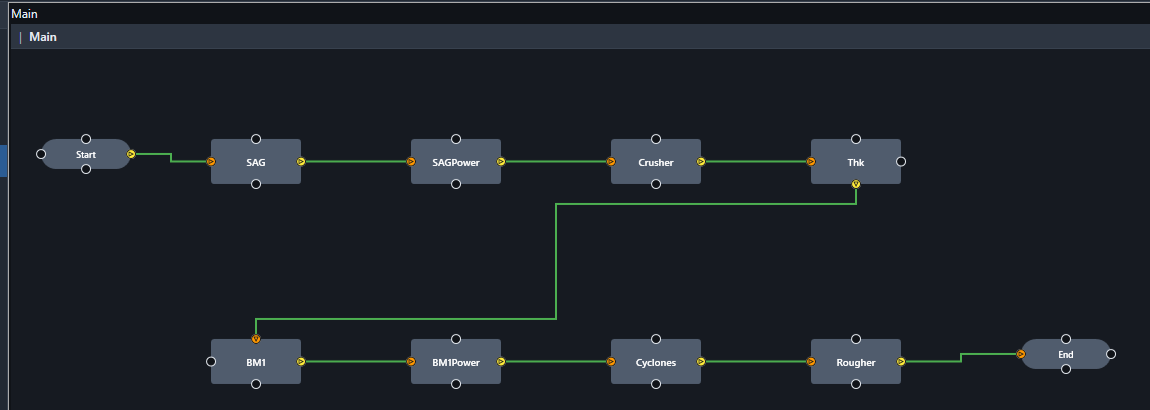
- Connect Start > Cyclones > End so it runs every scan cycle (1 s here)
- One node per unit: the demo project has eight models on one canvas
Step 2 - Choose the model type and name the I/O tags
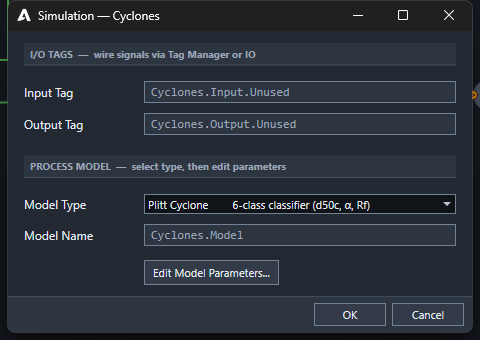
- Double-click the node to open the Simulation dialog
- Model Type: Plitt Cyclone (6-class classifier: d50c, α, Rf)
- Input Tag and Output Tag are the two headline signals; every other result gets its own tag automatically
- Press Edit Model Parameters... for the full model sheet
Step 3 - Cyclone geometry: Plitt computes the cut size from it
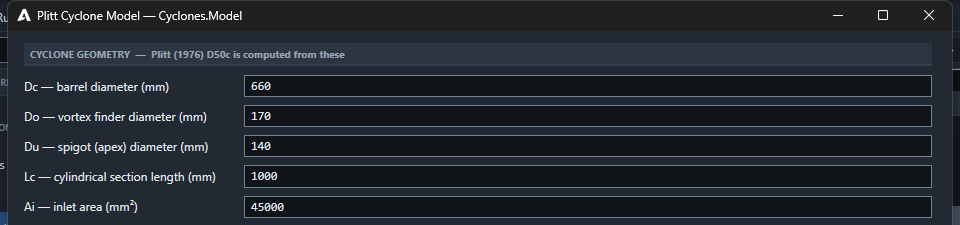
- Dc 660 mm barrel, Do 170 mm vortex finder, Du 140 mm spigot
- Lc 1,000 mm cylinder, inlet area 45,000 mm²
- d50c follows from geometry, flow, pressure and % solids each scan
- Number of cyclones open is a tag (14 in the demo)
Step 4 - Classification: sharpness and bypass
- α 2.5: sharpness of the partition curve
- Rf 0.30: fraction of fines carried to underflow with the water
- Water In: extra dilution water default
- Fit α and Rf to a survey's size-by-size split

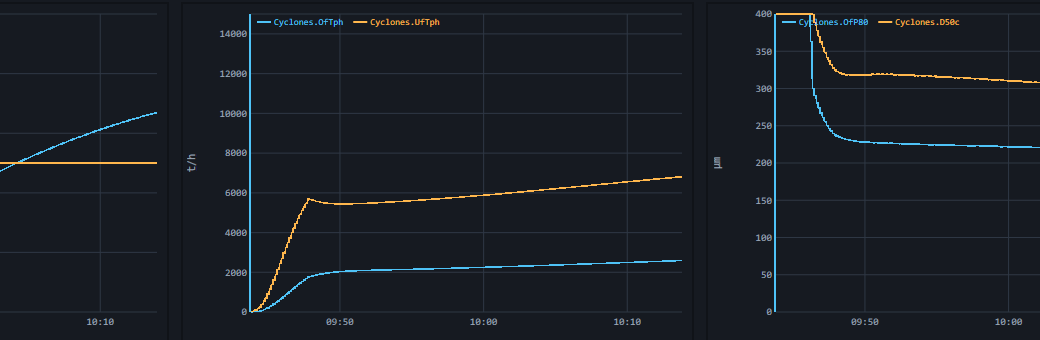
Step 5 - Run it: 40 kPa, 215 µm overflow, d50c trending down as the circuit loads
With 14 cyclones at 40 kPa the overflow P80 settles near 215 µm; d50c (orange) drifts down as feed density and circulating load settle.
Checks before you trust the model
- Overflow P80 within about 10 % of the survey
- Higher feed density coarsens the overflow
- More cyclones open at the same flow lowers pressure and coarsens the cut
- Underflow % solids stays below roping in normal running
Request a demo.
Talk to an engineerSources
- ProcessOpt RC3.1.4 - process model source code and editor dialogs, Aeterna Automation, 2026
- A mathematical model of the hydrocyclone classifier, Plitt, L.R., CIM Bulletin 69 (776), 1976
- Mineral Comminution Circuits: Their Operation and Optimisation (JKMRC Monograph 2), Napier-Munn, Morrell, Morrison and Kojovic, JKMRC, 1996
- Wills' Mineral Processing Technology, 8th edition, Wills and Finch, Butterworth-Heinemann, 2016