
Keeping APC Switched On: Service Factor, Operator Trust and Sustainment
Why advanced process control drifts into manual, and what sustaining sites do differently
Why APC gets switched off
Advanced process control sits on top of the regulatory (PID) layer and depends on it. When instruments drift or valves stick, the APC sees a distorted picture of the plant and its moves start to look odd. Operators, who are accountable for the shift, step in, and if their intervention seems to work, the controller stays off.
Mineral processing makes this harder than most industries: ore hardness, size and grade change by the hour, so a model identified at commissioning slowly stops matching the plant. Without periodic re-identification, the controller's predictions drift and confidence goes with them.
- Model-plant mismatch: ore body, equipment wear and circuit changes outpace the model.
- Instrument degradation: uncalibrated sensors and poor signals feed bad data to the controller.
- Operator distrust: logic that is not visible in the HMI invites overrides.
- Loss of expertise: knowledge leaves with the vendor team or a departing champion.
Key numbers
| Metric | Value | Context | Source |
|---|---|---|---|
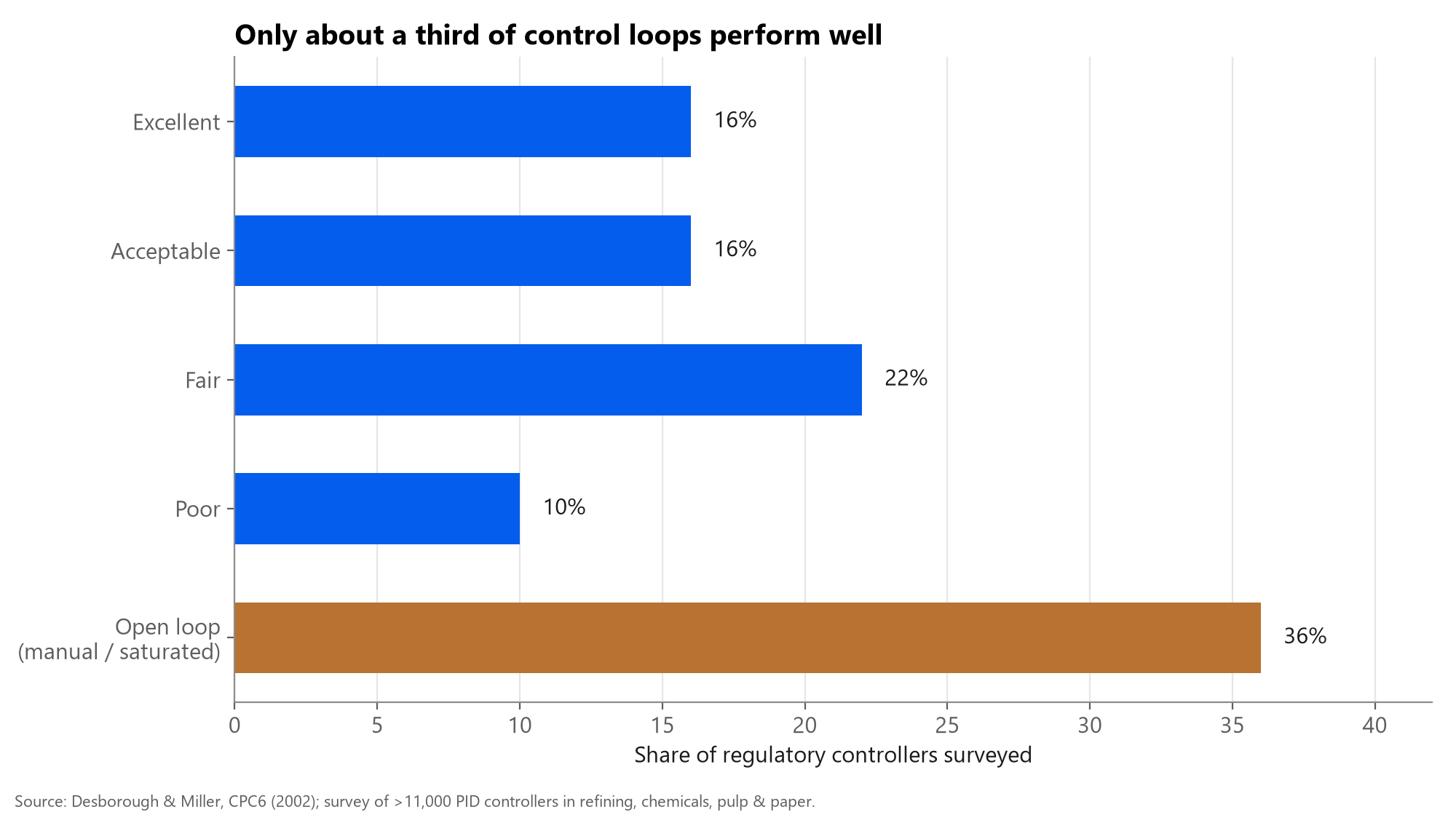
| PID share of regulatory controllers | ~97 % | Refining, chemicals, pulp & paper | Desborough & Miller 2002 |
| Loops excellent / acceptable | 16 % / 16 % | >11,000 controllers surveyed | Desborough & Miller 2002 |
| Loops fair / poor | 22 % / 10 % | same survey | Desborough & Miller 2002 |
| Loops open loop (manual or saturated >30 % of data) | 36 % | same survey | Desborough & Miller 2002 |
| MPC controllers inoperative | up to ~30 % | multi-industry | Desborough & Miller 2002 |
| APC benefit loss without maintenance | 30-50 % within 3 years; possibly all within 7 | survey of APC users | Honeywell, Process Online 2019 (vendor) |
| APC installations at pre-install performance or removed | over half after 18-24 months | articles cited in conference abstract | AIChE Spring Meeting 2020 (abstract) |
| Utilisation warning threshold | < 80 % time in auto | critical controllers | Mipac 2026 (consultancy rule of thumb) |
| Grinding expert system online utilisation | ~95 % | Barrick Goldstrike | OneMine paper |
| Throughput gain after MPC upgrade | ~5.1 % (one month after start-up) | SAG circuit, eastern Canada | ANDRITZ success story (vendor) |
KPIs that show whether APC is earning its keep
- Utilisation / service factor: % of operating time the controller is on with its key manipulated variables active.
- Constraint-active time: % of time the controller is pushing against a real plant limit (where the value is made).
- Operator interventions: overrides or set-point changes per shift, with a logged reason when APC is switched off.
- Model health: prediction error trend for key variables; triggers for re-identification.
- Base-layer health: % of loops in normal mode, valve stiction flags, instrument health status.
- Value delivered: throughput, recovery or specific energy against an agreed baseline, reviewed monthly.
Best practice for sustainment
The common thread in both the literature and vendor service models is that APC is not a one-off project. It needs a small, steady effort that keeps the base layer, the models and the people aligned.
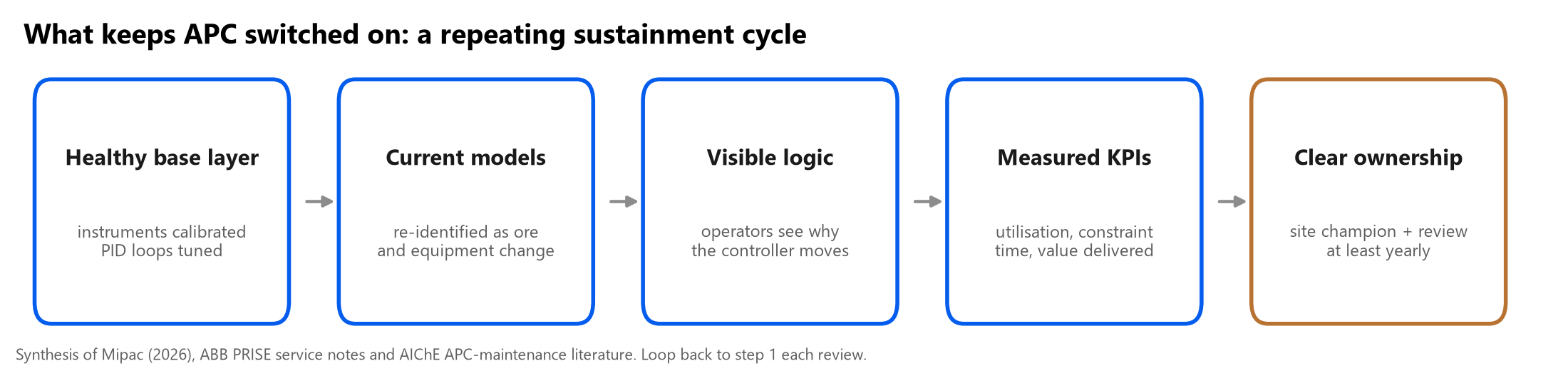
- Fix the foundation first: audit instruments and PID loops before (re)commissioning APC.
- Design with operators: involve shift crews in objectives and constraints; make 'operator acceptance' an explicit commissioning criterion (as Dome Mine did).
- Make the logic visible: show what the controller is doing and why, inside the HMI operators already use.
- Refresh models at least yearly, and after major ore or equipment changes.
- Name an owner: a site APC champion with time allocated, backed by a support agreement where in-house skill is thin.
- Review KPIs in the production meeting, not just in the control engineer's inbox.
- Train continuously: new operators and engineers learn how the controller thinks.
Instrumentation and Aeterna angle
Many APC drop-outs start with a measurement the operators no longer believe. Direct, continuous measurements of what the process is actually doing - rock size on the feed belt, froth velocity and bubble size, mill charge behaviour - give both the controller and the operator a shared, trustworthy view. That shared view is what builds trust and keeps the controller on.
Aeterna's smart instruments and MPC fit this story when framed as giving the controller a head start and giving operators visibility, not as replacing their judgement. Keep the tone humble: sustained gains of a few percent are credible and valuable.
Common misconceptions
- 'APC is a project with an end date' - it is an asset that needs maintenance like a pump or a mill liner.
- 'Operators turn APC off because they resist change' - more often the controller is acting on poor data or an outdated model, and operators are right to step in.
- 'Better algorithms fix utilisation' - most drop-outs trace to the base layer, models and people, not the algorithm.
- 'High benefit claims at commissioning are what you keep' - benefits erode unless sustained.
Want to know how much of the time your APC is really on? Ask us about an APC health review.
Talk to an engineerSources
- Increasing Customer Value of Industrial Control Performance Monitoring - Honeywell's Experience, L. Desborough & R. Miller, CPC6 proceedings, 2002
- Advanced Process Control failure in Mineral Processing: four causes and how to fix them, Mipac, 2026
- How to cut your advanced process control costs, Honeywell Process Solutions via Process Online, 2019
- Advanced Process Control Optimum Maintenance (137a), AIChE Spring Meeting, 2020
- Monitoring, best practices maintain APC applications, Oil & Gas Journal
- Barrick Goldstrike Grinding Expert System, OneMine (SME)
- Development and Implementation of an Expert System for Grinding Control at the Dome Mine, OneMine (SME)
- SAG mill success story, eastern Canada, ANDRITZ
- Advanced process control for the minerals industry (brochure), FLSmidth, 2021
- Process improvement services maximize efficiency of mining operations (PRISE), ABB