
Hydrocyclone Fundamentals: Cut Size, Partition Curves and Bypass
How a cyclone decides where each particle goes, and the three numbers that describe it
How a hydrocyclone works
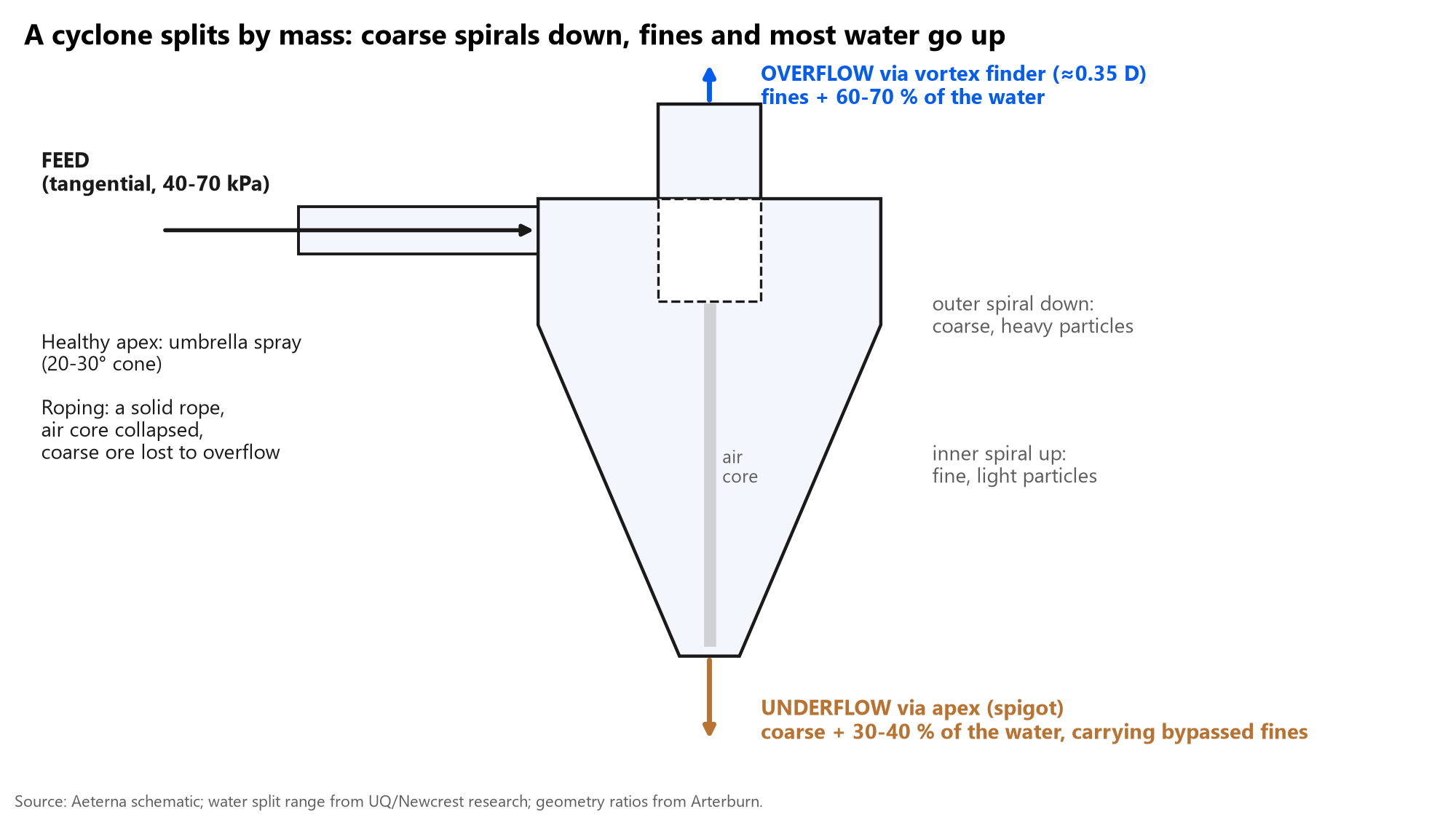
Slurry enters tangentially at the top of the cylindrical section under pump pressure (typically 40-70 kPa in grinding duty). The swirl creates a centrifugal field many times stronger than gravity. Heavier and coarser particles move to the wall and spiral down the cone to the apex (spigot); finer and lighter particles stay in the inner upward spiral and leave through the vortex finder as overflow. An air core forms along the axis when the apex discharges freely.
Because the separation is by settling velocity, a cyclone is a mass classifier: a dense sulphide particle reports to the underflow at a smaller size than a silicate particle of the same size. This is why the cut size in a ball mill circuit is often finer for the valuable mineral than for the gangue, and why heavy minerals tend to over-grind.
Arterburn's 'standard cyclone' sets the geometry that the design correlations assume: inlet area about 0.05 D², vortex finder about 0.35 D, a cylindrical section about one diameter long and a 10-20° cone.
The partition curve: d50, d50c and bypass
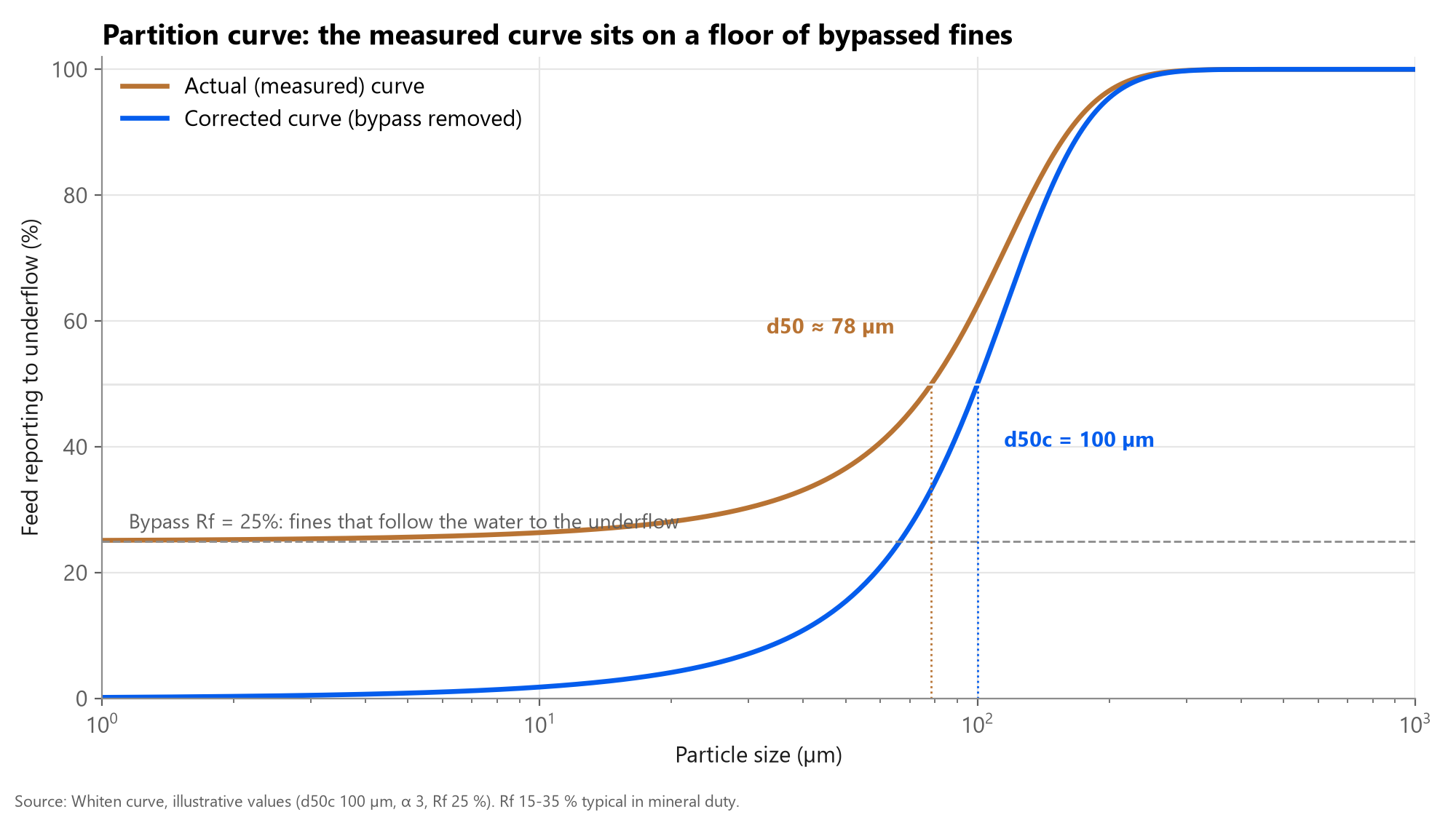
The partition (efficiency) curve shows, for each size class, the fraction of the feed that reports to the underflow. It is calculated from a cyclone survey: size distributions of feed, overflow and underflow, mass balanced.
The measured curve does not fall to zero at the fine end. It flattens onto a floor equal to the bypass Rf: the fines carried by the water that short-circuits to the underflow, regardless of size. Rf is normally close to the fraction of feed water reporting to the underflow.
Removing the bypass gives the corrected curve: E_corr = (E_actual - Rf) / (1 - Rf). The size at 50 % on the measured curve is d50; on the corrected curve it is d50c, which is always coarser. Equipment correlations (Arterburn, Plitt, Nageswararao) predict d50c, so always check which one a datasheet quotes.
Sharpness of separation
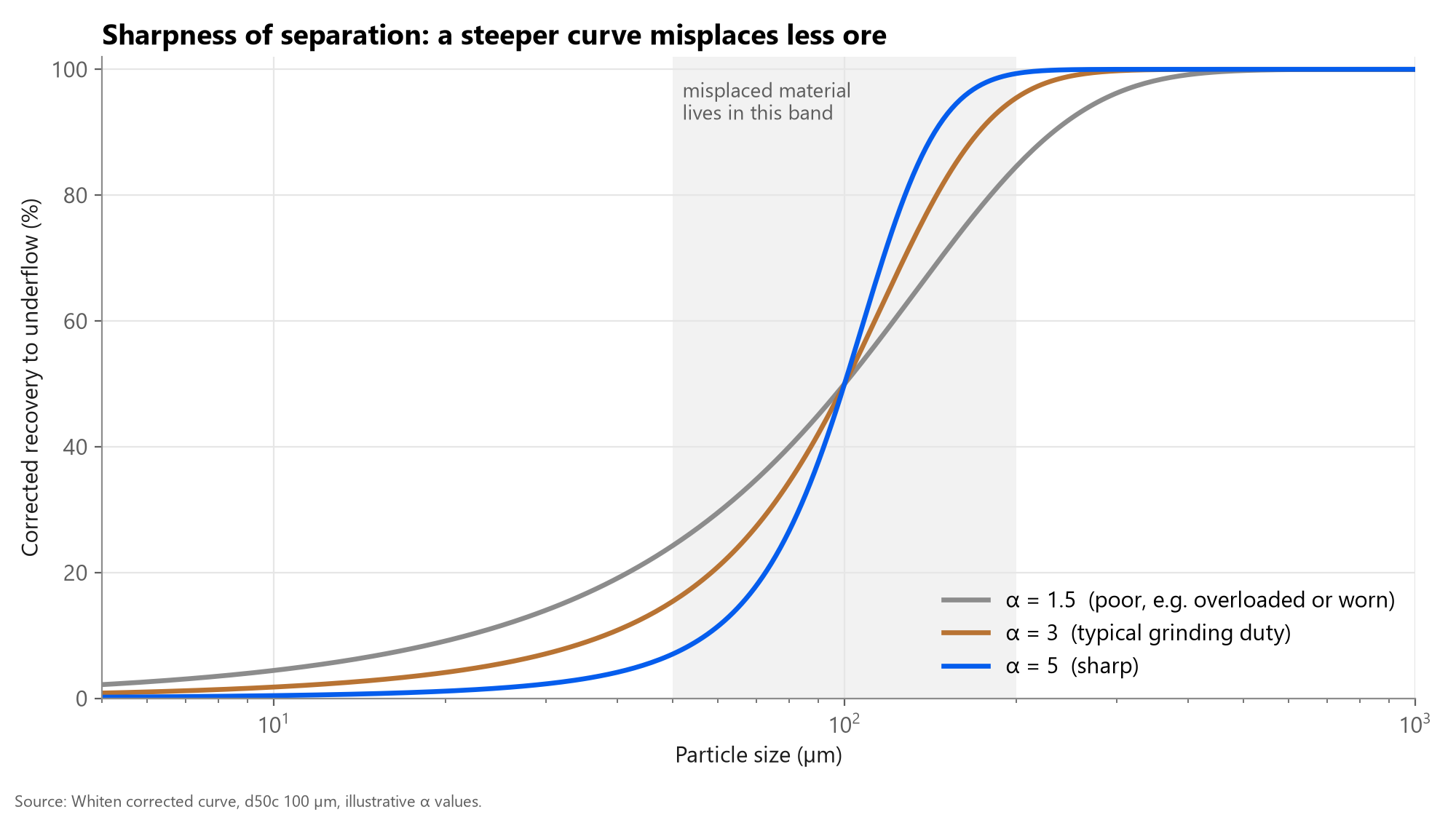
The corrected curve is usually fitted with the Whiten form E = (e^(αx) - 1) / (e^(αx) + e^α - 2), with x = d/d50c. Alpha sets the slope: a high alpha means fewer coarse particles escape to the overflow and fewer fines are trapped in the underflow. An equivalent measure is the imperfection I = (d75 - d25) / (2 d50c).
Alpha falls when a cyclone is overloaded, worn, fed unevenly from a poorly balanced distributor, or run near roping. In ball mill circuits a soft separation means fines return to the mill (over-grinding, slimes, wasted energy) and coarse particles go to flotation (lower recovery).
What moves the cut size
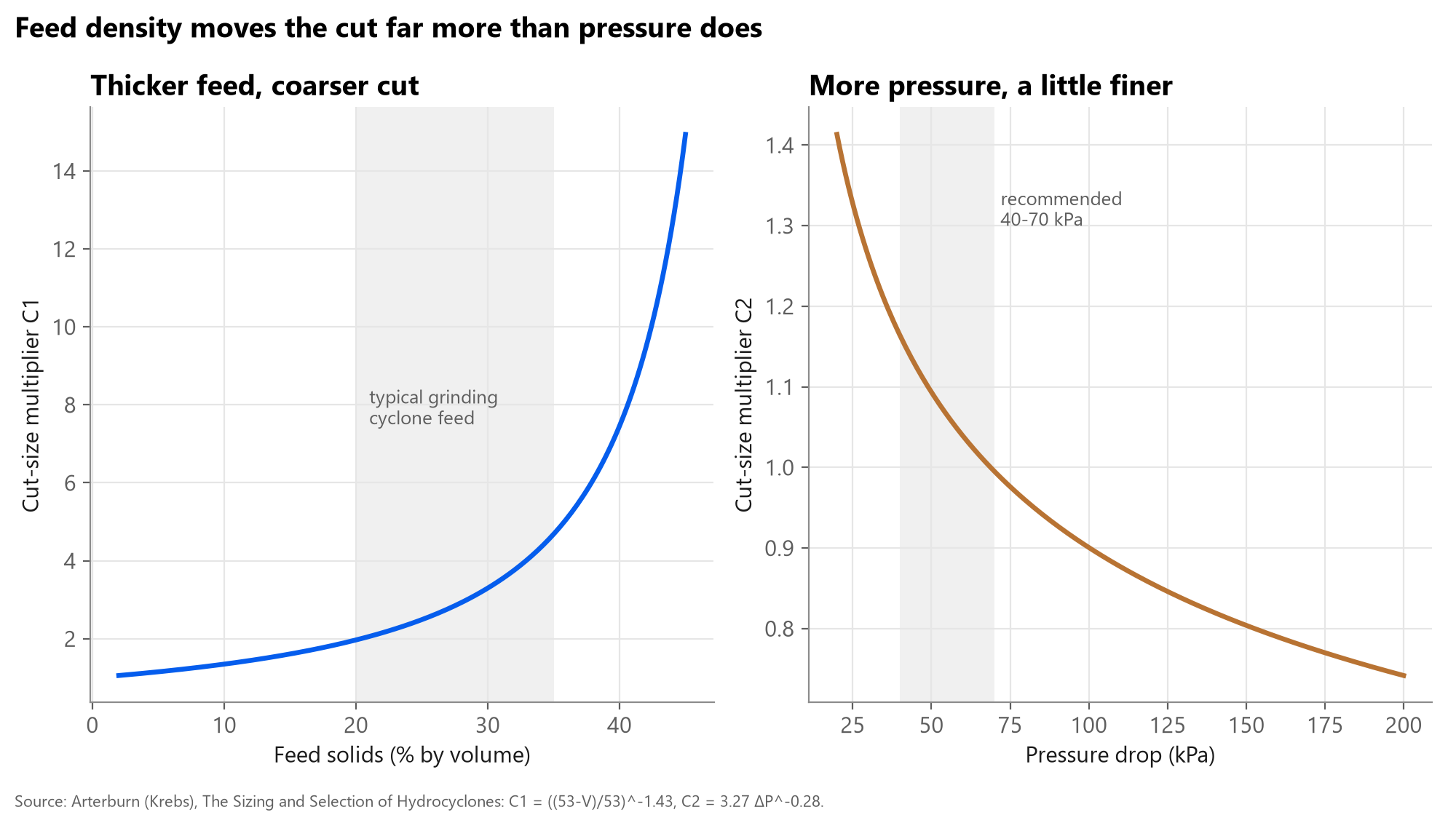
Arterburn (Krebs) gives a practical sizing method: d50c(base) = 2.84 D^0.66 (µm, D in cm) for water, 2.65 SG solids, <1 % solids and 69 kPa. The application value multiplies this by C1 (feed solids), C2 (pressure drop) and C3 (solids density).
C1 = ((53 - V)/53)^-1.43, where V is feed solids by volume, rises steeply as the feed thickens: at 20 % v/v it is about 2.0, at 30 % about 3.3, at 35 % about 4.6. C2 = 3.27 ΔP^-0.28 (kPa) changes slowly: 1.09 at 50 kPa, 0.90 at 100 kPa. In practice, cyclone feed density is the strongest handle operators have on the cut.
Geometry sets the operating range: a larger vortex finder gives a coarser cut and more flow; the apex must be sized to carry the underflow solids. Too small an apex ropes; too large lets in extra water and fines, raising bypass.
Key numbers and rules of thumb
| Item | Typical value | Source |
|---|---|---|
| Base corrected cut size | d50c = 2.84 D^0.66 µm (D in cm); ~24 µm for a 25 cm cyclone | Arterburn |
| Design pressure drop | 40-70 kPa (5-10 psi) | Arterburn |
| Feed solids correction C1 | ((53-V)/53)^-1.43, V = % solids by volume | Arterburn |
| Pressure correction C2 | 3.27 ΔP^-0.28 (kPa) | Arterburn |
| Vortex finder | ~0.35 x cyclone diameter | Arterburn |
| Inlet area | ~0.05 x D² | Arterburn |
| Underflow density | 50-53 % v/v primary grinding; 40-45 % v/v regrind | Arterburn |
| Feed water to underflow | 30-40 % | UQ / Newcrest |
| Bypass Rf | 0.15-0.35 in mineral duty | Redalyc review |
| Overflow 80 % passing size | ~d50c / 1.25 | Arterburn Table 1 |
| Feed line velocity | 2-3 m/s to keep solids suspended | Arterburn |
Operating practice
- Survey the cyclones (feed, overflow, underflow) and fit d50c, alpha and Rf; one survey is worth many assumptions.
- Watch the underflow: a 20-30° umbrella spray is healthy; a rope means the apex is overloaded.
- Hold feed density steady: it moves the cut more than any other operating variable.
- Keep pressure in the design window by opening and closing cyclones, not by running the pump outside its curve.
- Replace worn apexes and vortex finders on a schedule; wear slowly shifts the cut and the water split.
- Check the distributor: uneven feed between cyclones blurs the combined partition curve.
Instrumentation and control angle
Most grinding circuits control cyclone feed density and pressure through sump water and pump speed. Online particle size analysers on the overflow and roping detectors on the underflow add direct feedback. In an advanced control layer, cyclone pressure and density are set together with mill feed so the circuit holds its target grind while staying within the pump and sump limits.
For Aeterna, the tie-in is light: ProcessOpt can hold cyclone feed density and pressure in coordination with the mill, and a grinding circuit review starts with a cyclone survey like the one described here.
Common misconceptions
- 'The cut size is the d50 on the survey curve.' Design correlations predict d50c; the measured d50 includes bypass and is finer.
- 'More pressure always fixes a coarse overflow.' Pressure acts weakly (exponent -0.28); feed density and geometry act more strongly.
- 'Fines in the underflow mean a broken cyclone.' Some bypass is inherent because fines follow the water; it is reduced, not eliminated.
- 'A cyclone classifies by size.' It classifies by settling velocity, so density matters as much as size.
Where sources disagree or are uncertain
- The base coefficient appears as 2.84 (Arterburn) and 2.86 (some course notes); the difference is small but should be stated.
- Roping criteria differ: Plitt, Concha and Bustamante each use different geometry or concentration limits; none is universal.
- Typical alpha ranges are rarely published with a source; the values in Figure 3 are illustrative.
- Vendor claims on reduced bypass (curved-bottom and new cone designs, 5-25 %) are manufacturer data; an independent 2025 study reported bypass falling from 24.6 % to 18.6 % with a convex cone.
Ask for a grinding circuit review: we start with a cyclone survey and show where the cut sits today.
Talk to an engineerSources
- The Sizing and Selection of Hydrocyclones, R.A. Arterburn, Krebs Engineers (via 911 Metallurgist / SME)
- Poor classification costing the minerals industry significant revenue (Newcrest PhD research), University of Queensland, Sustainable Minerals Institute, 2020
- Hydrocyclone (Plitt) and (Nageswararao) model pages, Met Dynamics / SysCAD wiki
- Cyclone model documentation (Plitt, Arterburn corrections), SysCAD help
- Review of hydrocyclone models, bypass Rf range, Redalyc
- Influence of conic shape on bypass and cut-size in hydrocyclones, Pukkella et al., Separation and Purification Technology (LIST), 2025
- Six factors that affect hydrocyclone performance, McLanahan
- Fundamentals on the spigot capacity of dense medium cyclones (roping onset), University of Pretoria
- How cyclone water usage can increase ball mill circuit efficiency, MetCom Technologies