
Filter Press Fundamentals: Cake Formation, Moisture and Cycle Time
How the cake filters itself, what each cycle step buys, and where the minutes go
How a filter press works
A plate-and-frame (chamber) filter press is a stack of plates clamped together by a hydraulic cylinder. Each pair of plates forms a chamber lined with filter cloth. A feed pump pushes slurry into all chambers through a central feed port; liquid passes the cloth and drains through ports in the plate faces, while solids stay behind and build a cake that eventually fills the chamber.
Recessed (fixed-volume) plates form the cake by feed pressure alone. Membrane (variable-volume) plates add a flexible diaphragm that is inflated with water or air after filling, squeezing the cake mechanically. Horizontal-plate concentrate filters (for example the vertical-stack Larox PF type) use a diaphragm press and air drying in thin cakes with short cycles.
Typical mining ranges: feed pressure 6-16 bar (high-pressure units up to about 20-25 bar), membrane squeeze up to about 16 bar, chamber depth 30-60 mm (40 mm is common for tailings), and plates up to 2.5 x 2.5 m on large tailings presses, with 5 x 4.2 m plates now offered.
Cake formation - Darcy's law in plain terms
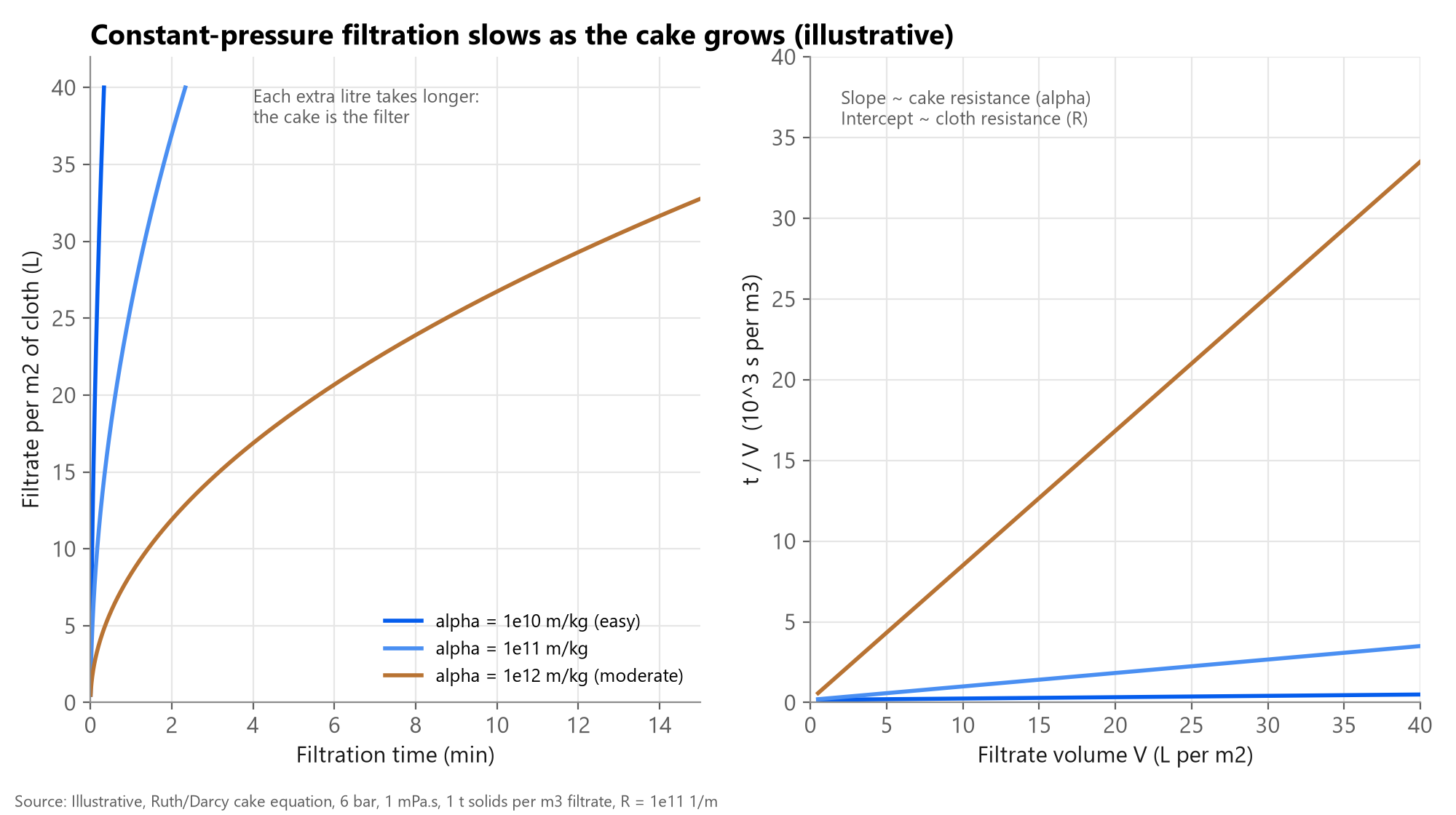
Darcy's law says flow through a porous bed is proportional to pressure drop and inversely proportional to liquid viscosity and bed resistance. In cake filtration the bed is the growing cake plus the cloth. Writing the cake resistance per kilogram of dry solids as alpha (specific cake resistance, m/kg) and the cloth resistance as R (1/m), the constant-pressure form is often written t/V = (mu alpha c / 2 A^2 dP) V + (mu R / A dP), where c is the dry solids deposited per unit filtrate volume.
Plain meaning: the time per litre grows linearly with the litres already collected. Double the cake thickness and filtration takes roughly four times as long. This is why chamber depth is a design trade-off: thicker chambers hold more cake per cycle but take disproportionately longer to fill and compact.
The same equation gives the standard lab test: plot t/V against V from a pressure leaf or bomb test. The slope gives alpha and the intercept gives R; only the straight-line part is used, because early points are distorted by settling and start-up.
Most mineral cakes are compressible, so alpha rises with pressure: alpha = alpha0 dP^n. A compressibility index n below 0.3 is low, 0.3-0.5 medium and above 0.5 high. For highly compressible cakes, raising feed pressure gives little extra rate, while a membrane squeeze (which compacts the cake mechanically) can do more.
What sets cake resistance
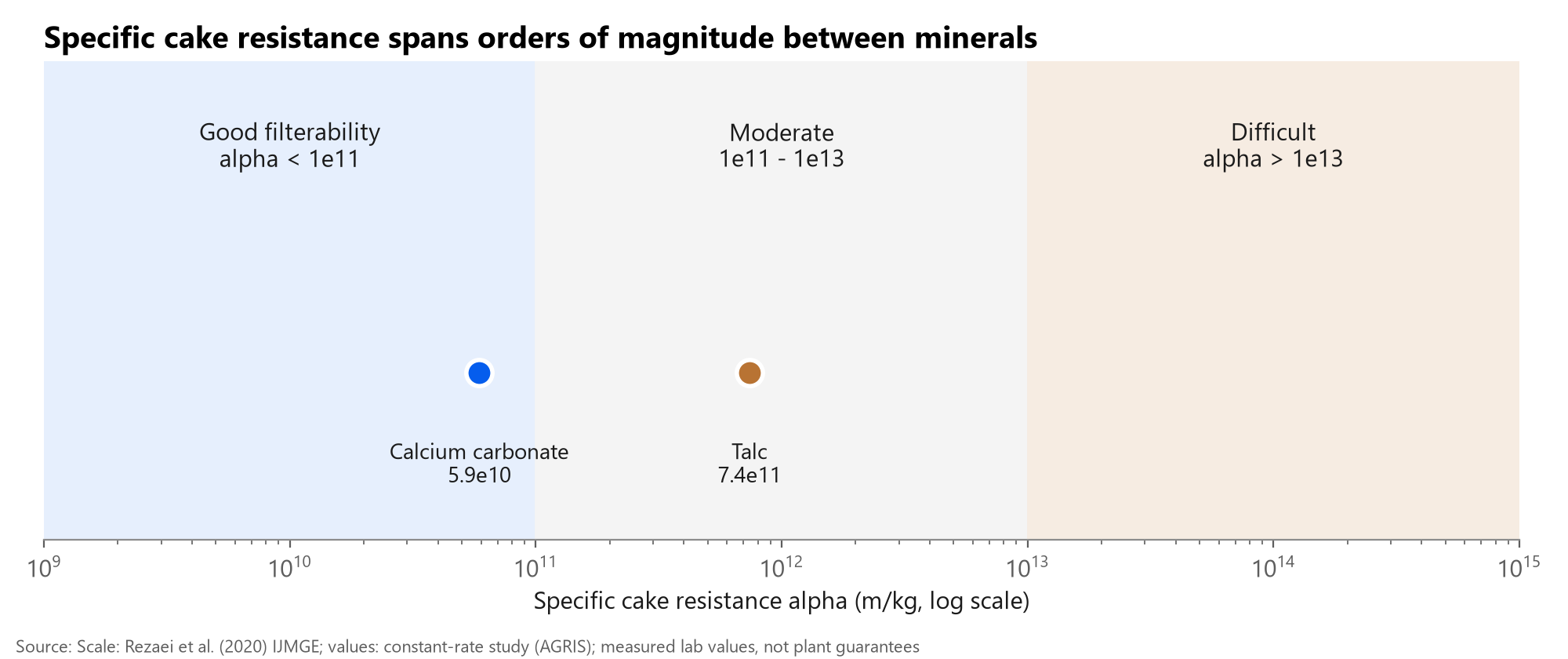
Particle size distribution has the strongest effect on alpha and compressibility; fines and clays fill the pores. Particle shape matters mostly for compressibility when shapes are far from spherical (platy talc, clays). Lab data show the spread: one constant-rate study measured about 5.9e10 m/kg for calcium carbonate and 7.4e11 m/kg for talc, more than a ten-fold difference.
Feed solids also matter: higher solids reduce fill time because less water has to pass the cake for the same cake mass, which is why filters are usually fed from a thickener underflow. Slurry chemistry (pH, dispersion, flocculant carry-over) and cloth weave change both alpha and R.
Moisture - what each step removes
Water leaves the cake by two different mechanisms. While the cake is saturated, liquid is pushed out by consolidation (feed pressure or membrane squeeze reduces pore volume). Once gas pressure exceeds the capillary entry pressure of the pores, air begins to displace liquid from the pores themselves: desaturation. Below that threshold, blowing air does little; above it, moisture falls until a residual saturation is reached that depends on pore size and wettability.
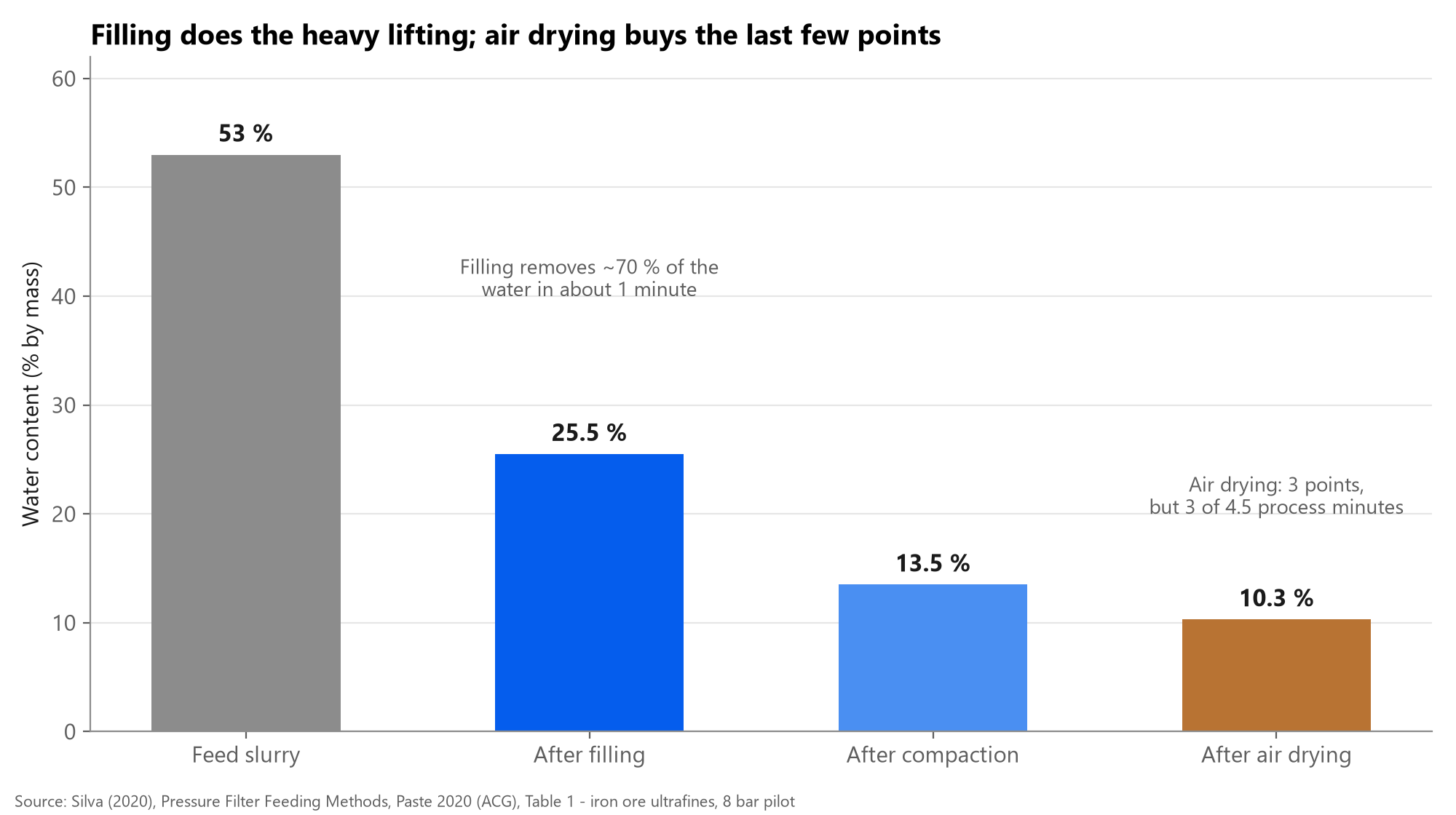
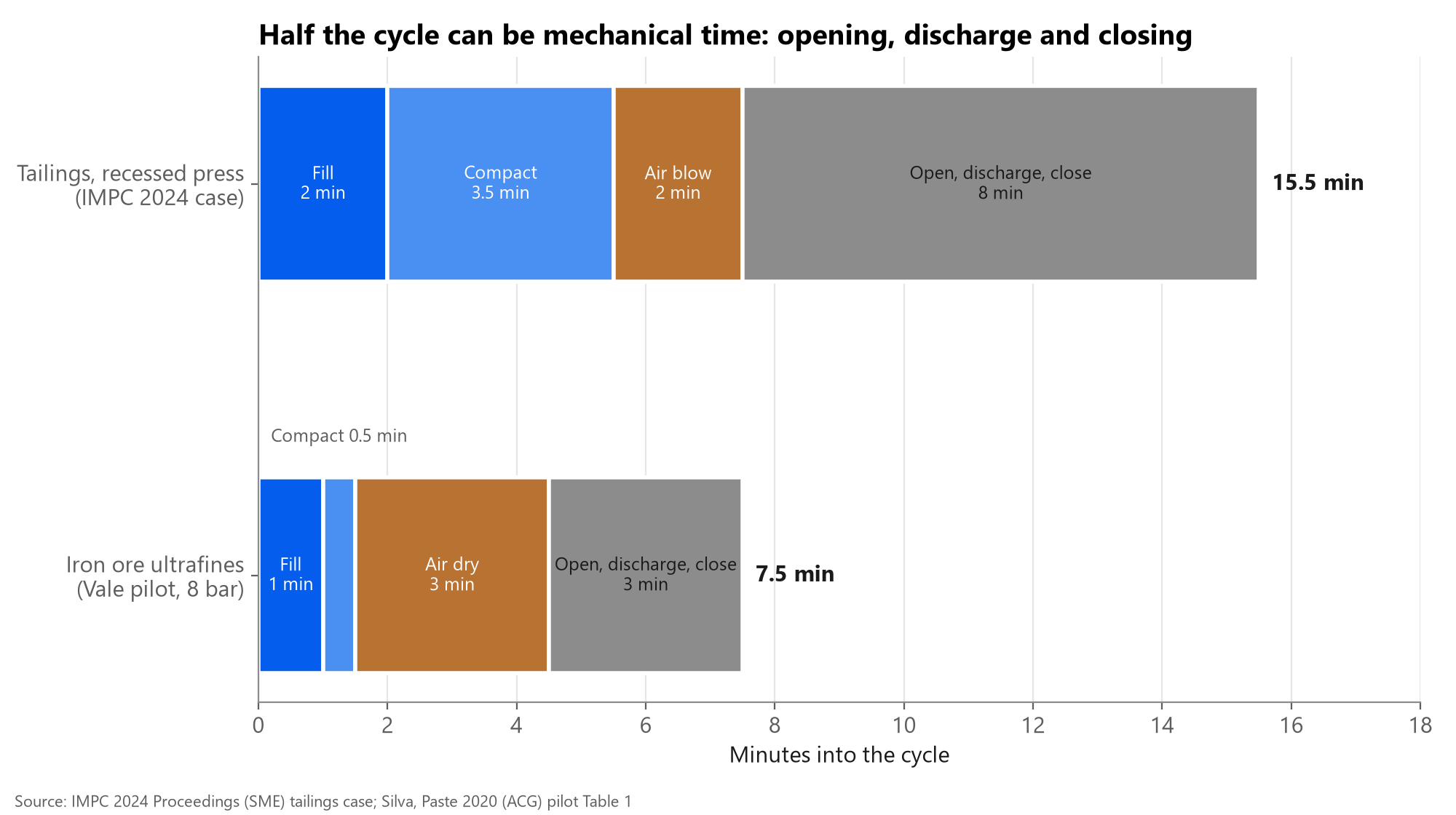
Pilot data from a Vale iron ore ultrafines test at 8 bar show the pattern: water fell from 53 % in the feed tank to 25.5 % after filling (about 1 minute), 13.5 % after compaction (0.5 minute) and 10.3 % after air drying (3 minutes). Filling removed about 70 % of the water; air drying took the last 3 percentage points but most of the process time.
Air drying has costs: compressed-air energy, larger filters because cycles are longer (solids throughput can fall by up to 35 %), and cake cracking in fine compressible cakes, which lets air short-circuit and stops further drying. It is also the only practical way to remove thixotropy from some tailings cakes.
Typical moisture outcomes
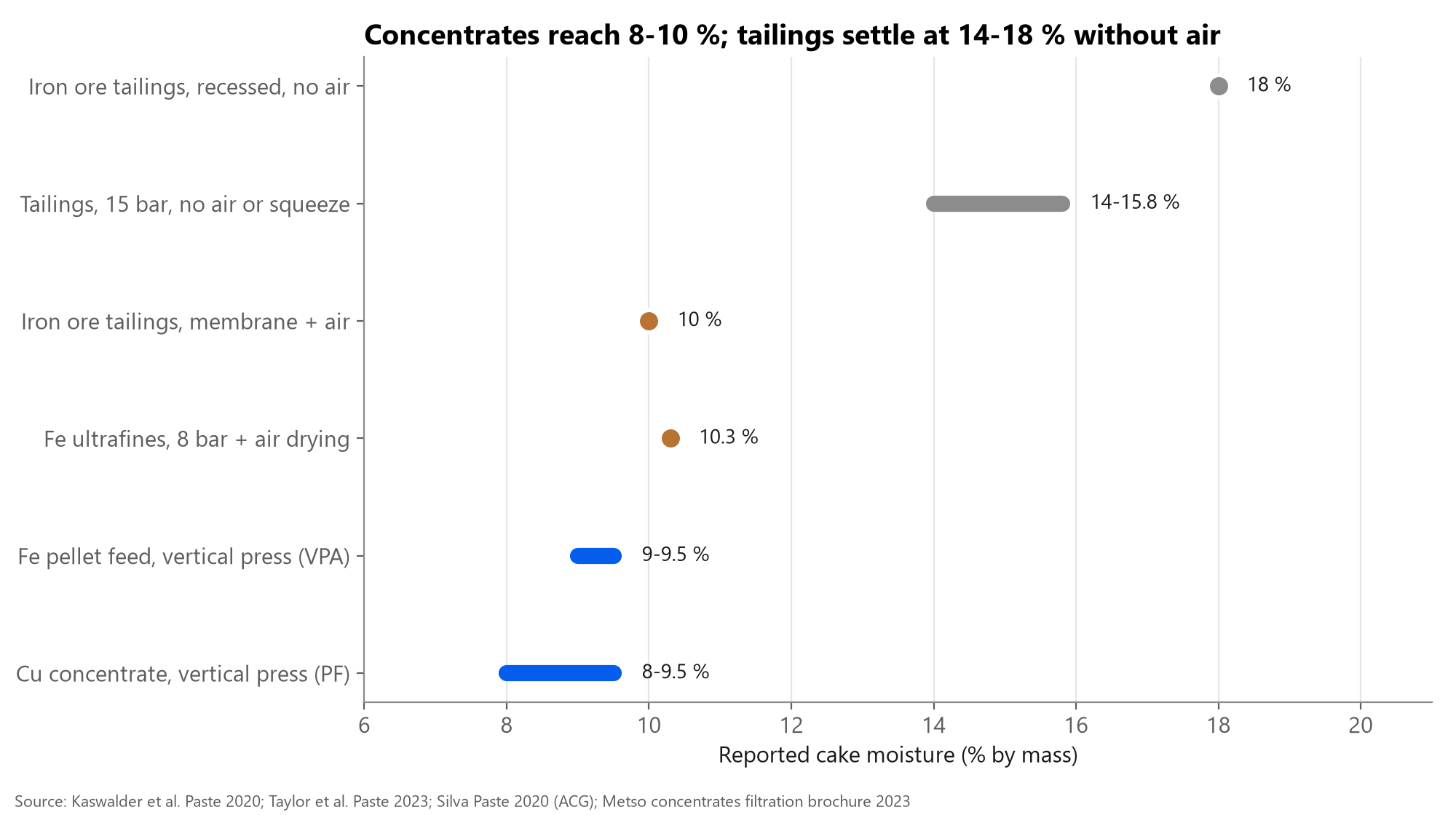
Moisture targets come from what happens next. Concentrates must ship below the Transportable Moisture Limit (TML) under the IMSBC Code to avoid liquefaction in the hold; a common target for copper concentrate is about 8 % by mass. Pellet feed has a balling window (around 9-9.5 % in one Metso VPA case). Tailings for dry stacking need a geotechnically stable cake, often below about 15 %.
Reported outcomes: copper concentrate 8-9.5 % on diaphragm-press concentrate filters, removing the need for a thermal dryer; iron ore tailings about 18 % on recessed plates without air versus about 10 % with membranes and air drying; tailings at 15 bar without air or squeeze about 14-15.8 % depending on feed solids and cake thickness.
Cycle time - where the minutes go
Cycle time = fill + filtration/compaction + optional squeeze + optional core blow + optional air drying + cake wash where needed + opening, discharge, cloth wash and closing. Throughput = cake mass per cycle x cycles per hour.
Reported cycles: about 6 minutes on thin-cake concentrate filters (Metso), 11 minutes average on one copper concentrate press, 15.5 minutes for a recessed tailings press (2 fill, 3.5 compact, 2 blow, 8 non-process) and around 20-30 minutes on large industrial presses once technical and dead time are counted (Vale design basis: 10 minutes feed, 20 minutes compression, drying and dead time).
Non-process time is frequently the largest single block. Plate shifting speed (1-5 seconds per plate on modern shifters), cake release and cloth washing set it. Feed pump type also matters: centrifugal pumps lose flow as the cake builds, while positive-displacement pumps hold flow and let pressure rise in a controlled way.
Key numbers and rules of thumb
| Item | Typical value | Source |
|---|---|---|
| Feed pressure, standard mining press | 6-16 bar | McLanahan; supplier data |
| Membrane squeeze pressure | up to ~16 bar | Metso PF-DS brochure |
| Vertical air-blow concentrate filter (VPA) | 7-10 bar | Metso |
| Chamber depth, tailings | 40 mm (30-60 mm) | Kaswalder et al. 2020 |
| Specific cake resistance - easy / moderate / difficult | <1e11 / 1e11-1e13 / >1e13 m/kg | Rezaei et al. 2020 |
| Copper concentrate moisture | 8-9.5 % | Metso 2023 |
| Tailings moisture, recessed, no air | 14-18 % | Taylor et al. 2023; Kaswalder et al. 2020 |
| Throughput loss from air drying | up to 35 % | Kaswalder et al. 2020 |
| Cycle time, concentrate filter | 6-11 min | Metso; case study |
| Cycle time, tailings press | 15-30 min | IMPC 2024; Silva 2020 |
| Cloth life, mining duty | 1,500-3,000 cycles (vendor) | Micronics |
Operating practice
- Feed the press at steady, high solids from the thickener underflow; density swings change fill time and cake mass cycle to cycle.
- Watch the filtrate flow curve during fill and compaction: end the step on flow (litres per minute per m2 falling below a set point) rather than a fixed timer when the ore varies.
- Set air-drying time from a moisture-versus-air-consumption curve; past the knee, extra minutes cost throughput and compressor energy for little moisture.
- Track non-process time as a KPI: sticky cake release, slow plate shifting and manual cake knocking add minutes every cycle.
- Wash cloths on a schedule and replace on rising fill time; blinding by fines is the main reason cloths are changed apart from mechanical damage.
- Keep cake thickness uniform - unfilled or soft chambers cause plate deflection risk and wet patches.
Instrumentation and control angle
Filter presses are sequence-controlled by their own PLCs, and most of the control value sits upstream and in step timing. A steady thickener underflow density gives repeatable fill times and cake mass; model predictive control on the thickener (bed level, underflow density, flocculant) is the natural place for Aeterna's MPC to help. Within the press, ending fill, compaction and air drying on measured filtrate flow and pressure rather than fixed timers is a simple, well-proven improvement. Keep the tie-in light: this is a fundamentals piece.
Common misconceptions
- 'Higher feed pressure always means drier cake' - for compressible cakes alpha rises with pressure, so returns diminish; squeeze and air drying act differently.
- 'The cloth does the filtering' - after the first layer, the cake is the filter; the cloth mainly sets the initial clarity and the medium resistance R.
- 'Longer air drying is free' - it costs compressed air and can reduce throughput by up to a third; cracked cakes stop drying.
- 'Thicker chambers mean more capacity' - filtration time scales with the square of cake thickness, so capacity can fall.
Ask us how steady thickener control makes your filter cycle more predictable.
Talk to an engineerSources
- Studies on the effects of physical parameters of filtration process on the fluid flow characteristics and de-watering efficiency of copper concentrate, Rezaei, Abdollahi, Gharabaghi, Mamghaderi - Int. J. Mining & Geo-Engineering, 2020
- Pressure Filter Feeding Methods: Case Study, M. Silva (Vale) - Paste 2020, ACG, 2020
- High Capacity Dewatering Plants, Kaswalder, Fritzke, Cavalli, Bassi (Aqseptence / Diemme) - Paste 2020, ACG, 2020
- Filtered tailings test work at 15 bar (pressure filtration series), Taylor et al. - Paste 2023, ACG, 2023
- XXXI International Mineral Processing Congress Proceedings - filtered tailings cycle, SME, 2024
- Concentrates filtration brochure (Larox PF, VPA, FFP), Metso, 2023
- Larox PF-DS brochure, Metso, n.d.
- 8 Factors Affecting Filter Press Cycle Time, McLanahan, n.d.
- Pressure Filtration Theory, 911 Metallurgist, n.d.
- Influence of particle size and shape properties on cake resistance and compressibility during pressure filtration, HAL open archive, n.d.
- A Study of Cake Filtration Parameters Using the Constant Rate Process, AGRIS (FAO) record, n.d.
- Filter press with adaptive automated control arrangement (US 5,275,740), USPTO, 1994
- Desaturation and capillary entry pressure in filter cakes, KIT publications, n.d.
- Regeneration of filter press fabrics in the mining sector, Filtration + Separation (summary of Minerals Engineering 2021), 2021
- MINE-XLL mining filter cloth, Micronics (vendor), n.d.
- Cargo Advice - Liquefaction (IMSBC Code, TML), The Swedish Club, 2025