
Cyclone Feed Density and Pressure: The Grind Size Trade-off
Density sets the grind, pressure fine-tunes it, and the cyclone count sets the pressure
Why this matters
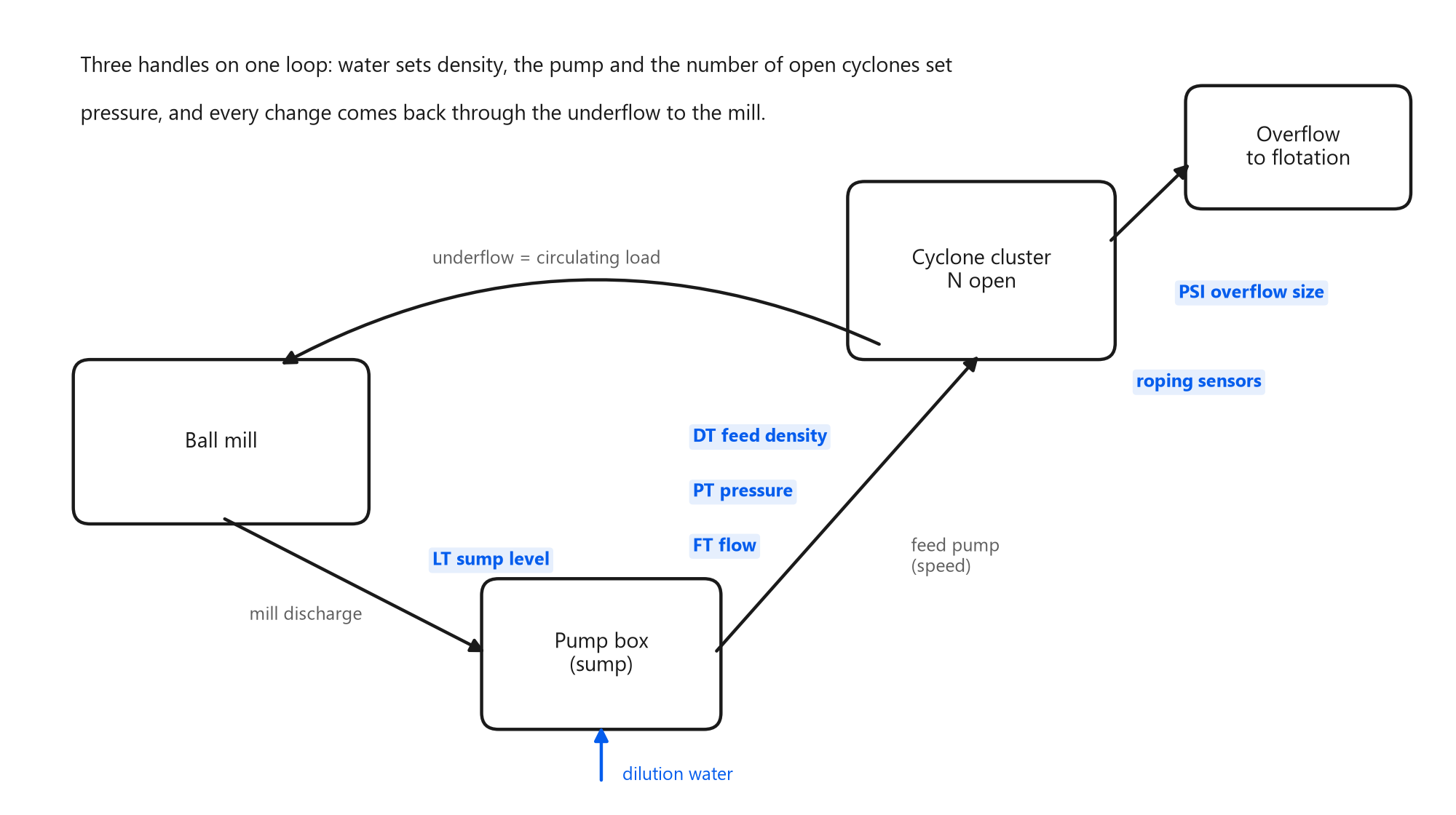
In a ball mill-cyclone circuit, the cyclone decides the product. Every particle that leaves through the overflow goes to flotation or leaching; everything else goes back to the mill. The operator has three handles on that decision: how much water dilutes the cyclone feed (density), how hard the slurry is pushed through each cyclone (pressure), and how many cyclones are open on the cluster (which sets the pressure for a given flow).
The cyclone fundamentals (cut size, partition curve, bypass) are covered in research pack R-004, and the value of recycle in R-027 and the published post 'Recycle load is the SAG's early warning'. This pack focuses on the trade-off itself: how much each handle moves P80, what it costs downstream, and where control helps.
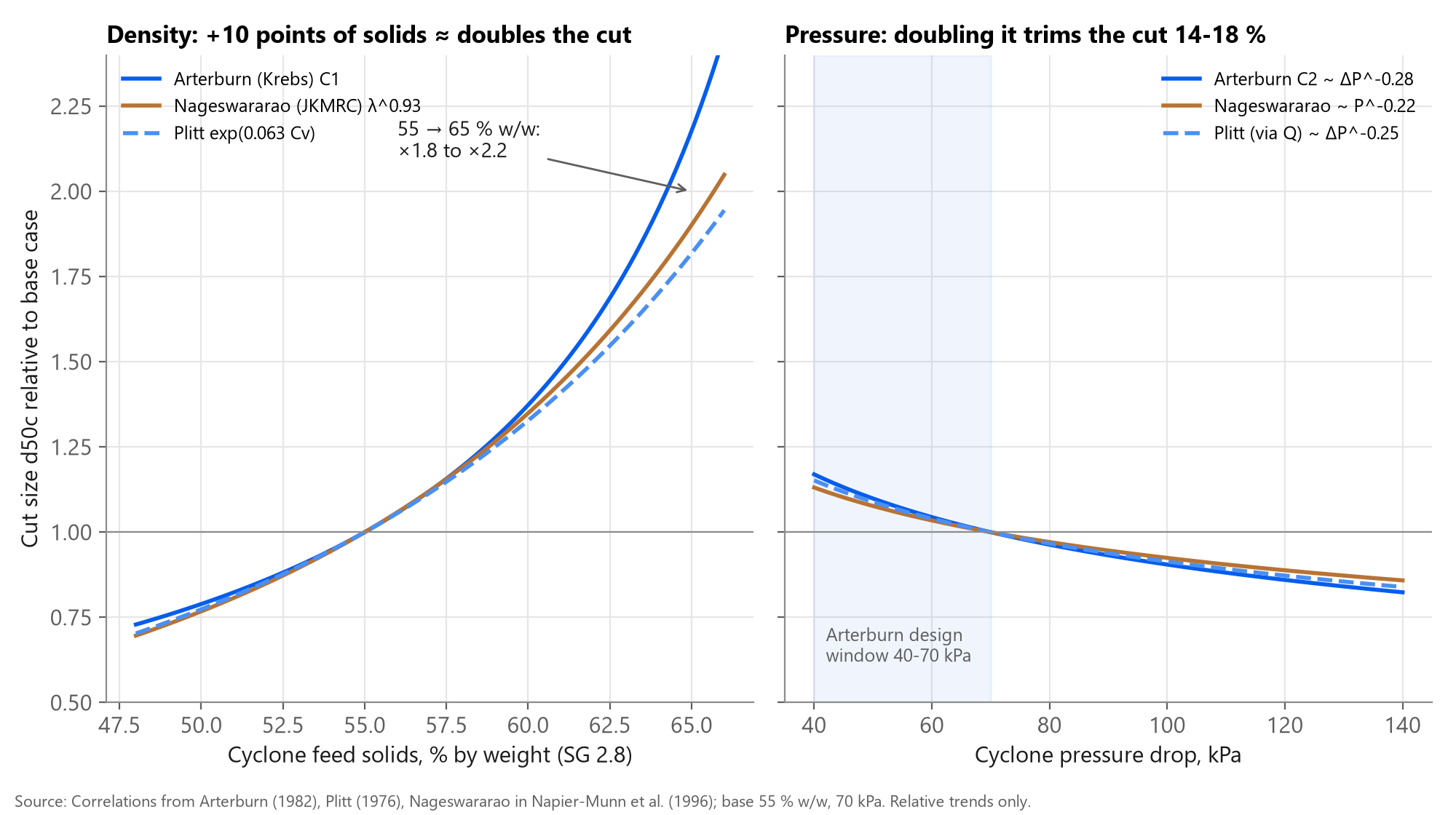
Density moves the cut much more than pressure
Arterburn's sizing method (Krebs) corrects the base cut size with C1 = ((53 - V)/53)^-1.43 for feed solids V (% by volume) and C2 = 3.27 dP^-0.28 for pressure drop in kPa. Plitt's model carries feed solids as exp(0.063 Cv) and pressure through flow (d50 ~ Q^-0.45, dP ~ Q^1.78, so d50 ~ dP^-0.25). The JKMRC Nageswararao model uses a hindered-settling factor lambda^0.93 with lambda = 10^(1.82 Cv) / (8.05 (1 - Cv)^2) and pressure to the -0.22 power.
Converted to % solids by weight for an SG 2.8 ore, the three models agree closely up to about 60 % w/w and diverge above it (Arterburn rises fastest as V approaches 53 % by volume). The shared message: a 10-point change in feed solids moves the cut about as much as a 10-fold change in pressure would.
Physically, a thicker slurry is more viscous and particles settle hindered by their neighbours, so coarser particles stay in the inner vortex and leave with the overflow. Pressure only adds centrifugal force, with diminishing returns.
Cyclone count: how pressure is really set
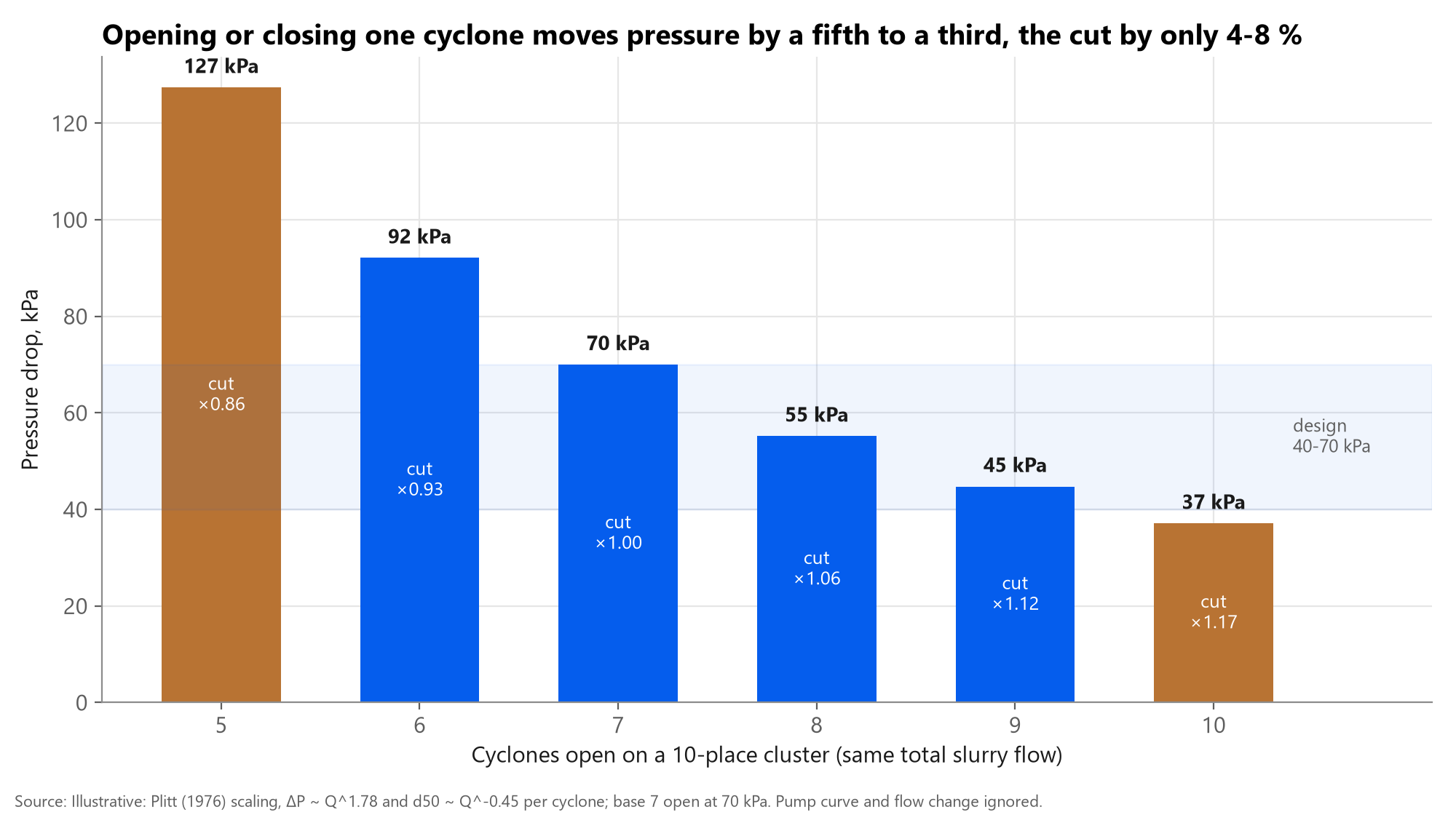
Most clusters run on a fixed-speed or speed-limited pump, so pressure is set by the number of open cyclones. Closing one forces the same flow through fewer units: per-cyclone flow rises, pressure rises steeply (dP ~ Q^1.78) and the cut becomes slightly finer (d50 ~ Q^-0.45). In the illustrative 10-place cluster, going from 7 to 6 open cyclones lifts pressure from 70 to about 92 kPa but trims the cut by only 7 %.
Arterburn recommends 20-25 % standby cyclones. Operators use them to hold pressure when circulating load swings, and to replace a cyclone that ropes or blocks. CiDRA data show how quickly this cascades: after one cyclone went out of class following a 10 % rise in SAG feed and was closed, the pressure surge pushed two more cyclones into poor performance for about 10 minutes.
The operating window and the trade-off
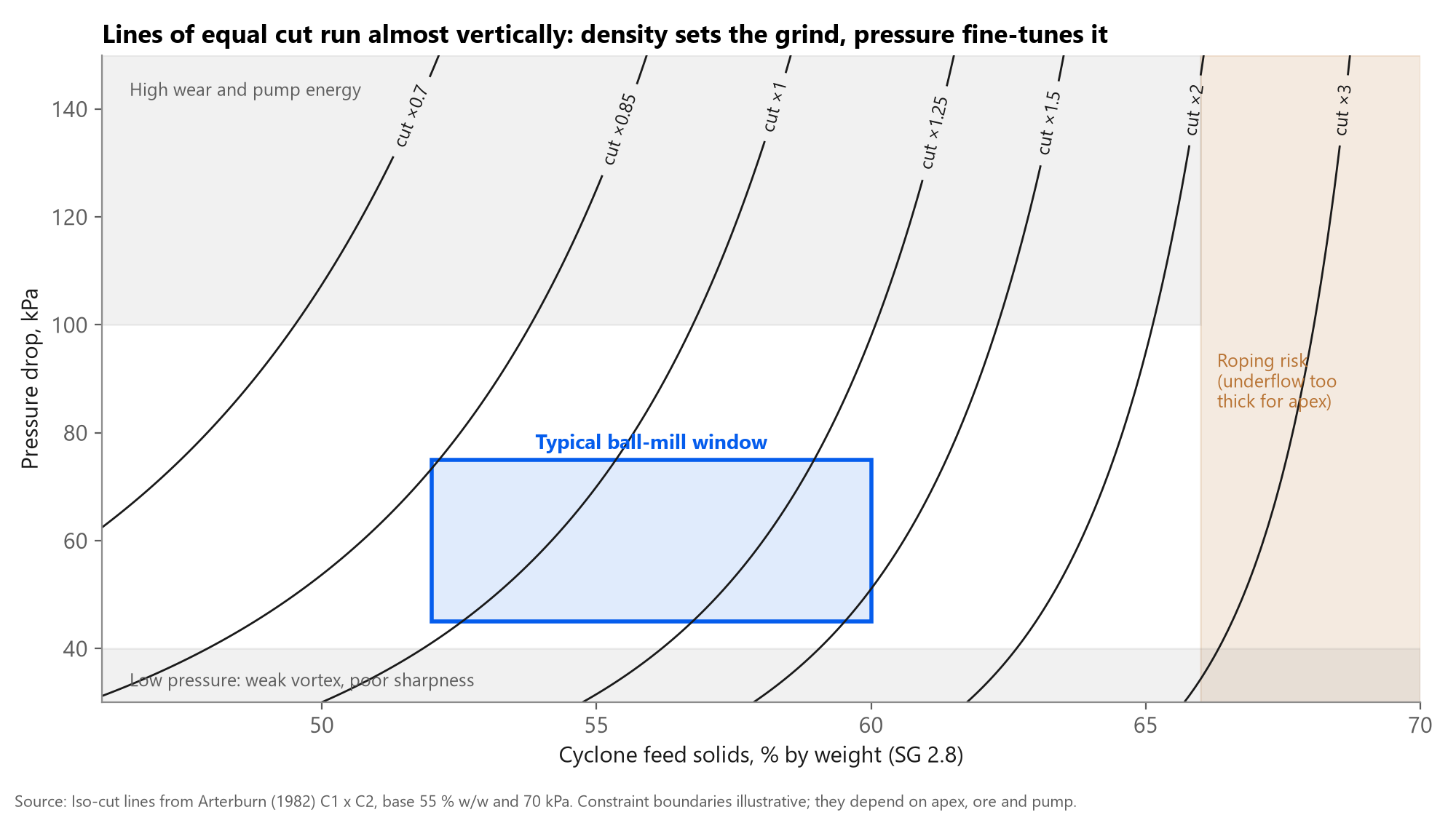
Plotted as lines of equal cut on a density-pressure map, the iso-cut lines run almost vertically: density sets the grind, pressure fine-tunes it. The usable window is bounded by roping at high solids (the underflow becomes too thick for the apex), by wear and pump energy at high pressure, and by a weak vortex and poor sharpness at low pressure.
Moving left in that window (more dilution) makes the overflow finer and, in many surveys, sends fewer misplaced fines to the underflow (this is site-specific; see where sources disagree), but it is not free. A finer cut sends more mass back to the mill, so circulating load rises; the extra water raises volumetric flow, so the pump and cyclone capacity limits come closer; and a more dilute overflow can shorten flotation residence time and load the thickener. At a fixed mill power, the plant chooses between a finer grind and more tonnes. The best operating point is where the recovery gain from a finer grind equals the value of the tonnes given up, and it moves with ore hardness.
Key numbers and rules of thumb
| Item | Value | Source |
|---|---|---|
| Feed solids +10 points w/w (55 to 65 %, SG 2.8) | Cut size x1.8 to x2.2 | Arterburn C1, Plitt, Nageswararao (computed) |
| Feed solids 54 to 48 % (plant/lab study) | Cut 130 to 90 um (-31 %) | Can. Metall. Q. 2018, doi 10.1080/00084433.2018.1464618 |
| Feed solids 52 to 48 % plus ball load 23 to 35 % | Overflow P80 128 um -22.7 %, P80 std dev -40 % | Poursaeidi et al. 2013 (changes confounded) |
| Pressure drop 50 to 100 kPa | Cut size -14 to -18 % | Arterburn C2 = 3.27 dP^-0.28; Nageswararao P^-0.22 |
| Pressure vs flow per cyclone | dP ~ Q^1.78; d50 ~ Q^-0.45 | Plitt 1976 (SysCAD implementation) |
| One cyclone opened/closed (7 of 10 open) | Pressure -18 to +38 %, cut 4-8 % | Illustrative, Plitt scaling |
| Design pressure drop | 40-70 kPa | Arterburn 1982 |
| Standby cyclones on a cluster | 20-25 % | Arterburn 1982 |
| Overflow P80 vs corrected cut | P80 ~ d50c / 1.25 | Arterburn 1982, Table 1 |
| Feed water reporting to underflow | 30-40 % | UQ / Newcrest (Lisso 2020) |
| Direct particle-size control (PST) | Up to 4.5 % finer at same t/h, or up to 10 % more t/h at same size | Cirulis 2017 (E&MJ), Metplant 2015 |
Operating practice
- Calibrate the cyclone feed density meter against hand samples on a schedule; a drifting meter quietly moves the grind. Kennecott recalibrated and re-oriented its density meters before introducing a setpoint strategy.
- Set density from a survey, not habit. A short series of density steps with overflow sizing finds the curve for your ore; many plants simply maximise water within pump limits.
- Use the cyclone count to keep pressure inside the design window (about 40-70 kPa), not as the main grind handle. Open a standby cyclone before pressure climbs, not after.
- Watch the underflow: a spray discharge is healthy, a rope means the apex is overloaded and coarse material is escaping to the overflow. Replace or close a roping cyclone quickly.
- Expect circulating load and mill density to move when the cut moves; adjust mill dilution water so the mill does not become too thick at higher recycle.
- Change one handle at a time and give the circuit a residence time or two before judging the result.
Instrumentation and control angle
A classic regulatory scheme holds sump level with pump speed, cyclone feed density with dilution water, and pressure with the number of open cyclones. These loops interact: a pressure loop on pump speed can amplify sump level swings, and density changes move flow and pressure. O'Keefe (2017) notes that until reliable online size measurement existed, plants used cyclone feed density, pressure or both as surrogates for grind size, and that direct size control performs better because the surrogate relationship shifts with ore.
A multivariable controller holds overflow size (from a particle-size instrument or a soft sensor) and ball mill power by trimming the density setpoint, while respecting pump, sump, pressure and roping constraints. CiDRA reports up to 4.5 % finer product at the same throughput, or up to 10 % more throughput at the same size, with such a scheme, and a simulated US$2 M/yr from closing the coarsest cyclone in a cluster. These are vendor-reported and should be read as upper references.
Aeterna fit: MPC coordinates density, cluster pressure and size; a Digital Twin of the cyclone and mill helps choose the density target per ore type; the Rock Analyzer gives an early signal of harder or coarser feed that will raise circulating load. Fundamentals first; the tie-in should stay light.
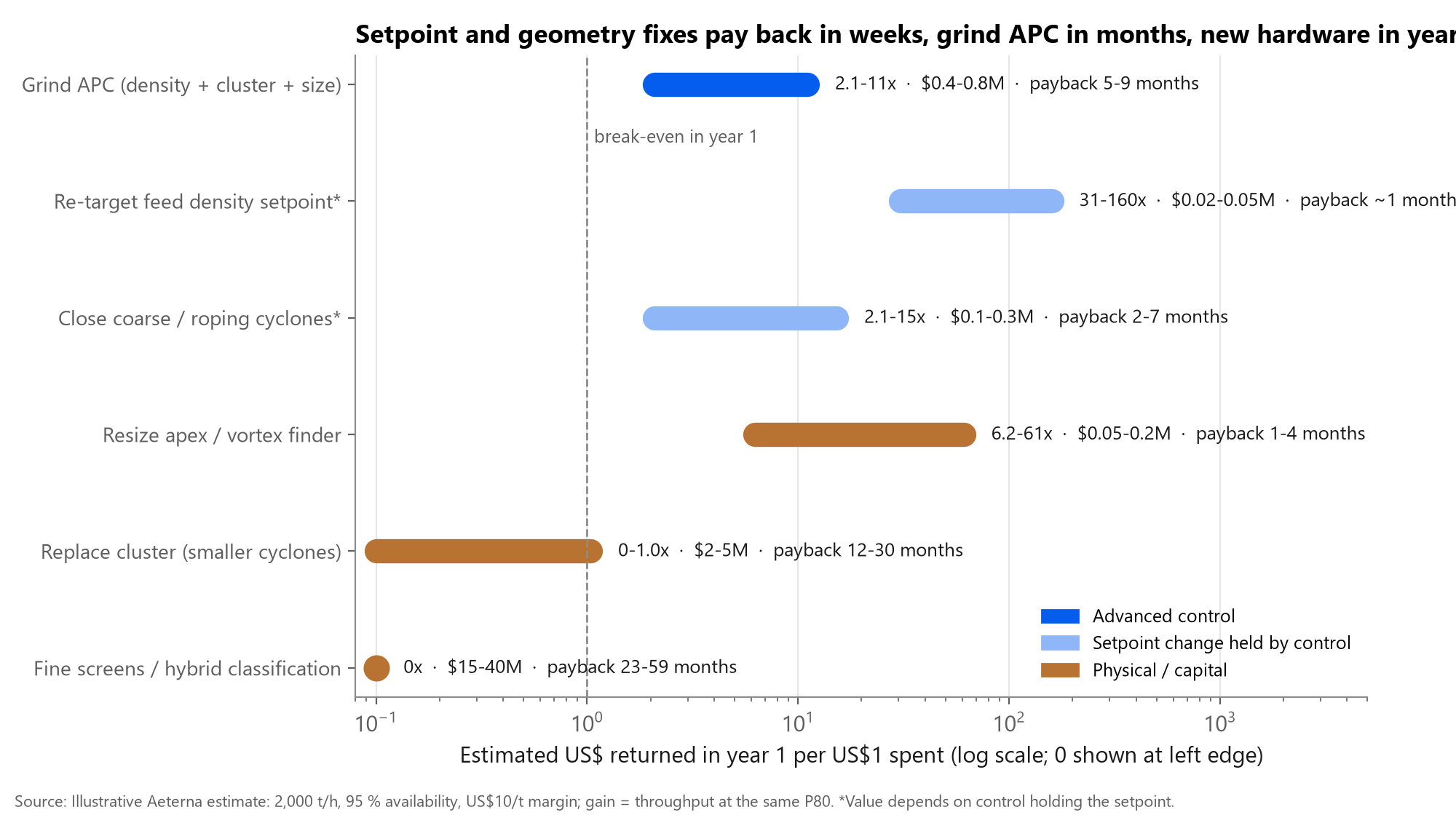
Estimated ROI of grind levers (illustrative)
Reference plant 2,000 t/h, 95 % availability, US$10/t margin, so 1 % throughput is worth about US$1.66 M/yr. Gains are expressed as throughput at the same P80. The cheapest levers (density setpoint, apex/vortex finder sizing) have the highest return per dollar, but the density gain only lasts if control holds the setpoint as ore changes. Grind APC costs more and returns about 2-11x in year one.
| Lever | Gain (throughput at same P80) | Est. cost incl. lost production | Time to value | Payback | Year-1 return per $1 | What it needs |
|---|---|---|---|---|---|---|
| Grind APC (density + cluster + size) | 2-4 % | $0.4-0.8M | 4-6 months | 5-9 months | 2.1-11x | no shutdown · uses existing meters + PSI |
| Re-target feed density setpoint* | 1-2 % | $0.02-0.05M | 0.5-1 months | ~1 month | 31-160x | survey + recalibrated DT · held by control |
| Close coarse / roping cyclones* | 0.5-1 % | $0.1-0.3M | 1-3 months | 2-7 months | 2.1-15x | per-cyclone sensing · held by control |
| Resize apex / vortex finder | 1-2 % | $0.05-0.2M | 1-3 months | 1-4 months | 6.2-61x | spares + change-out at a stop |
| Replace cluster (smaller cyclones) | 3-5 % | $2-5M | 9-18 months | 12-30 months | 0-1.0x | capital · tie-in shutdown |
| Fine screens / hybrid classification | 10-20 % | $15-40M | 18-30 months | 23-59 months | 0x | capital project · plant layout |
Common misconceptions
- 'Raise the pressure to get a finer grind.' Pressure is a weak lever (doubling it gives 14-18 % finer) and costs wear and pump energy.
- 'The density reading is the truth.' Nuclear and Coriolis meters drift and scale; without regular checks the setpoint means less every month.
- 'More water is always better.' Over-dilution raises flow toward pump and cyclone limits, dilutes the overflow to flotation and can starve the mill of density.
- 'Closing cyclones fixes a coarse overflow.' It raises pressure but can overload the remaining apexes and trigger roping elsewhere.
- 'Holding density means holding grind.' Density is a surrogate; ore hardness and feed size change the density-size relationship.
Where sources disagree or are uncertain
- The three correlations agree within about 10 % up to 60 % solids by weight but diverge above it; Arterburn's C1 rises sharply as feed solids approach 53 % by volume. Treat model numbers above 62 % w/w as indicative only.
- Plitt carries pressure through flow, not as an independent variable; the 'pressure exponent' of -0.25 assumes fixed geometry and free discharge.
- The 54 to 48 % / 130 to 90 um result is cited from the abstract of a 2018 Canadian Metallurgical Quarterly paper; authors and full method were not confirmed.
- The Poursaeidi et al. copper case changed feed solids together with ball load and mill density, so the 22.7 % P80 reduction cannot be attributed to density alone; the abstract text is partly garbled (52 to 48 % is an inference).
- PST benefits (4.5 % finer, 10 % more throughput, US$2 M/yr) are vendor-reported (CiDRA) and should be treated as upper references.
- The effect of feed density on bypass is not settled: dilution is widely recommended to improve classification efficiency (UQ/Newcrest, plant surveys), but a 24-inch cyclone test reported by 911 Metallurgist found lower bypass at higher density. Treat bypass gains from dilution as site-specific.
- The cyclone-count figure is illustrative: real pump curves reduce flow when cyclones are closed, so pressure changes are smaller than the constant-flow case.
Ask for a grind survey: a few density steps show where your cyclone cut sits and what a steadier grind is worth.
Talk to an engineerSources
- The sizing and selection of hydrocyclones, Arterburn, R.A., Krebs Engineers / SME-AIME, Design and Installation of Comminution Circuits, 1982
- A mathematical model of the hydrocyclone classifier, Plitt, L.R., CIM Bulletin 69, 1976
- Cyclone model documentation (Plitt and Nageswararao equations), SysCAD / KWA Kenwalt, 2024
- Mineral comminution circuits: their operation and optimisation, Napier-Munn, Morrell, Morrison, Kojovic, JKMRC, 1996
- Particle size tracking system vs traditional measurement techniques, Cirulis, D., E&MJ (CiDRA), March 2017, 2017
- Process optimization using real time tracking of coarse material in individual cyclone overflow streams, Cirulis et al., Metplant 2015, AusIMM, 2015
- Grind circuit optimization at Rio Tinto Kennecott, O'Keefe et al., CiDRA reprint BI0614, 2014
- Measuring grinding circuit performance with real-time particle size on individual cyclones, O'Keefe, C.V., 2017 Platinum Conference, SAIMM, 2017
- Effect of grinding parameters including hydrocyclone feed solids on grinding efficiency, Canadian Metallurgical Quarterly (Taylor & Francis), 2018
- Increasing efficiency of the primary grinding circuit of Shahr-e-Babak copper concentrator, Poursaeidi, Shamsadini, Arghavani, Banisi, J. Analytical and Numerical Methods in Mining Eng. 2(4), 2013
- Poor classification costing the minerals industry significant revenue, UQ Sustainable Minerals Institute / Newcrest (Frausto 2020; Lisso 2020), 2020
- Hydrocyclone roping detector and method (US 6,983,850), Olson et al., US patent, 2006
- Sensitivity analysis of hydrocyclone performance in mineral processing using Monte Carlo simulation, Brazilian Journal of Instrumentation and Control (UTFPR), 2023
- Effect of chemical dispersants on hydrocyclone efficiency, 911 Metallurgist, n.d.
- Grinding circuit control strategy, 911 Metallurgist, n.d.