
Crushing Fundamentals: Jaw, Gyratory and Cone Crushers
How jaw, gyratory and cone crushers break rock, and why it matters for the mills
How each crusher breaks rock
Jaw crusher: rock is squeezed between a fixed jaw and a swinging jaw driven by an eccentric shaft. The opening at the top (the gape) limits the largest lump it can accept; the narrowest gap at the bottom (CSS) limits the largest product. Crushing happens on one side only, half the cycle, so capacity per unit of gape is modest, but the machine is simple, robust and easy to install, including underground.
Gyratory crusher: a conical head (mantle) gyrates inside a fixed bowl (concaves). Crushing happens continuously around the circumference, so a gyratory delivers far more capacity for the same gape. Haul trucks can dump directly into the top, which keeps it choke fed without a separate feeder.
Cone crusher: a compact relative of the gyratory with a shorter, supported spindle, a flatter head and a wider throw at higher speed. Standard heads are used in secondary duty, short heads in tertiary duty. Hydraulic adjustment of CSS and tramp-iron relief are standard on modern units.
- Gape: width of the feed opening. Feed top size is usually kept somewhat below the gape so lumps do not bridge.
- CSS (closed side setting): smallest gap between crushing surfaces during the cycle; sets product top size.
- OSS (open side setting): largest gap during the cycle.
- Throw: OSS minus CSS; more throw generally means more capacity and coarser product.
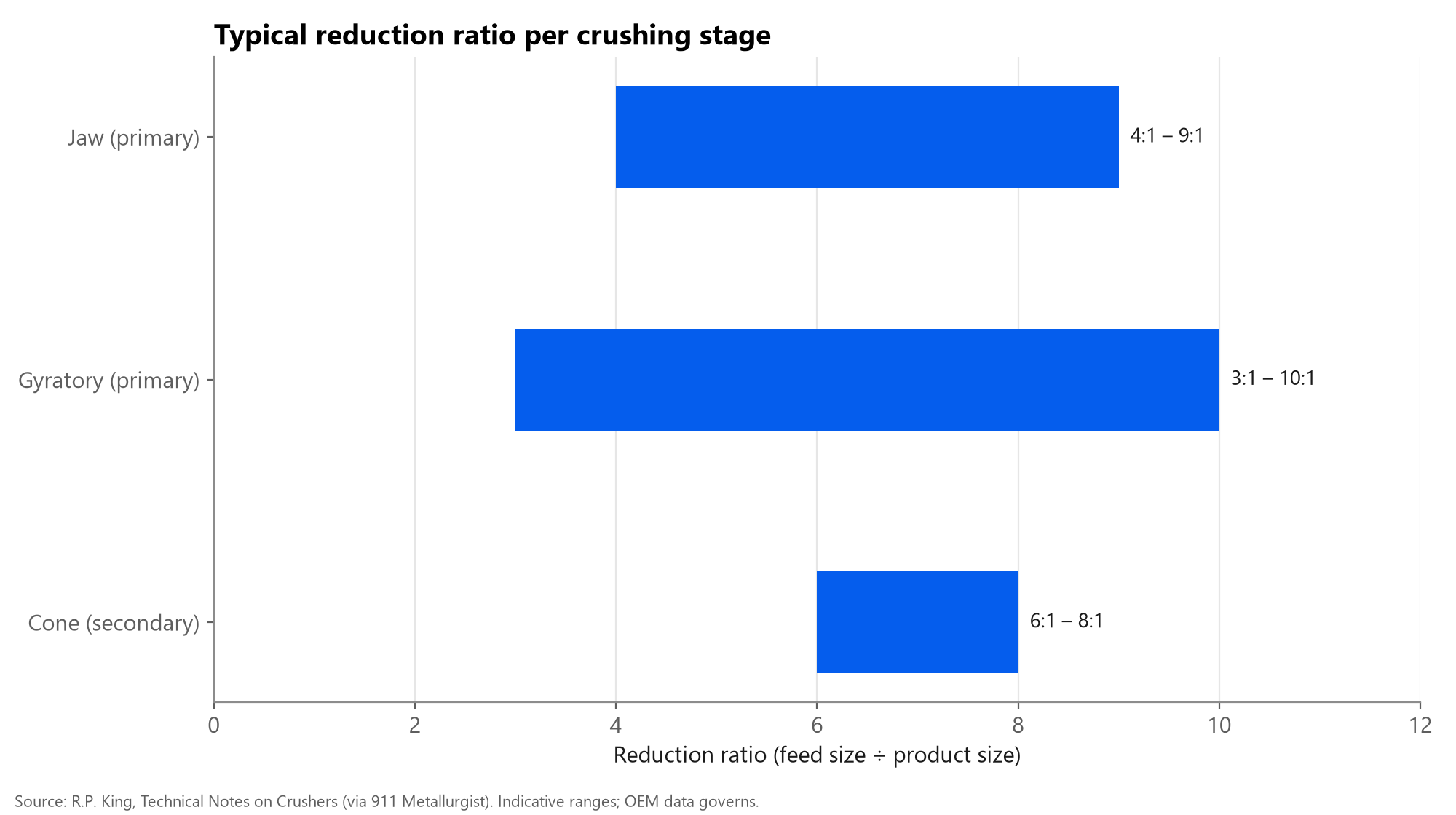
- Reduction ratio: feed size divided by product size, usually expressed with 80 % passing sizes (F80 / P80).
Key numbers and rules of thumb
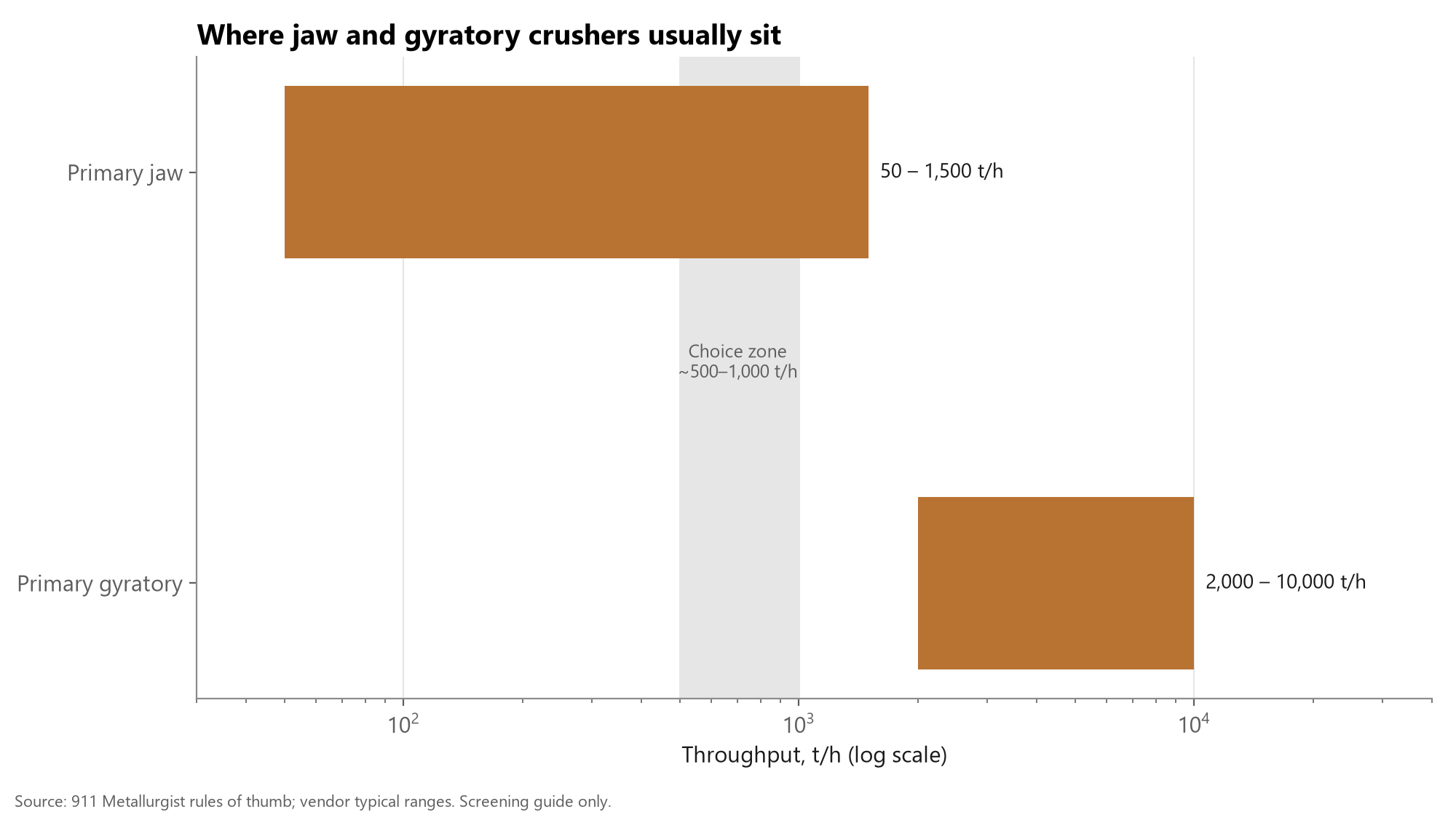
- Jaw vs gyratory screen: jaw below ~500-600 t/h, gyratory above ~1,000 t/h, choice zone in between (911 Metallurgist rules of thumb).
- Quick test quoted in the same guides: if hourly tonnage divided by the square of the required gape (inches) is below ~0.115, a jaw is indicated; metric form ~162 x gape(m)^2 t/h. Treat as a screening rule only.
- A finer CSS produces a higher proportion of fines and lowers capacity (Pit & Quarry).
| Item | Jaw | Gyratory | Cone |
|---|---|---|---|
| Typical duty | Primary | Primary (high tonnage) | Secondary / tertiary |
| Reduction ratio (per stage) | ~4:1 - 9:1 | ~3:1 - 10:1 | ~6:1 - 8:1 (secondary) |
| Typical throughput band | ~50 - 1,500 t/h | ~2,000 - 10,000 t/h | Depends on size and setting |
| Crushing action | One side, half cycle | Continuous, full circumference | Continuous, wide throw, higher speed |
| Feeding | Needs feeder / grizzly to choke feed | Direct truck dump, naturally choke fed | Choke feeding recommended |
| Strengths | Simple, low cost, suits underground | Capacity per gape, low cost per tonne at scale | Fine product, good shape when choke fed |
Where each crusher sits in the flowsheet
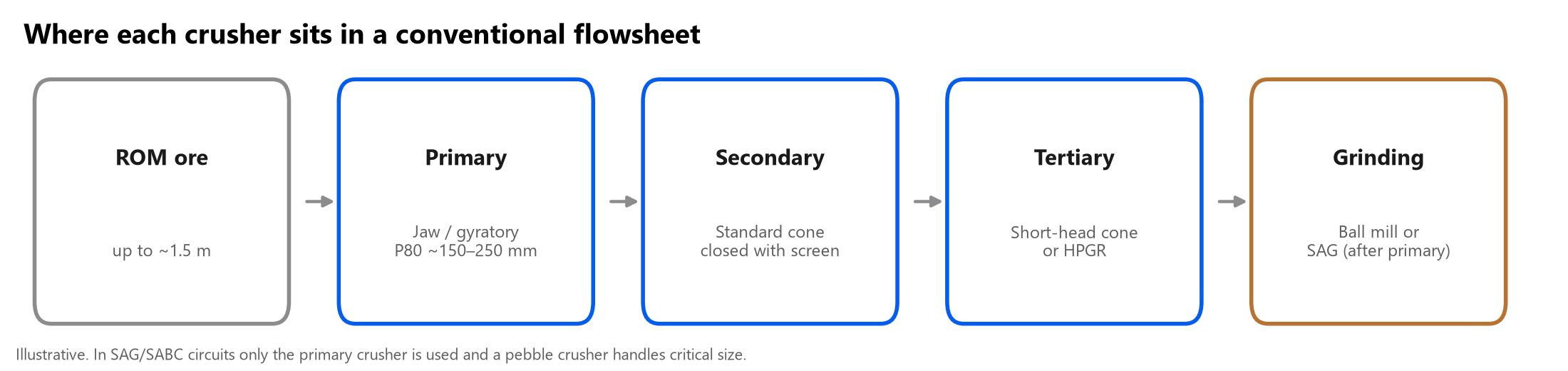
In a conventional three-stage plant, a primary jaw or gyratory takes run-of-mine ore down to roughly 150-250 mm, a standard cone in closed circuit with a screen takes it further, and a short-head cone (or HPGR) prepares ball mill feed. In SAG and SABC circuits only the primary crusher is used ahead of the mill, and a pebble (recycle) crusher handles the critical-size material the SAG mill struggles to break.
Because each stage only reduces size by a ratio of roughly 3-10, the number of stages follows from the ratio between run-of-mine top size and the size the mills want to see.
Operating insight: choke feeding and breakage mode
Research at Chalmers University of Technology shows the choke level in a cone crusher decides the breakage mode: above it particles break against each other (interparticle breakage), below it mostly single particles break against the liners. Interparticle breakage gives a more cubic product and spreads wear more evenly.
Model studies report the share of interparticle breakage moving from about 64 % in a poor setup (small throw, low speed, large setting) to about 87 % in a good one (large throw, high speed, medium setting). Increasing CSS raises the choke level and reduces the number of interparticle crushing zones.
Higher reduction ratio per stage tends to worsen particle shape; when product shape matters (aggregates) or when the next stage is sensitive to it, spreading reduction across stages helps.
- Keep the cone chamber full: steady feed and level control matter as much as the setting.
- Check CSS routinely as liners wear; drift opens the product size and shifts load downstream.
- Watch power and hydraulic pressure together; running against one limit while the other has room usually means an adjustment is possible.
Instrumentation and control angle
Crushers are where the ore first meets the plant's control system, and crusher product size is one of the earliest signals of what the mills will face next. Typical crusher automation includes cavity (choke) level control, constant power or pressure control and automatic CSS adjustment.
Measuring the size distribution on the crusher discharge belt, continuously rather than by occasional sampling, gives the grinding controller a head start: a coarser or harder feed can be anticipated before it shows up as a rising SAG load. This is the natural bridge to Aeterna's Rock Analyzer and MPC, and should be kept light in a Fundamentals piece.
Common misconceptions
- 'A gyratory is just a big jaw' - its continuous crushing action is why capacity per gape is so much higher.
- 'Tighter CSS is always better for the mill' - finer product helps the mill, but costs crusher capacity and liner life; the optimum is a circuit-level trade-off.
- 'Reduction ratio is a machine constant' - it depends on ore, setting, throw, speed and how full the chamber is.
Curious how your crusher product size moves your SAG mill? Talk to us about continuous rock-size measurement.
Talk to an engineerSources
- Technical Notes 5: Crushers, R.P. King (hosted by 911 Metallurgist)
- Crusher Close Side Settings, 911 Metallurgist
- Primary Crusher Selection & Design, 911 Metallurgist
- Rock Crushing Rule of Thumb, 911 Metallurgist
- Mill operations - crushing, University of Alaska Fairbanks
- Tips to Maximize Crushing Efficiency, Pit & Quarry, 2019
- Cone Crusher Performance (PhD thesis), Chalmers University of Technology
- Application of discrete element method for simulating feeding conditions and size reduction in cone crushers, Chalmers University of Technology
- Crusher (Whiten) model, MetDynamics wiki
- Mining legacy processes setting the industry behind in sustainability targets (Weir-commissioned study), MINING.COM
- Grinding down energy consumption in comminution (CEEC), MINING.COM (sponsored)
- Wills' Mineral Processing Technology, 8th ed., Wills & Finch, Butterworth-Heinemann, 2016