
Cleaner Circuit Best Practice: Recirculating Loads and Grade Stability
Why cleaner circuits drift, and the habits and controls that keep final grade steady
How a cleaner circuit is built
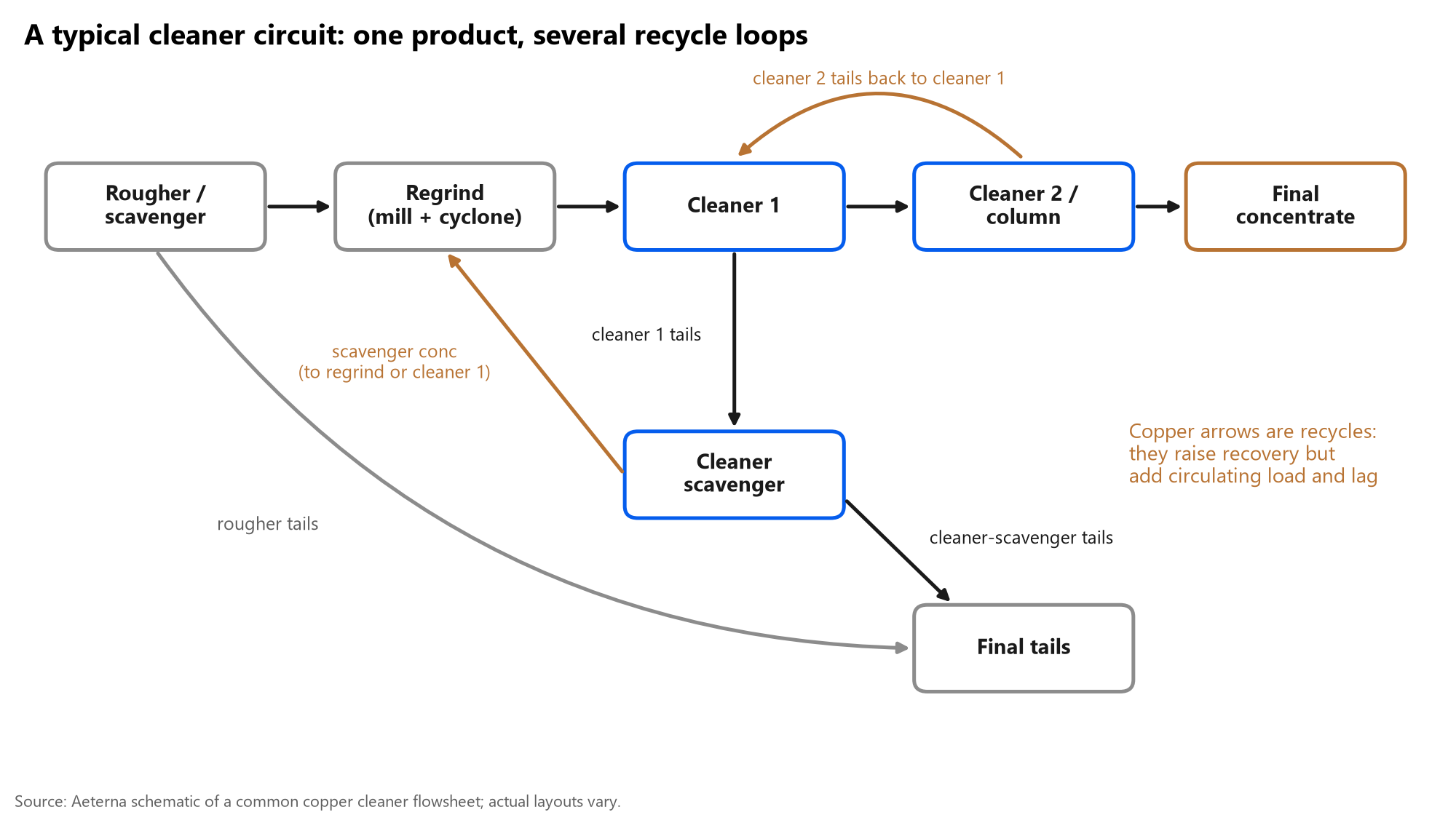
Rougher concentrate is usually reground, then upgraded in one to three cleaning stages (mechanical cells and, often, a column as the last stage). Cleaner 1 tails go to a cleaner scavenger whose tails are final tails and whose concentrate is returned to regrind or to cleaner 1. Later-stage cleaner tails usually return counter-current to the previous stage.
Each recycle recovers mineral that would otherwise be lost, but every recycle also creates a loop: material that floats slowly goes round and round until it either floats, is reground, or leaves in the scavenger tails. That loop is where most of the instability of a cleaner circuit comes from.
Recirculating load: why slow floaters pile up
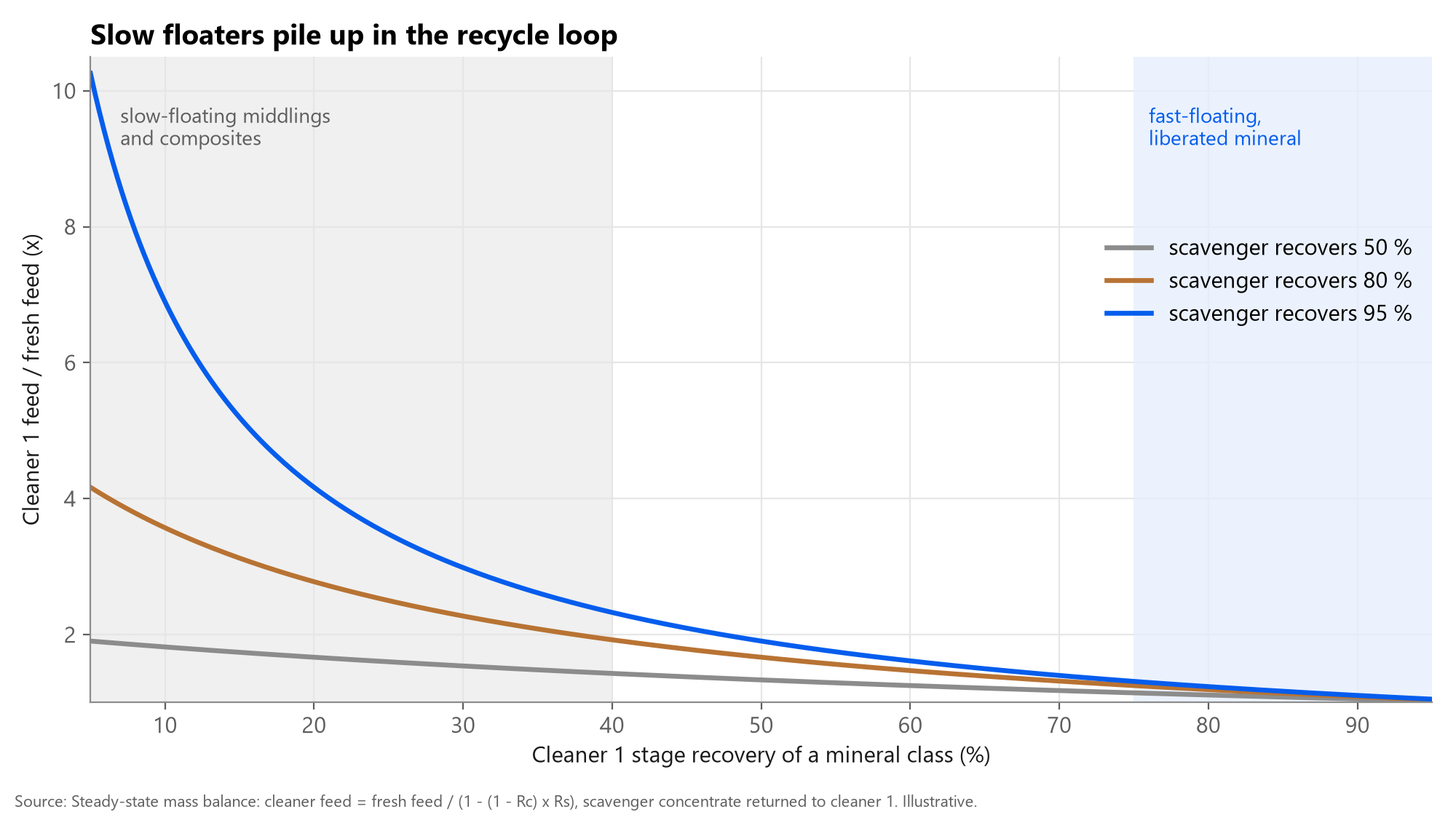
For a mineral class with cleaner-1 stage recovery Rc, and a cleaner scavenger that recovers a fraction Rs of what it receives back to cleaner 1, the steady-state cleaner feed is the fresh feed divided by 1 - (1 - Rc) Rs. Liberated, fast-floating mineral (Rc above 75 %) adds little load. Composites and middlings with Rc of 10-30 % can multiply cleaner feed by three to six times when the scavenger is efficient.
That build-up raises mass pull, shortens residence time, and fills the cleaner with low-grade material, so final grade drops even though nothing upstream has changed. At Los Pelambres, high throughput turned the cleaner-scavenger loop and its concentrate launders and transfer boxes into the bottleneck, with circulating load defined as scavenger concentrate over rougher concentrate.
Practical consequences: send slow-floating scavenger concentrate to the regrind mill rather than straight back to cleaner 1 where liberation is the issue; size launders and pumps for the circulating load, not the design product rate; and measure the circulating load (flow and density on the scavenger concentrate) so it can be controlled.
Recycles and grade stability
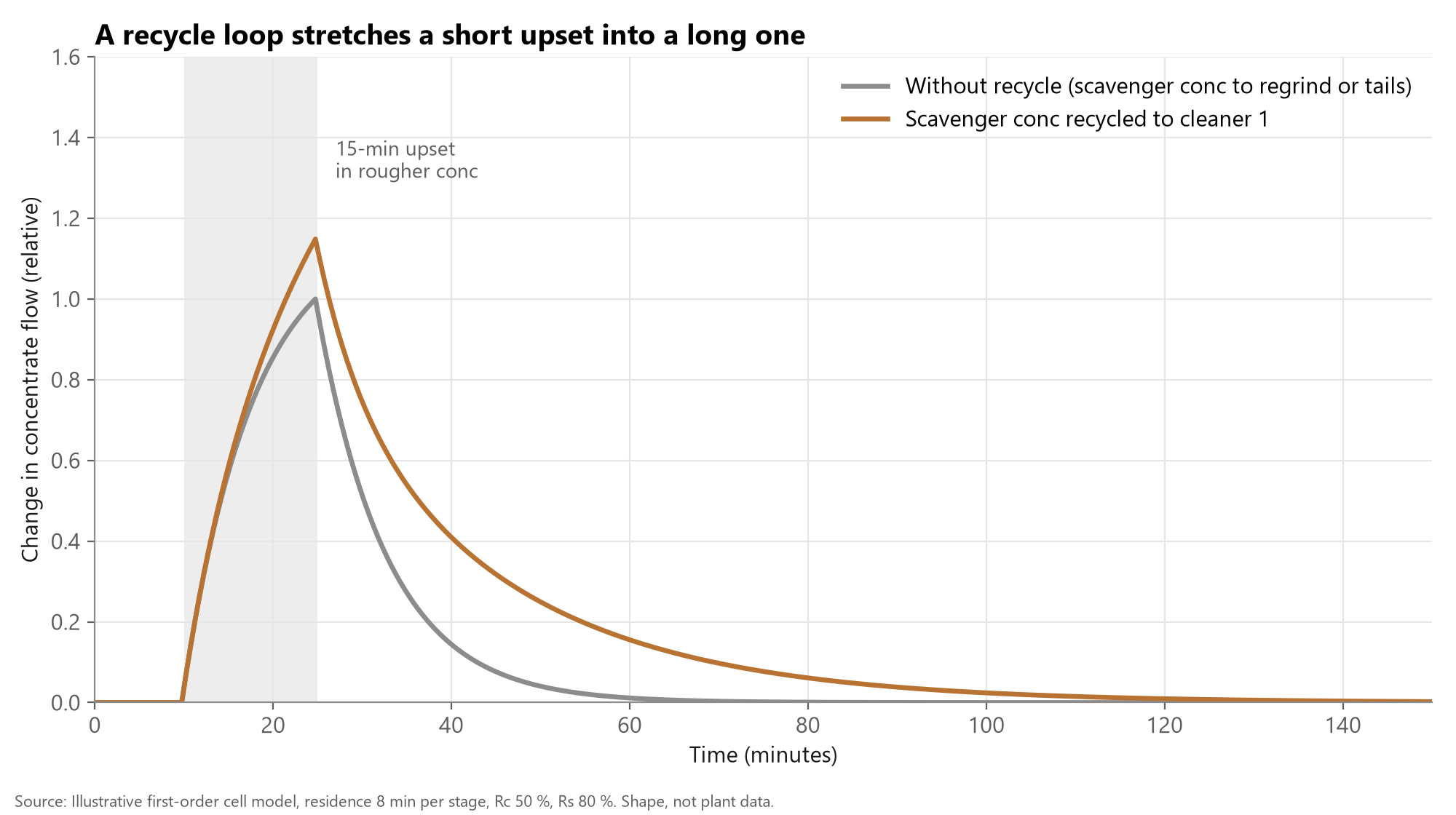
A recycle loop is a feedback path with lag. A surge in rougher concentrate reaches cleaner 1, part of it goes to the scavenger, comes back eight to fifteen minutes later and passes through cleaner 1 again. The circuit's response to any upset is longer and larger than any single cell would suggest, which is why operators see final grade swing long after the original cause has gone.
This is also why many plants run cleaners conservatively (low air, shallow pull) and accept lost recovery to protect grade. Stabilising levels, air and the circulating load first, then optimising grade-recovery set-points, is the order recommended across flotation control literature, and was the approach at Renison, where control of the major recycle dominated circuit behaviour.
Entrainment and wash water
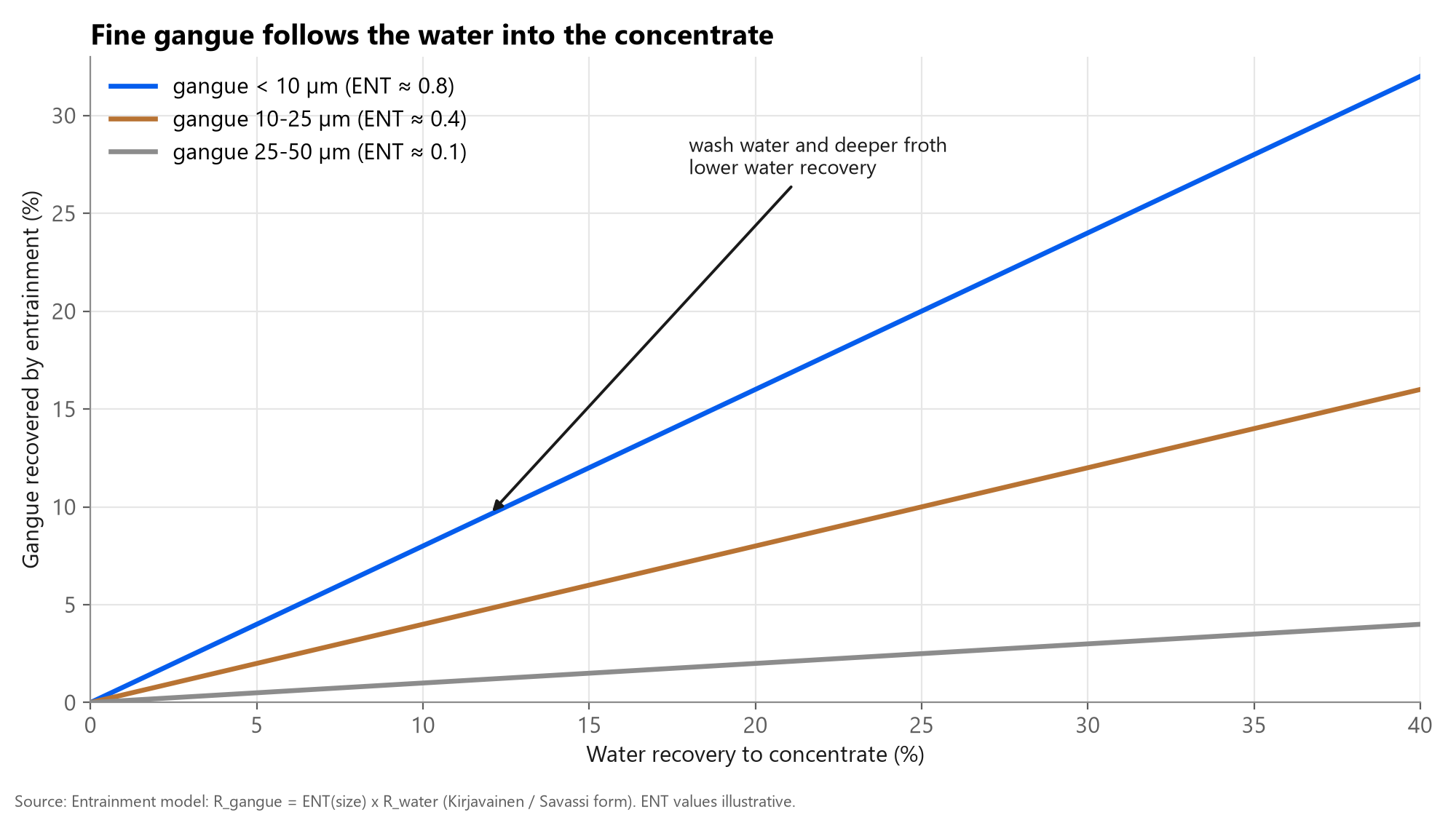
Gangue reaches cleaner concentrate mainly by entrainment: fine particles carried up in the water between bubbles. Gangue recovery by entrainment is roughly proportional to water recovery, with a factor (ENT) close to 1 for slimes and falling towards zero for particles above about 50 µm.
So the cleaner's grade levers are the water levers: froth depth (deeper froth drains more), air rate (more air carries more water), and wash water. Wash water added at the top of a column or onto a mechanical cell froth displaces the entrained water; it raises concentrate grade, with the trade-off that water added above the froth raises water recovery while water added just below the froth-pulp interface cuts entrainment more at a lower water recovery. Regrinding finer liberates more mineral but makes more slimes, so entrainment control matters more after a finer regrind.
Regrind: the ceiling on cleaner grade
- Regrinding a copper rougher-scavenger concentrate from P80 83 µm to 32 µm raised chalcopyrite liberation in cleaner feed from 63 % to 90 % (911 Metallurgist case summary).
- Locked-cycle tests: a regrind P80 of 45 µm gave 23.3 % Cu; 27 µm gave 29.4 % Cu, recovery 92.7 % vs 91.6 %.
- Prominent Hill: rougher concentrate needed P80 20-25 µm to liberate fluorine-bearing gangue; an IsaMill was chosen partly for its inert grinding environment.
- Sandfire DeGrussa: IsaMill regrind to about P80 18 µm; cleaner recovery 75-82 % with entrained non-sulphide gangue in the concentrate, leading to additional cleaner cells.
- Regrind cyclone performance matters as much as mill size: poor classification sends fines back to the mill and over-grinds them into slimes.
Best-practice checklist
- Measure the circulating load: flow and density on scavenger concentrate and cleaner feed.
- Route slow-floating, composite scavenger concentrate to regrind, not straight back to cleaner 1.
- Stabilise levels and air first; then set grade-recovery targets.
- Use froth depth and wash water to control entrainment; review after any regrind change.
- Size launders, pumps and transfer boxes for peak circulating load.
- Survey the cleaner circuit by size and liberation at least yearly; check cleaner stage recoveries by class.
Estimated ROI of cleaner-circuit levers
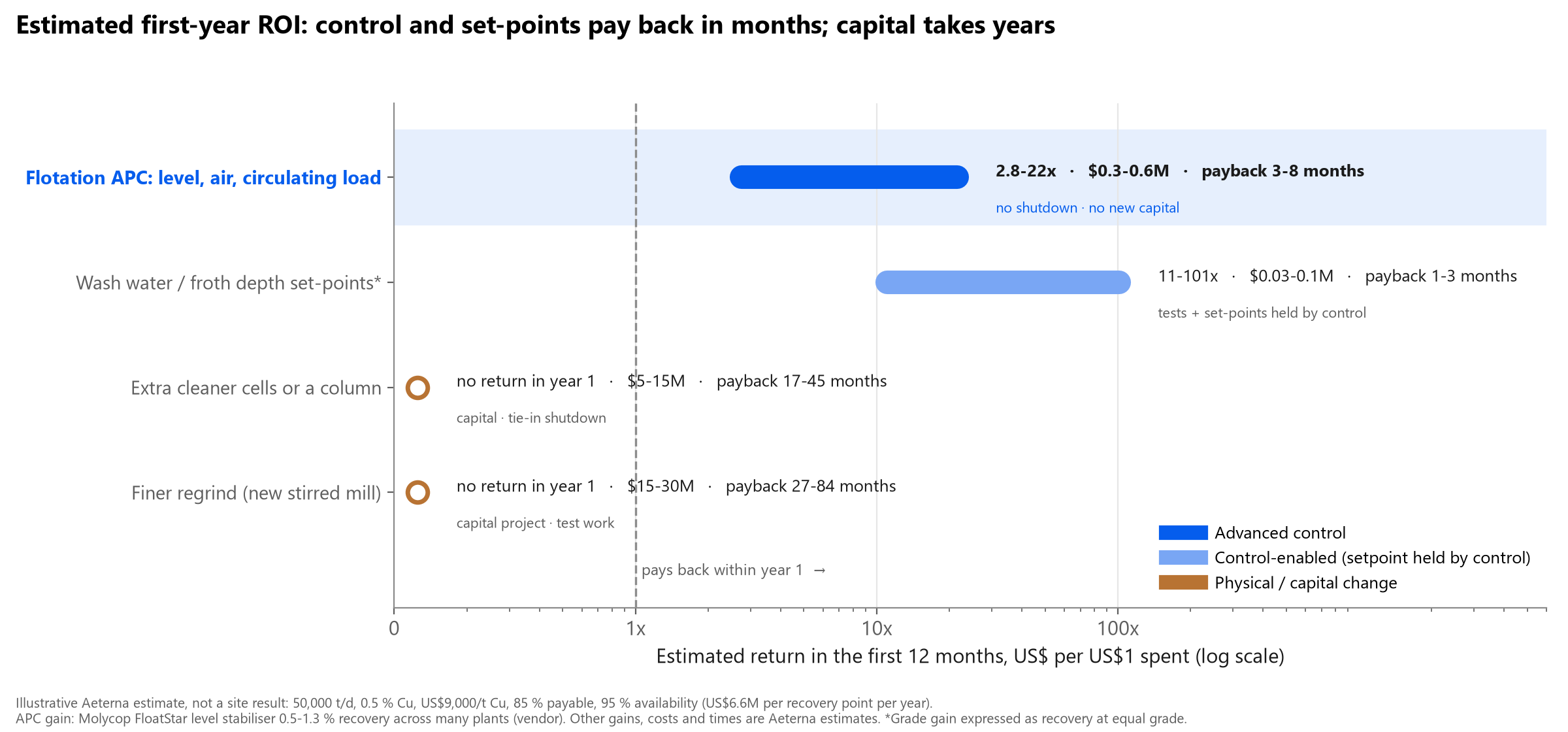
Using an illustrative copper concentrator (50,000 t/d, 0.5 % Cu, US$9,000/t Cu, 85 % payable, 95 % availability), each percentage point of recovery is worth about US$6.6M a year. Stabilising control (level, air and circulating-load control) uses the published 0.5-1.3 % recovery range from level stabiliser installations; the other gains, costs and times are Aeterna estimates. Costs include lost production for tie-ins.
On this basis, control returns roughly 3-22x its cost in the first year with a payback of three to eight months. Wash water and froth-depth set-points held by control return even more per dollar because they cost very little. Extra cleaner cells or a column, and a finer regrind mill, may deliver larger gains but return nothing in the first year and pay back over one and a half to seven years.
| Lever | Gain | Est. cost incl. lost production | Time to value | Payback | Year-1 return |
|---|---|---|---|---|---|
| Flotation APC: level, air, circulating load | 0.5-1.3 % rec. | $0.3-0.6M | 3-6 months | 3-8 months | 2.8-22x |
| Wash water / froth depth set-points* | 0.2-0.5 % rec. | $0.03-0.1M | 1-2 months | 1-3 months | 11-101x |
| Extra cleaner cells or a column | 1-2 % rec. | $5-15M | 12-18 months | 17-45 months | 0x |
| Finer regrind (new stirred mill) | 1-3 % rec. | $15-30M | 18-30 months | 27-84 months | 0x |
APC and instrumentation angle
The cleaner circuit is where advanced control is most visible to the metallurgist: final grade is the product. A useful hierarchy is (1) level control that handles the interaction between cells in series, (2) air and froth-depth control per bank, (3) circulating-load control on the scavenger concentrate, and (4) a grade-recovery layer that trims mass pull from an online analyser or froth measurements.
Aeterna's Froth Analyzer measures froth velocity, bubble size and colour on cleaner cells so the controller sees changes in minutes, before an assay arrives; ProcessOpt holds levels, air and circulating load together and trims mass pull to the final-grade target. The honest message is stability first: steady cleaners let the plant run closer to its grade target with more recovery.
Common misconceptions
- 'More recycle always means more recovery.' Beyond a point it adds load, lowers residence time and dilutes grade.
- 'Low grade means the reagent is wrong.' Often it is entrainment from high water recovery or an overloaded loop.
- 'Finer regrind always helps.' It raises liberation but also slimes and entrainment; it must be matched with froth and wash-water control.
- 'The cleaner circuit is small, so it can be run by hand.' Its recycles make it the most interactive part of the plant.
Where sources disagree or are uncertain
- Recovery gains from flotation control are mostly vendor reported (0.5-1.3 %); independent before/after studies are scarce.
- Whether to send scavenger concentrate to regrind or cleaner 1 depends on liberation; sources give site examples, not a rule.
- Wash water benefits depend on addition point; sources agree on direction but not size of the effect.
- Figures 2, 3 and 4 are illustrative models showing direction and shape, not plant data.
Ask for a flotation circuit review: we map your recycles and show where grade stability is lost.
Talk to an engineerSources
- FloatStar technical sheet (level stabiliser 0.5-1.3 % recovery), Molycop / Mintek
- Effective circulating load in flotation (Los Pelambres cleaner-scavenger), BazTech / Physicochemical Problems of Mineral Processing
- Control experiences with a cassiterite flotation circuit (Renison), OneMine / AusIMM, 1984
- Flotation circuit automation, 911 Metallurgist
- Froth washing in mechanical flotation machines, 911 Metallurgist
- Wash water and entrainment in column flotation (thesis), University of Cape Town
- Effect of regrinding (liberation and grade cases), 911 Metallurgist
- Designing the optimal flotation circuit - the Prominent Hill case, AusIMM Mill Operators' Conference, 2009
- Implementation of an advanced milling and flotation control system at Mopani Mufulira, AusIMM Mill Operators' Conference, 2014