
Choke Feeding a Cone Crusher: Liner Life, CSS Checks and Throughput
Keep the chamber full, the gap honest and the liners worn evenly
Why choke feeding matters
A cone crusher breaks large rocks directly between mantle and bowl liner (single-layer crushing) and smaller rocks against each other (multi-layer or interparticle crushing). Metso's HP guide credits multi-layer crushing with better product shape and lower wear-part consumption, and it only happens when the chamber is full.
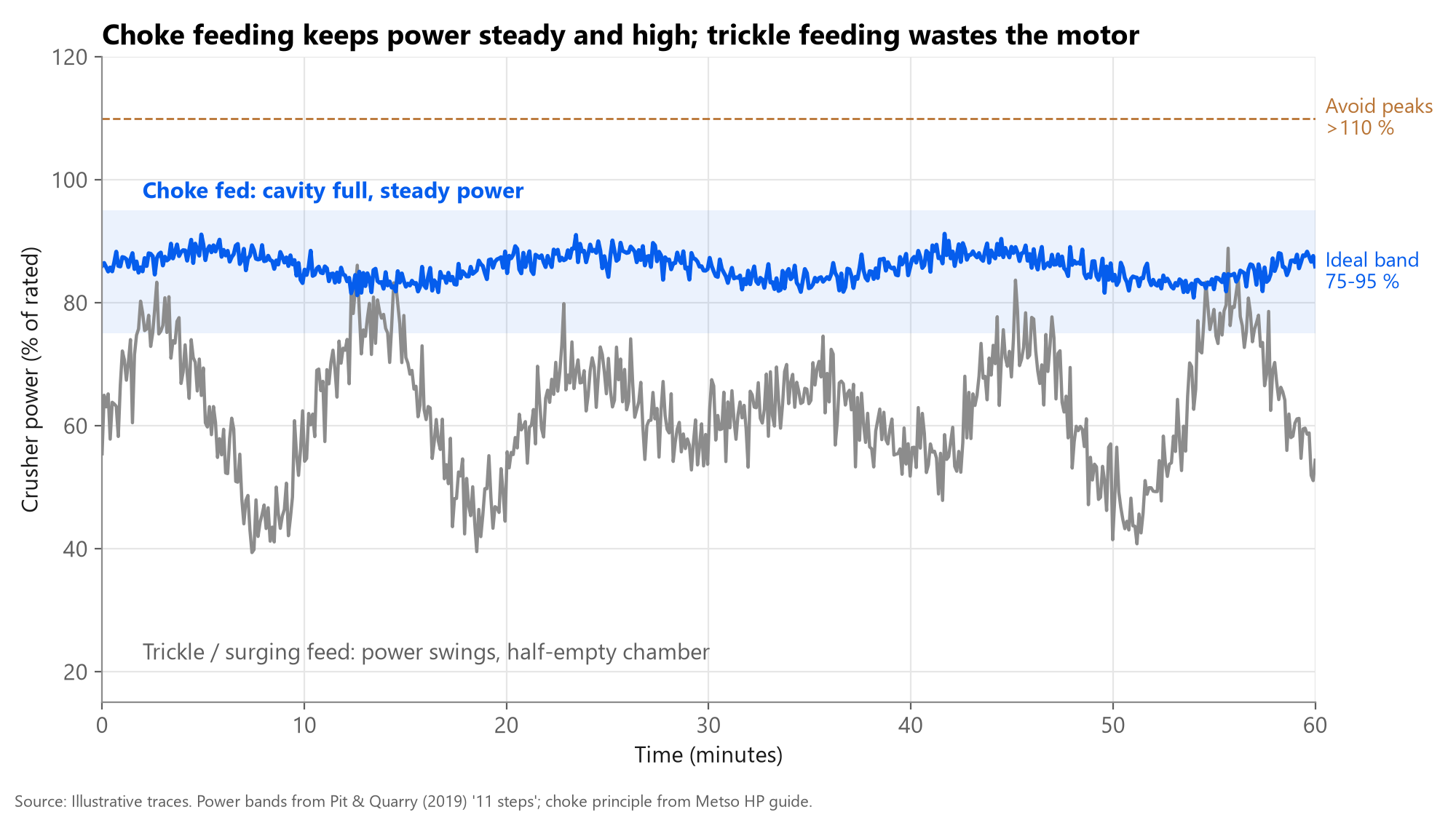
A choke-fed crusher has rock stacked above the feed plate all the way around - Metso gives at least 300 mm for HP cones. A trickle-fed crusher, by contrast, runs a half-empty chamber: rocks are crushed one at a time, product becomes flatter and more elongated, power swings and the bottom of the liners wears faster than the top.
- Feed into the centre so the cavity fills evenly 360 degrees; off-centre feed creates power and force cycles every gyration.
- Avoid segregation (coarse on one side, fines on the other) - it packs one side, causes ring movement and wears the liners unevenly.
- Keep fines low: <= 25 % for secondary, <= 10 % for tertiary cones; screen out 0-4 mm where possible.
- Limit feed drop height (about 1 m on small to mid-size cones) to avoid high-velocity wedging.
- Smooth the flow: surge bins and variable-speed feeders turn intermittent truck or conveyor flow into a steady choke level.
The three design limits: volume, power and force
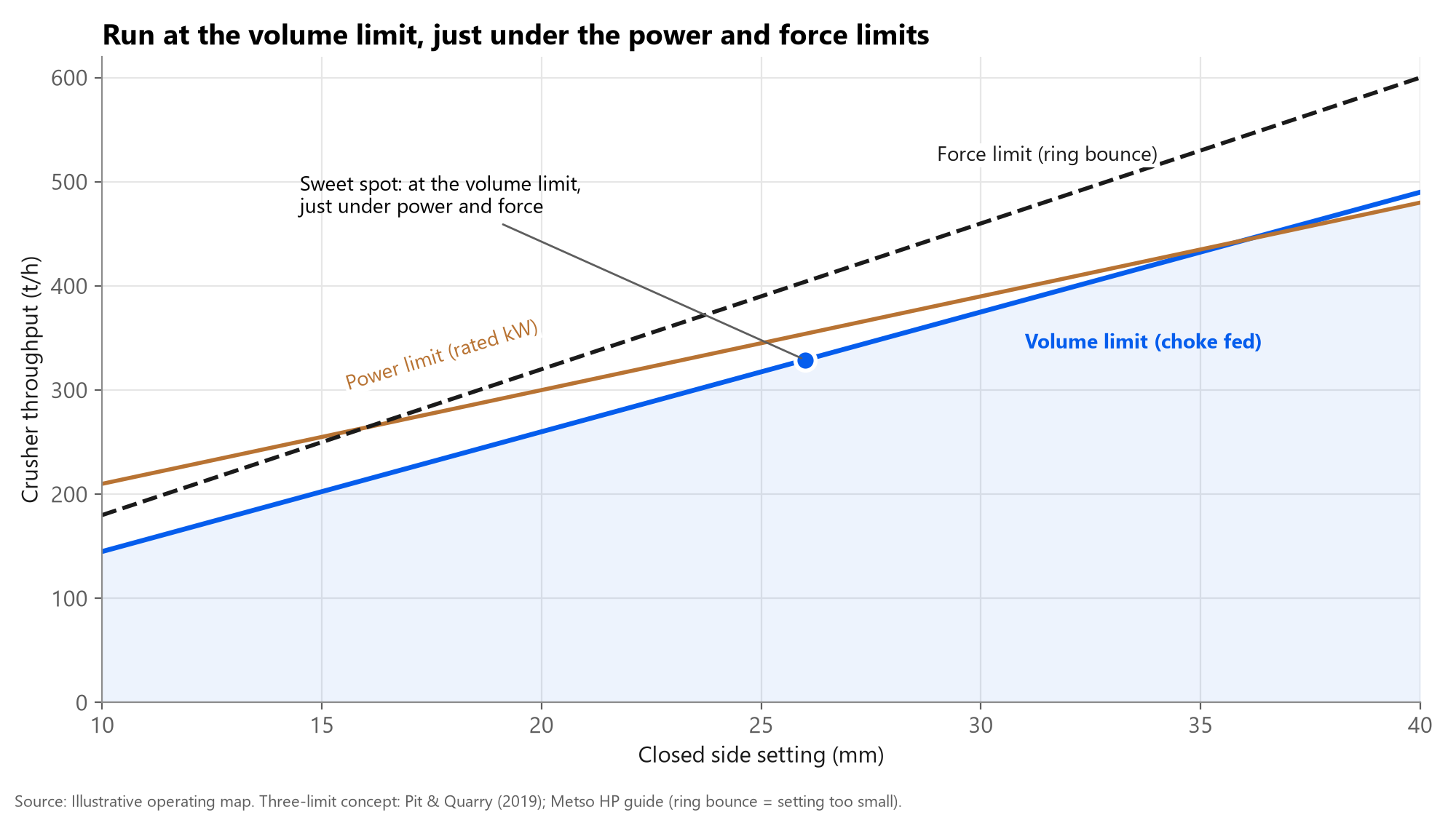
Every cone crusher is limited by volume (how much rock the chamber can pass), power (installed motor rating) and crushing force (the hydraulic or spring relief that lets the bowl lift - ring bounce or 'ring movement'). Pit & Quarry's guidance is to run at the volume limit while staying slightly below the power and force limits.
Ring bounce means the force limit has been reached: Metso describes it as a sign that the setting is too small. The common causes are tramp metal, poor distribution, segregation, too many fines, moisture, the wrong liner profile or a setting tighter than the ore allows. The fix is to open the setting slightly while staying choke fed, or reduce feed rate - not to keep running against the relief, which shortens component life through fatigue.
CSS checks: keeping the gap honest
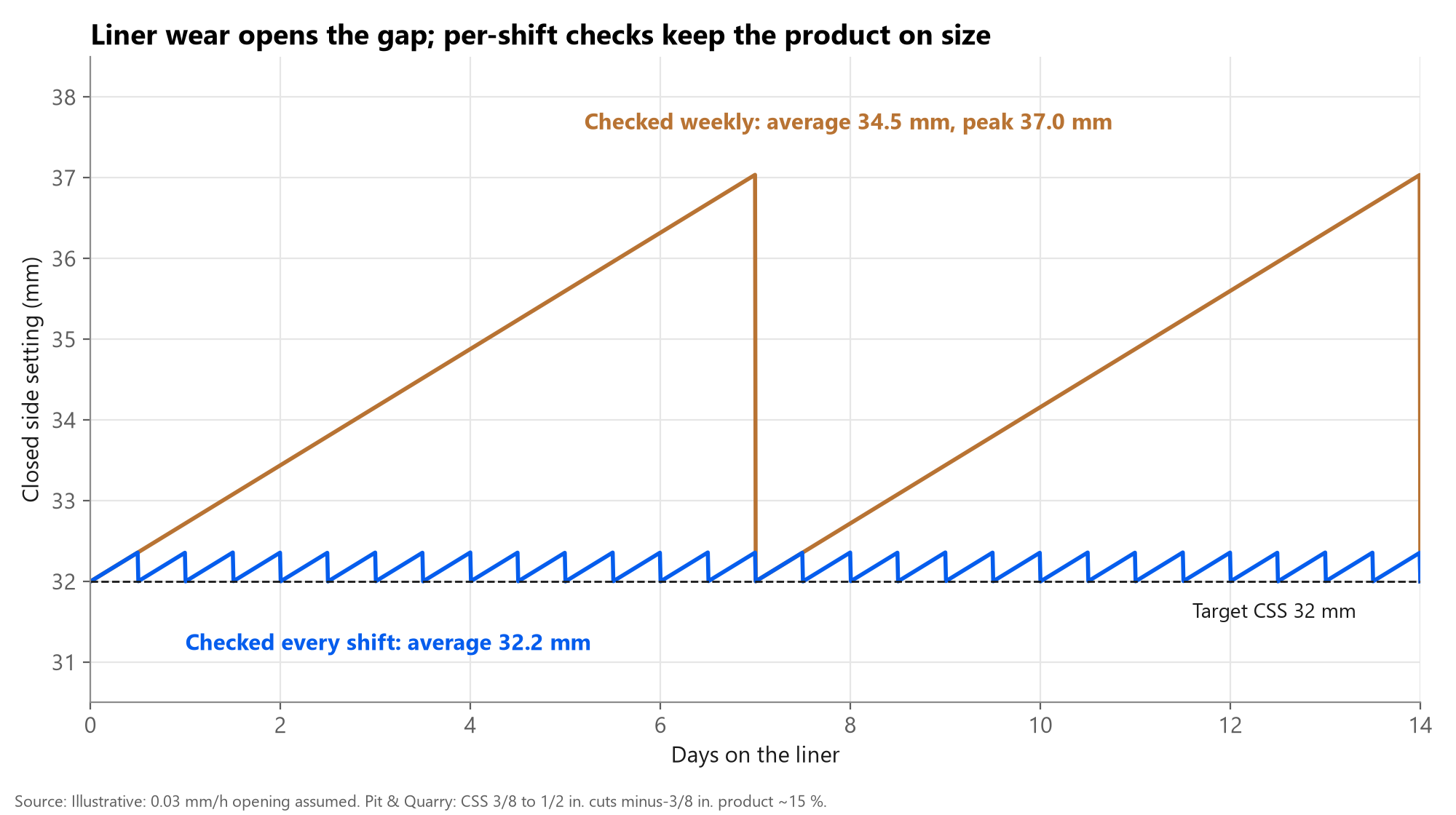
The closed side setting (CSS) is the narrowest gap between the bottom of the mantle and bowl liner during gyration. As the liners wear, the gap opens and the product coarsens unless the setting is adjusted. Trade guidance is to check CSS every shift; Mintap recommends measuring at north, south, east and west on cones because one-side readings miss tilt and uneven wear.
The cost of drift is real. Pit & Quarry reports that a setting wearing from 3/8 in. to 1/2 in. can cut minus-3/8 in. product by about 15 %. Metso adds that a 1/8 in. (3 mm) tilt of the adjustment ring cut 10 mm-minus output by roughly 10 % in one example - the gap differs around the chamber even when the average looks right.
Measurement methods trade accuracy against downtime: lead balls or plumbs are accurate but single-use and need disposal; manual tape checks need isolation and people near the chamber (about 3 h for one gyratory check in Mintap's example); pressure-based and hydraulic position systems measure without entry. Modern hydraulic-adjust cones track the setting continuously and can compensate for wear automatically, but still need periodic physical calibration.
Liner life and wear profiles
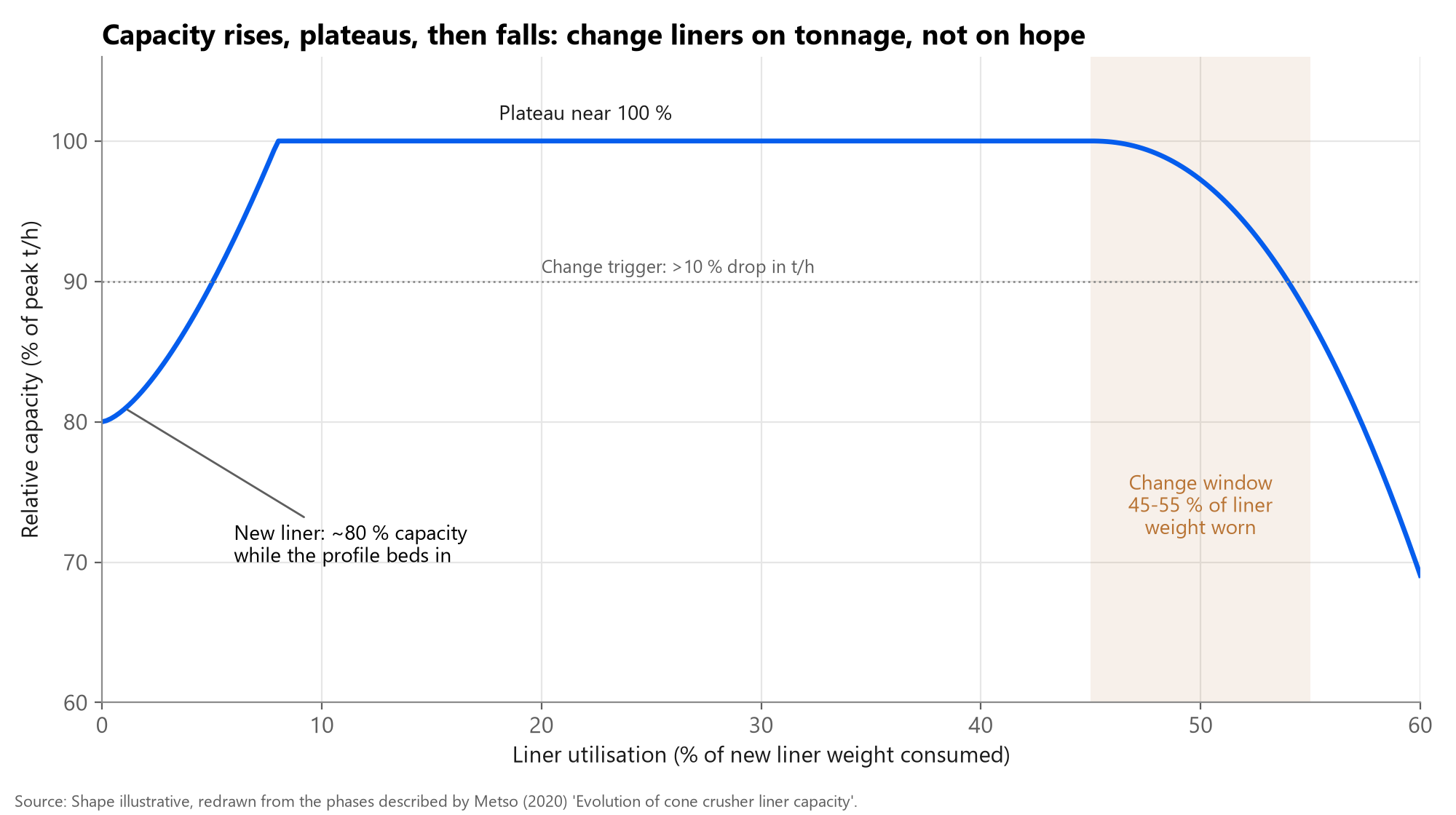
Metso describes three phases in a liner's life: a new liner starts at about 80 % of productive capacity while the profile beds in, runs near 100 % for most of its life, then declines once about 50 % of the liner weight has been consumed. It suggests changing liners around 45-55 % utilisation, and earlier if throughput falls more than 10 %.
Distorted wear - cupping at the bottom, a groove where segregated feed lands, or heavier wear in the quadrant where trucks tip - lowers capacity, raises power draw and crushing force, and forces an early change while much of the manganese is still unused. Laser scanning (under 30 minutes in Maptek's case study) and tracking driver-ring teeth used for wear compensation give a profile without cutting liners up.
Evidence on how much capacity a worn profile costs is mostly vendor-based; no independent multi-site dataset was found. Treat the curve as a shape to calibrate with your own tonnage-per-liner records.
Typical operating ranges
| Variable | Reported range / practice | Why it matters | Source |
|---|---|---|---|
| Choke level (HP cones) | >= 300 mm of rock above the feed plate | Keeps the chamber full for interparticle crushing | Metso HP guide |
| Power draw | 40-100 % of rated; ideally 75-95 %; avoid peaks >110 % | Steady, high power = work done on rock | Pit & Quarry (2019) |
| Fines in feed | <= 25 % (secondary), <= 10 % (tertiary); screen out 0-4 mm | Fines pack the chamber and trigger ring bounce | Pit & Quarry; Metso HP guide |
| Feed drop height | <= ~1 m (3 ft) on small-mid cones | High-velocity wedging overloads the chamber | Pit & Quarry (2019) |
| CSS check | Every shift; N/S/E/W on cones | Wear opens the gap between checks | Pit & Quarry; Mintap (2015) |
| CSS drift effect | 3/8 to 1/2 in. CSS cuts minus-3/8 in. product ~15 % | Product size and downstream load | Pit & Quarry (2019) |
| Ring tilt effect | 1/8 in. (3 mm) tilt cut 10 mm-minus output ~10 % | Uneven CSS around the chamber | Metso aggregates blog |
| Reduction ratio | 3-5 standard chamber; 2-4 short head | Too high a ratio hurts shape and capacity | Metso HP guide |
| Liner change point | ~45-55 % of liner weight consumed; or >10 % t/h drop | Capacity falls after ~50 % wear | Metso liner capacity blog (2020) |
Control: holding the crusher at its limits
Crusher control has existed since the 1960s, mainly to compensate for liner wear and protect against long-term overload (Evertsson et al., 2014). A sound base layer holds the feed hopper level (choke level) with the feeder; Itävuo et al. (IMPC 2014) found that the conveyor transport delay dominates this loop and that the best structures remove it, for example with a variable-speed feeder mounted on the hopper.
On top of that, power and hydraulic pressure act as constraints, and the setting is adjusted to hold product size as liners wear. Published results: Hulthén's CSS algorithm raised stage yield 3.5 % over a fixed CSS; adding speed control gave 4.2-6.9 % over a well-chosen fixed speed and 27 % longer manganese life on one crusher; Metso's SmartCone trial on MP1250 cones at Morenci reported about 8 % more throughput and a 4 mm finer discharge P80 in an on/off comparison.
These gains are site-specific and assume crushing limits the plant or that finer crusher product helps the mill. Honest planning numbers are +2-5 %.
Estimated return on investment
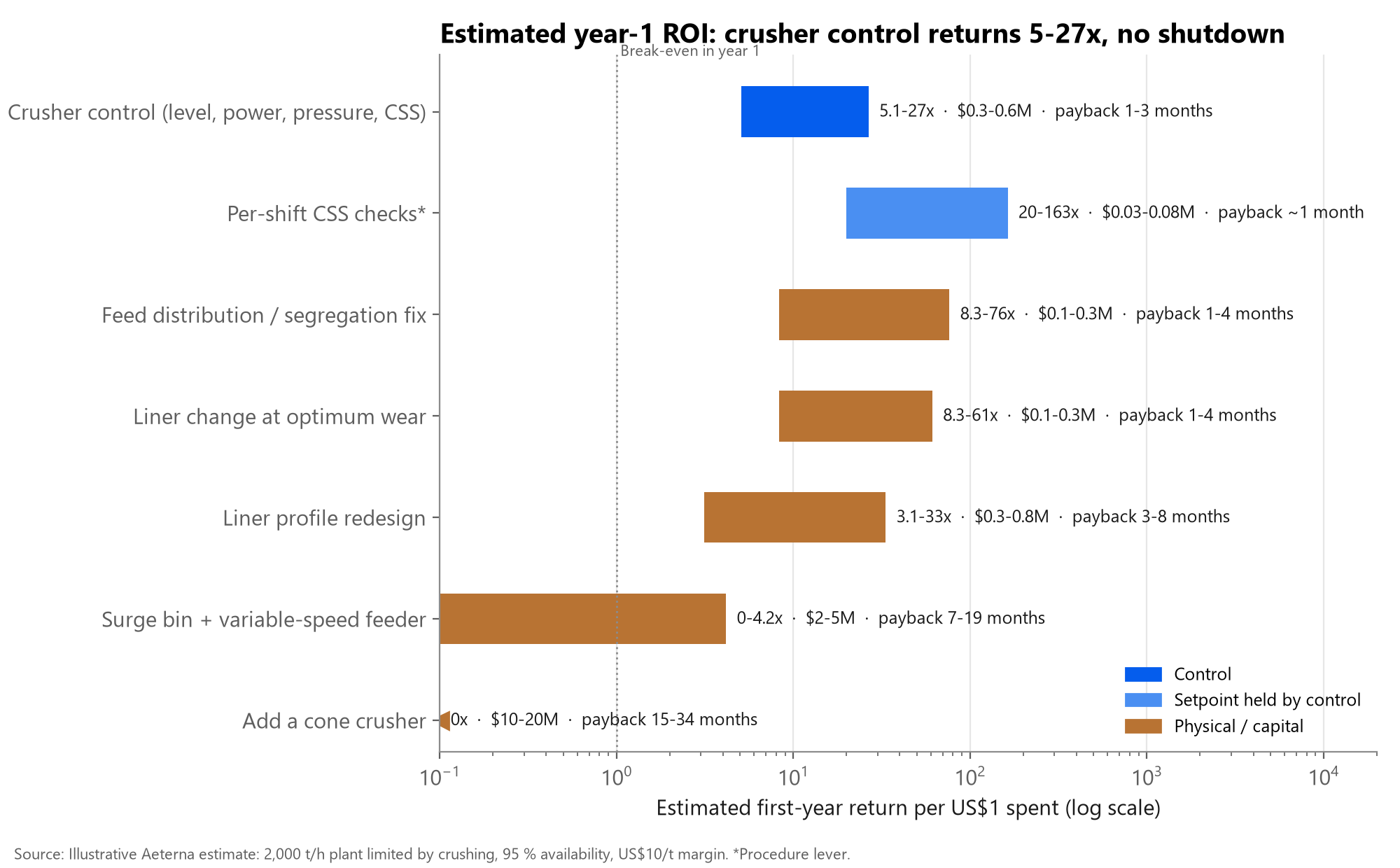
Levers were compared on estimated first-year return per dollar, using a reference plant of 2,000 t/h, 95 % availability and US$10 per tonne margin, where the cone crushing stage is the bottleneck (US$1.66M per year per 1 % throughput). Costs include lost production for shutdowns. This is an illustrative Aeterna estimate, not a measured result.
Per-shift CSS checks and feed distribution fixes beat control on ROI because they cost very little - they are presented here as complements, and the setting is what automatic wear compensation then holds. Crusher control is the best-value lever that needs no shutdown and no new capital; surge bins and an extra crusher make sense when the volume limit itself is the constraint.
| Lever | Est. throughput gain | Est. cost (incl. lost production) | Time to value | Payback | Year-1 return per $1 |
|---|---|---|---|---|---|
| Crusher control (level, power, pressure, CSS) | 2-5 % | $0.3-0.6M | 2 wk-1 mo | 1-3 months | 5.1-27x |
| Per-shift CSS checks* | 1-3 % | $0.03-0.08M | 1 wk-2 wk | ~1 month | 20-163x |
| Feed distribution / segregation fix | 2-5 % | $0.1-0.3M | 1 mo-3 mo | 1-4 months | 8.3-76x |
| Liner change at optimum wear | 2-4 % | $0.1-0.3M | 1 mo-3 mo | 1-4 months | 8.3-61x |
| Liner profile redesign | 3-8 % | $0.3-0.8M | 3 mo-6 mo | 3-8 months | 3.1-33x |
| Surge bin + variable-speed feeder | 5-10 % | $2-5M | 6 mo-12 mo | 7-19 months | 0-4.2x |
| Add a cone crusher | 15-25 % | $10-20M | 12 mo-24 mo | 15-34 months | 0x |
Instrumentation and Aeterna angle
The control loop is only as good as what it can see. Crusher power, hydraulic pressure, choke level (radar or ultrasonic) and CSS position are standard; feed size and segregation usually are not. Aeterna's Rock Analyzer measures the feed size distribution on the belt, which lets the controller anticipate fines-rich or coarse feed before it reaches the chamber, and Aeterna's MPC can hold choke level and power while respecting pressure limits and the downstream screen and bin levels.
Keep the tie-in light: most of the gain in this topic comes from operating discipline - choke level, even distribution, honest CSS checks and tonnage-based liner changes. Control keeps those habits in place shift after shift.
Common misconceptions
- 'Feeding less protects the crusher.' Trickle feeding concentrates wear low in the chamber, flattens the product and wastes the motor.
- 'High amps mean high throughput.' Power is a proxy for a full chamber only when the feed is consistent; packing from fines or a blocked discharge also raises power while tonnage falls.
- 'Ring bounce is normal at a tight setting.' It is the force limit; running against it shortens component life. Open slightly and stay choke fed.
- 'Liners should run until they are thin.' Capacity usually declines after ~50 % weight consumed; changing on tonnage data can pay.
Where sources disagree or are uncertain
- Control gains range from ~3.5 % to ~20 %; the high end in Hulthén's work reflects a poorly chosen installed speed, and the 17.5 % iron-ore figure applies only to the -1 mm fraction.
- The Morenci SmartCone abstract reports an 11 % change in specific energy without a clear direction; the full SAG 2023 paper was not read.
- The 'yield +20-25 % if wear compensation works' figure in Evertsson et al. (2014) is described as industry opinion, not measured.
- Most liner-wear and CSS figures come from OEM or vendor literature (Metso, Mintap, Maptek); independent multi-site data were not found.
Estimate what a steadier crushing stage is worth on your plant - try the savings estimator or request a demo.
Talk to an engineerSources
- Nordberg HP Series cone crushers - Wear parts application guide, Metso, n.d. (current)
- 11 steps to maximize cone crusher productivity, Pit & Quarry, 2019
- 5 tips for energy efficient and productive cone crushing, Metso Insights, 2021
- Evolution of cone crusher liner capacity, Metso Insights, 2020 (upd. 2022)
- Real-Time Optimization of Cone Crushers (PhD thesis), E. Hulthén, Chalmers University of Technology, 2010
- Two variable real-time algorithm for cone crusher control, Hulthén & Evertsson, Chalmers, 2010
- Real-time optimization of a speed controlled cone crusher in an iron ore application, Chalmers research, 2014
- Control systems for improvement of cone crusher yield and operation, Evertsson, Hulthén, Bengtsson, Quist - Comminution '14, 2014
- Novel Metso SmartCone control system at Freeport McMoRan Morenci (SAG 2023 abstract), International Mining / Metso, 2023
- Tight feed-hopper level control in cone crushers, Itävuo, Väyrynen, Vilkko, Jaatinen - IMPC, 2014
- Centralized control of a crushing circuit (Energies 17(14) 3374), MDPI Energies, 2024
- C-Gap CSS measurement presentation, Mintap, 2015
- I-Site crusher scanning case study, Maptek, 2022
- Cone crusher liners: how to select and when to change, McLanahan, n.d.